1. Introduction and Executive Summary
The transition of modern manufacturing from standard carbon steels to high-performance superalloys represents a major leap in engineering capability. Among these superalloys, Titanium and its primary alloy, Ti-6Al-4V (Grade 5), stand out due to their exceptional strength-to-weight ratios, excellent high-temperature properties, and resistance to chemical and biological attack.
From the combustion chambers of geostationary satellites to the complex geometries of orthopedic hip stems, titanium components operate under severe conditions where surface integrity is non-negotiable.
The Critical Role of Surface Preparation
In every stage of the lifecycle of a titanium component, surface preparation plays a defining role. Whether the goal is the removal of oxide layers after heat treatment, texturing a surface prior to thermal barrier coating, or passivating an implant to prevent tissue rejection, the selection of the abrasive medium and the delivery mechanism dictates the success or failure of the part.
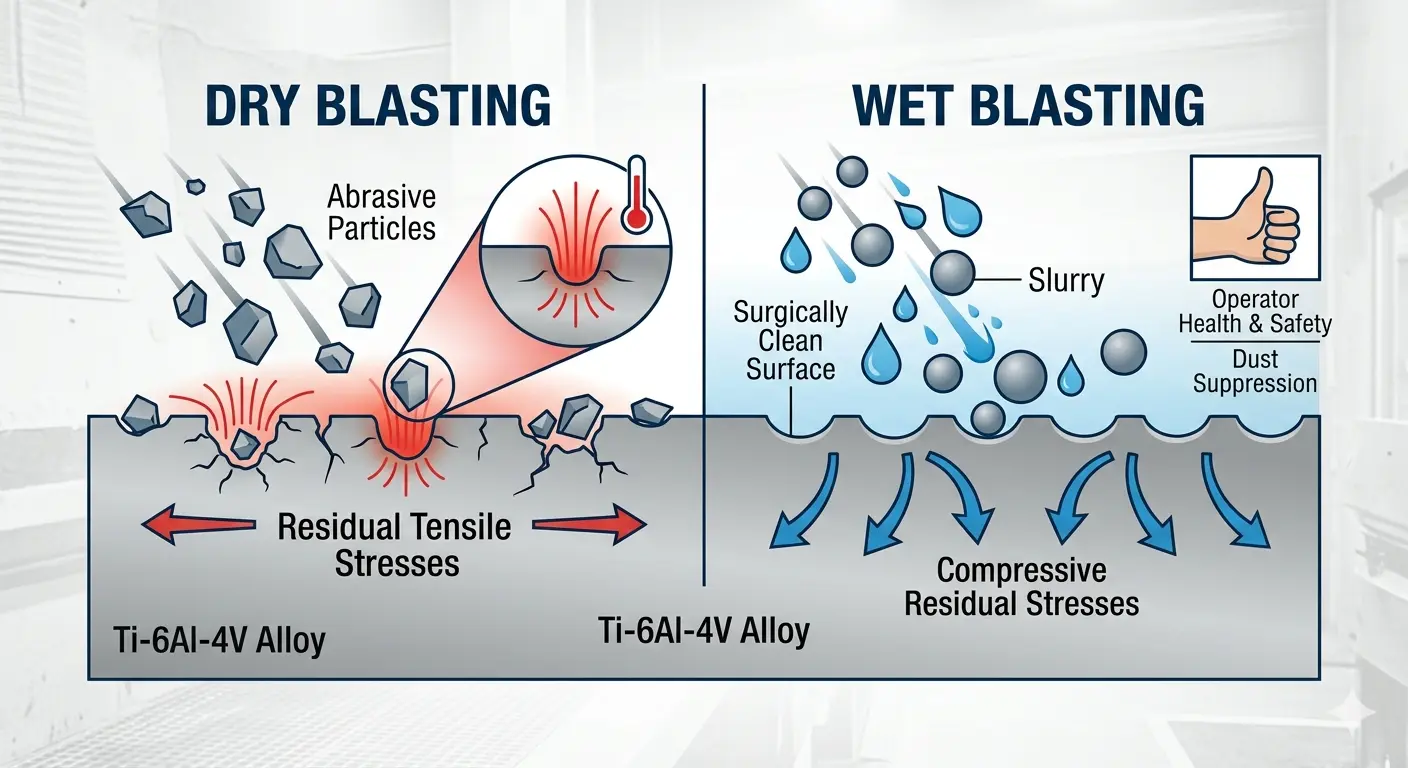
For decades, Dry Blasting was the universal workhorse of the metal finishing industry. It was inexpensive, well-understood, and highly effective for removing heavy mill scale from structural steel and cast iron. However, when applied to reactive and soft metals like titanium, dry abrasive blasting introduces an array of failure mechanisms:
- Thermal distortion
- Tensile residual stresses
- Chemical contamination
- Severe operator health hazards
The emergence of Wet Blasting (also known as vapor honing or liquid honing) addresses these issues by using a water-based slurry. It acts as a buffer and a coolant, protecting the substrate while cleaning the surface.
                       [Dry Blasting Process]
                                 │
                   (High thermal/kinetic impact)
                                 ▼
         [Surface Micro-Cracking & Media Impregnation]
                                 │
                 (Destructive tensile residual stresses)
                                 ▼
                     [Premature Fatigue Failure]

                                 vs.

                       [Wet Blasting Process]
                                 │
                    (Hydro-cushioned slurry impact)
                                 ▼
              [Satin Surface Finish & Compressive Stress]
                                 │
                      (Metallurgical purity)
                                 ▼
                     [Extended Component Life]
This comprehensive guide analyzes the physical, chemical, and metallurgical differences between wet and dry blasting on titanium surfaces. It provides technical insights into how wet blasting improves both component longevity and worker safety in high-stakes industries.
2. Metallurgy of Titanium and Its Alloys (Ti-6Al-4V)
To understand why titanium requires specialized surface preparation, we must first analyze its metallurgical properties.
Titanium exists in two allotropic forms: an alpha phase (hexagonal close-packed crystal structure) and a beta phase (body-centered cubic crystal structure). Ti-6Al-4V is an alpha-beta alloy containing 6% aluminum and 4% vanadium, representing over 50% of all titanium alloys used in global production.
       +-------------------------------------------------------------+
       |                  ALLOY COMPOSITION: Ti-6Al-4V               |
       +-------------------------------------------------------------+
       | Titanium (Ti)     │ ~90%                                    |
       | Aluminum (Al)     │ 6% (Alpha stabilizer)                   |
       | Vanadium (V)      │ 4% (Beta stabilizer)                    |
       | Iron/Oxygen (Fe/O)| Trace elements (Interstitial impurities)|
       +-------------------------------------------------------------+
Mechanical Properties and Processing Sensitivities
Low Thermal Conductivity
The thermal conductivity of titanium is significantly lower than that of steel or aluminum (approximately $6.7 \, \text{W/m}\cdot\text{K}$ at room temperature, compared to $45 \, \text{W/m}\cdot\text{K}$ for carbon steel).
During dry blasting, the kinetic energy of particles impacting the surface converts directly into heat. Because this heat cannot dissipate rapidly into the bulk of the metal, it creates localized surface temperatures that can exceed the beta-transus temperature ($995^\circ\text{C}$).
This thermal spike alters the microstructure of the immediate surface layer, causing phase transformation, residual stress, and micro-cracking.
Ductility and Shear Sensitivity
Titanium exhibits high yield strength, but its shear modulus is relatively low, making it susceptible to galling, smearing, and particle embedment. When subjected to the high-energy, high-velocity impact of dry abrasive grit, the material does not fracture cleanly away.
Instead, the abrasive particle tears and displaces the material. This creates microscopic surface folds and laps that trap foreign elements.
Alpha-Case Formation
During high-temperature processing, such as investment casting or vacuum heat treating, titanium reacts with oxygen and nitrogen to form a brittle, oxygen-rich surface layer known as the alpha-case.
Removing the alpha-case requires controlled mechanical abrasion or chemical milling.
If removed with aggressive dry abrasive blasting, the high energy can drive the hard, brittle oxide particles further into the ductile core. This produces sites for stress concentration.
3. The Mechanics of Abrasive Blasting
Abrasive blasting processes differ based on how energy is delivered to the abrasive particles and the medium used to suspend them.
3.1 Physics of Dry Blasting
In dry blasting systems, compressed air (typically ranging from 40 to 100 PSI) accelerates the abrasive particles through a converging-diverging nozzle. The velocity of these particles can approach $300 \, \text{m/s}$.
$$\text{Kinetic Energy} \, (E_k) = \frac{1}{2} m v^2$$
Where:
- $m$ is the mass of the abrasive particle
- $v$ is the impact velocity
Because there is no dampening medium, the total kinetic energy translates into mechanical, thermal, and acoustic energy upon impact with the metal surface.
When an angular abrasive grain hits titanium, it cuts and deforms the material, releasing energy that generates localized heat.
The impacts deform the crystal lattice on the surface of the titanium part. This develops high tensile residual stresses. These stresses reduce the fatigue life of high-stress components such as turbine blades.
                  DRY IMPACT

                  Compressed Air + Abrasive Grain
                             |
                             v
                  +---------------------+
                  | Hard Angular Impact |
                  +---------------------+
                             |
         +-------------------+-------------------+
         |                                       |
         v                                       v
[Plastic Deformation]                   [Localized Heating]
         |                                       |
         v                                       v
High Tensile Residual Stresses          Microstructural Damage (Alpha Phase Transition)
3.2 Physics of Wet Blasting
Wet blasting processes suspend the abrasive media in an aqueous solution, which contains water and proprietary chemical additives (usually rust inhibitors and surfactants).
This mixture is fed to a delivery nozzle either through suction or a direct-pressure pump. It is then combined with compressed air to project the slurry onto the workpiece.
                 WET IMPACT (Vapor Honing)

                 Compressed Air + Liquid Slurry (Water + Abrasive)
                             |
                             v
                  +---------------------+
                  | Hydro-Damped Impact |
                  +---------------------+
                             |
         +-------------------+-------------------+
         |                                       |
         v                                       v
[Hydro-Abrasion / Micro-Peening]        [Thermal Quenching]
         |                                       |
         v                                       v
Compressive Residual Stress             Chemically Cleaned, Satin Surface
The fluid in the mixture acts as a hydraulic cushion:
- Energy Attenuation: The water layer absorbs the extreme portion of the kinetic energy, slowing the acceleration of the abrasive grain and distributing the stress across a wider surface area.
- Hydro-Cushioning: Rather than creating deep craters with high lips, the abrasive grain produces a smooth dimple. This peens the surface and creates compressive residual stresses.
- Thermal Quenching: The water-based carrier provides immediate cooling, preventing localized temperature spikes and protecting the microstructure from phase changes.
4. Comprehensive Analysis of Failure Modes in Dry Blasting Titanium
Using dry abrasive blasting on critical components made of Ti-6Al-4V causes major issues that affect component performance.
               +--------------------------------------------+
               |  Failure Mechanisms from Dry Blasting      |
               +--------------------------------------------+
               | 1. Mechanical Impregnation of Media        |
               | 2. Residual Tensile Stress Accumulation    |
               | 3. Surface Micro-cracking                  |
               | 4. Oxidation and Structural Contamination  |
               +--------------------------------------------+
4.1 Media Impregnation and Biocompatibility Failures
When angular, hard dry particles—such as aluminum oxide ($\text{Al}_2\text{O}_3$), silicon carbide ($\text{SiC}$), or chilled iron grit—impact titanium at high velocity, they shatter upon contact. The sharp tips of the abrasive materials embed into the soft, ductile titanium matrix.
          Surface Matrix of Titanium (Ti-6Al-4V)
          +-----------------------------------------------------+
          |  Ti   |  Ti   |  Ti   |  Ti   |  Ti   |  Ti   |  Ti   |
          |-------+-------+-------+-------+-------+-------+-------|
          |  Ti   | Embedded Al2O3 |  Ti   | Embedded SiC| Ti     |
          |-------+-------+-------+-------+-------+-------+-------|
          |  Ti   |  Ti   |  Ti   |  Ti   |  Ti   |  Ti   |  Ti   |
          +-----------------------------------------------------+
In orthopedic implants, these embedded particles present a serious biocompatibility risk:
- Particulate Shedding: The body recognizes these foreign ceramic or mineral phases as debris, leading to osteolysis (bone loss) and aseptic loosening of the implant.
- Galvanic Corrosion Cells: Embedded fragments of hard, conductive materials or iron can create micro-galvanic corrosion cells within the titanium oxide film ($TiO_2$). This accelerates pitting corrosion and ion release into the body, which can be toxic.
In aerospace structures, embedded particles act as points for stress concentration. The mismatched coefficients of thermal expansion between the titanium matrix and the embedded abrasive grain create micro-voids during thermal cycling, leading to early cracking.
4.2 Mechanical Distortions and Tensile Stresses
The high impact energy of dry abrasive blasting displaces metal at the surface, creating tensile residual stresses in the outer layer of the component.
$$\sigma_{\text{residual}} = \sigma_{\text{applied}} + \sigma_{\text{thermal}} + \sigma_{\text{mechanical}}$$
These residual tensile stresses make the component more susceptible to stress corrosion cracking (SCC) and high-cycle fatigue (HCF).
In rotating aerospace components, such as compressor blades, this reduction in fatigue life can cause unexpected, early failures.
       +---------------------------------------------------------------+
       | COMPARISON OF RESIDUAL STRESS DISTRIBUTIONS                   |
       +---------------------------------------------------------------+
       |                                                               |
       | Depth (μm)     Dry Blasting                 Wet Blasting      |
       | 0 (Surface)    High Tensile (+180 MPa)      Compressive (-220)|
       | 50             Low Tensile (+50 MPa)        Compressive (-150)|
       | 100            Neutral (0 MPa)              Neutral (0 MPa)   |
       |                                                               |
       +---------------------------------------------------------------+
4.3 Frictional Heating and Microstructural Alterations
As mentioned in Section 2, the low thermal conductivity of titanium causes frictional heat to collect at the surface during dry blasting.
This thermal energy can reach levels high enough to alter the microstructure of the alpha-case or the underlying titanium. It can form brittle, untempered alpha phases that are prone to cracking.
The affected layer must be removed by chemical etching, which adds cost and hazardous waste to the manufacturing process.
5. Wet Blasting as an Engineering Solution
Wet blasting addresses these limitations through controlled fluid dynamics and specialized abrasive media.
      +----------------------------------------------------------------+
      | FEATURES OF WET BLASTING                                       |
      +----------------------------------------------------------------+
      | 1. Hydro-dampened mechanical action                            |
      | 2. Continuous flushing of the surface                          |
      | 3. Surface peening via slurry impact                           |
      | 4. Dust suppression for a safer work environment               |
      +----------------------------------------------------------------+
5.1 Mechanics of the Hydro-Buffer
The hydro-buffer consists of a boundary layer of water that coats the titanium part during the blasting process.
When the abrasive grain hits the surface, it passes through the water film. The fluid dampens the impact, preventing the abrasive particle from fracturing or embedding into the surface.
$$\text{Impact Energy} \, (E_{\text{net}}) = \frac{1}{2} m v^2 – E_{\text{friction-loss}} – E_{\text{fluid-drag}}$$
This modification allows the abrasive to act as a burnishing and peening agent rather than a cutting tool.
The media creates a clean, uniform surface without the deep micro-cracks or folds seen in dry blasting.
               [Impact Dynamics in Wet Blasting]

               Abrasive Particle (\rho_p)
                  \
                   \
                    v
            ~~~~~~~~~~~~~~~~~~~~~~~~~~~~ Water Slurry Layer (Hydro-buffer)
             \
              \ -> Impact Attenuation
               v
          +---------+
          |         | Titanium Substrate (Ti-6Al-4V)
          |_________|
5.2 Surface Roughness (Ra) and Topographical Control
Wet blasting produces a clean satin surface with low $R_a$ (Roughness Average) values and a high bearing area ratio.
It removes the sharp peaks of the surface profile left behind by machining or heat treating, leaving smooth, rounded valleys. This surface profile is ideal for several reasons:
- Implant Coatings: Excellent for adhesion of Hydroxyapatite (HA) or plasma-sprayed coatings used in orthopedics.
- Aerospace Components: Prevents crack initiation by removing the sharp surface marks that cause stress concentrations.
6. Operator Health, Safety, and Environmental (EHS) Compliance
Industrial health and safety regulations are becoming more stringent worldwide. These regulations make dry abrasive blasting of titanium, aluminum, and other reactive metals increasingly difficult to manage.
                     [EHS Challenges of Dry Blasting]
                                    │
    (Hazardous airborne dust < 5 microns — High worker health risk)
                                    ▼
       [Combustible metal dust hazard (NFPA 484) — Explosion risk]
                                    ▼
       [High cost of ventilation, dust collection, and disposal]
6.1 The Threat of Combustible Metal Dust
According to the National Fire Protection Association (NFPA) 484 (Standard for Combustible Metals), titanium and its alloys present severe combustible dust hazards:
- Explosion Sensitivity: Fine titanium dust generated during dry blasting can ignite if exposed to a spark or static discharge. The minimum ignition energy for titanium dust clouds is low, making this a significant risk.
- Ventilation Requirements: Dry blasting titanium requires explosion-proof ventilation, continuous dust collectors with wet suppression systems, and frequent filter maintenance.
6.2 Silicosis and OSHA Permissible Exposure Limits (PELs)
Dry blasting using sand or materials containing silica generates respirable crystalline silica dust, which causes silicosis.
OSHA enforces a strict Permissible Exposure Limit (PEL) for respirable crystalline silica of $50 \, \mu\text{g/m}^3$ as an 8-hour time-weighted average (TWA).
       +---------------------------------------------------------------+
       | OCCUPATIONAL HEALTH COMPARISON                                |
       +---------------------------------------------------------------+
       | Hazard Type           Dry Blasting    Wet Blasting            |
       | Respirable Dust       High            None (Vapor Trapped)    |
       | Combustible Dust Risk Severe          Negligible              |
       | Operator PPE Level    Supplied Air    Standard Face Shield    |
       | Noise Level           100-115 dBA     80-85 dBA               |
       +---------------------------------------------------------------+
Wet blasting eliminates these health risks:
- The water slurry traps dust particles at the point of impact, so they never become airborne.
- This removes the need for restrictive supplied-air hoods and reduces operational noise levels from over $100 \, \text{dBA}$ down to less than $85 \, \text{dBA}$.
7. Industrial Standards and Aerospace Specifications
When processing titanium for high-performance applications, the process must adhere to strict international standards and specifications.
    +----------------------------------------------------------------+
    | KEY INDUSTRIAL STANDARDS                                       |
    +----------------------------------------------------------------+
    | • SAE AMS2431: Aerospace Material Specification - Peening Media  |
    | • ISO 4287: Geometrical Product Specifications                 |
    | • ASME BPE: Bioprocessing Equipment Standard                   |
    | • NFPA 484: Standard for Combustible Metals                    |
    +----------------------------------------------------------------+
- SAE AMS2431: This specification defines the requirements for peening media used in aerospace applications. The standard applies to conditioned cut wire, ceramic, and glass beads, ensuring that media used for titanium treatments do not contain cross-contaminants like iron or heavy sulfur compounds.
- ISO 4287: This standard defines the parameters for measuring surface texture ($Ra$, $Rq$, $Rz$), providing a common language for quality control teams to assess wet-blasted parts.
- ASME BPE: In the pharmaceutical and food industries, this standard sets criteria for surface roughness ($Ra \leq 0.4 – 0.8 \, \mu\text{m}$) and requires finishes that are free of crevices and embedded media. Wet blasting meets these requirements better than dry blasting.
8. Case Studies and Empirical Evidence
Case Study 1: Aerospace Engine Turbine Blades
- Component: Ti-6Al-4V Compressor blade.
- Problem: Blade root fatigue failure during testing. Dry blasting with aluminum oxide was causing micro-cracking and leaving tensile stresses on the surface.
- Solution: The manufacturer changed the process to wet blasting using GB-13 Glass Beads in a high-pressure slurry system.
- Result: The treatment created a compressive residual stress layer of $-250 \, \text{MPa}$ down to a depth of $75 \, \mu\text{m}$. The high-cycle fatigue life of the blade increased by $140\%$, and no micro-cracking was observed.
         Compressive Stress Profile (Wet Blasted Turbine Blade)

         Stress (MPa)
         -300 |--------------------------------------
              | \                                    /
              |  \                                  /
              |   \                                /
            0 +----+------------------------------+---- Depth (μm)
              |     10   20   30   40   50   60   70
Case Study 2: Medical Implant Surface Finish
- Component: Titanium femoral knee stems.
- Problem: Sterilization and biocompatibility issues due to traces of embedded aluminum oxide from the dry blasting process.
- Solution: The manufacturer adopted wet blasting using a fine, non-contaminating abrasive slurry (zirconia/glass bead mix).
- Result: Particle embedment dropped to zero. The surface finish showed an $Ra$ of $0.6 \, \mu\text{m}$, which is ideal for tissue integration. Rework rates dropped from 12% to less than 0.5%.
9. Coreblast Solutions: Technical Product Selection Guide
Selecting the proper abrasive media for wet blasting depends on the alloy and the application. Below is a guide to help quality engineers choose the best media for their processes.
       +-------------------------------------------------------------+
       |                  COREBLAST SOLUTIONS PRODUCT MATRIX         |
       +-------------------------------------------------------------+
       | Grade      | Abrasive Type    │ Application                 |
       +------------+------------------+-----------------------------+
       | GB-Series  | Glass Beads      │ Peening, non-marring clean  |
       | WA-Series  | White Alumina    │ Profiling, micro-abrasion   |
       | CS-Series  | Ceramic Shots    │ Peening, high coverage      |
       +------------+------------------+-----------------------------+
9.1 GB-Series Glass Beads
Engineered from high-quality soda-lime glass, these spheres are designed to clean and peen sensitive surfaces without changing the dimensions of the part.
- Hardness: 5.5 – 6.0 Mohs
- Specific Gravity: $2.5 \, \text{g/cm}^3$
- Applications: Removing heat-treat discoloration, cosmetic finishing, peening titanium compressor blades, and cleaning medical devices.
              GB-Series Bead (Spherical / Peening Effect)
                             _.-""-._
                           .'        '.
                          /            \
                         |              |
                          \            /
                           '.        .'
                             '-....-'
9.2 WA-Series White Aluminum Oxide
Made from high-purity fused alumina, these angular grains provide fast, controlled cutting action for texturing, while remaining free of iron contamination.
- Hardness: 9.0 Mohs
- Specific Gravity: $3.95 \, \text{g/cm}^3$
- Applications: Preparing surfaces for coating, removing heavy alpha-case layers, and generating deep, consistent anchor patterns.
              WA-Series Grain (Angular / Cutting Effect)
                             /\
                            /  \
                           /    \
                          /      \
                         /________\
9.3 Recommended Operating Parameters for Wet Blasting
       +-------------------------------------------------------------+
       | PARAMETER                    │ VALUE RANGE                  |
       +------------------------------+------------------------------+
       | Air Pressure                 | 30 to 60 PSI                 |
       | Slurry Concentration         | 25% to 35% by volume         |
       | Stand-off Distance           | 100 to 200 mm                |
       | Nozzle Angle                 | 45 to 75 degrees             |
       | Abrasive Size                | 50 to 150 microns            |
       +-------------------------------------------------------------+
10. Conclusion and Future Outlook
The use of titanium in critical applications is expected to grow. As manufacturing becomes more precise, processing these advanced materials requires a move away from the aggressive techniques used for cast iron and structural steel.
Dry blasting, while inexpensive, introduces failure risks such as embedded foreign materials, tensile residual stresses, and micro-structural distortion that can lead to early component failure.
+--------------------------+  Hydro-Cushioning  +---------------------------+
| WET BLASTING (Vapor      | -----------------> | Surgically Clean Parts    |
| Honing)                  |                    | No Alpha-Case Contaminant |
+--------------------------+                    +---------------------------+
                                                             |
                                                             v
                                                +---------------------------+
                                                | NADCAP/AS9100 Compliance  |
                                                +---------------------------+
Wet blasting offers an alternative for aerospace, defense, and medical manufacturing:
- The hydro-buffer protects the titanium substrate, providing consistent cleaning and peening without structural damage.
- It eliminates hazardous dust and makes the work environment safer for operators.
At Coreblast Solutions, our media is designed to help you meet these quality standards. We formulate and test our abrasives to deliver consistent results, shipment after shipment.
11. Reference Standards and Technical Links
For further information on the standards and practices outlined in this guide, consult the following resources:
- SAE International (Society of Automotive Engineers): Aerospace material specifications and surface enhancement processes.
- OSHA (Occupational Safety and Health Administration): Airborne contaminants, respiratory protection, and hazardous dust regulations.
- NFPA (National Fire Protection Association): Code 484 for the processing and handling of combustible metals.
- ASME (American Society of Mechanical Engineers): Bioprocessing equipment design and surface finish guidelines.
- ASTM International: Standard test methods for assessing the peening and finishing of metallic materials.