The Complete Guide to Abrasive Media: Types, Uses & How to Choose the Right One
Last updated: May 2026 | Reviewed by surface preparation specialists
What you’ll learn: This guide covers every major type of abrasive blasting media — what each is made from, how it performs, which industries use it, how to select the right one for your job, and the international standards that govern surface preparation. Whether you’re a procurement manager, blast operator, or quality engineer, this is the only reference you need.
1. What Is Abrasive Media?
Abrasive media — also called blasting media, abrasive grit, or blast media — refers to any granular or particulate material propelled at high velocity against a surface to clean it, roughen it, shape it, or apply a specific texture or surface profile.
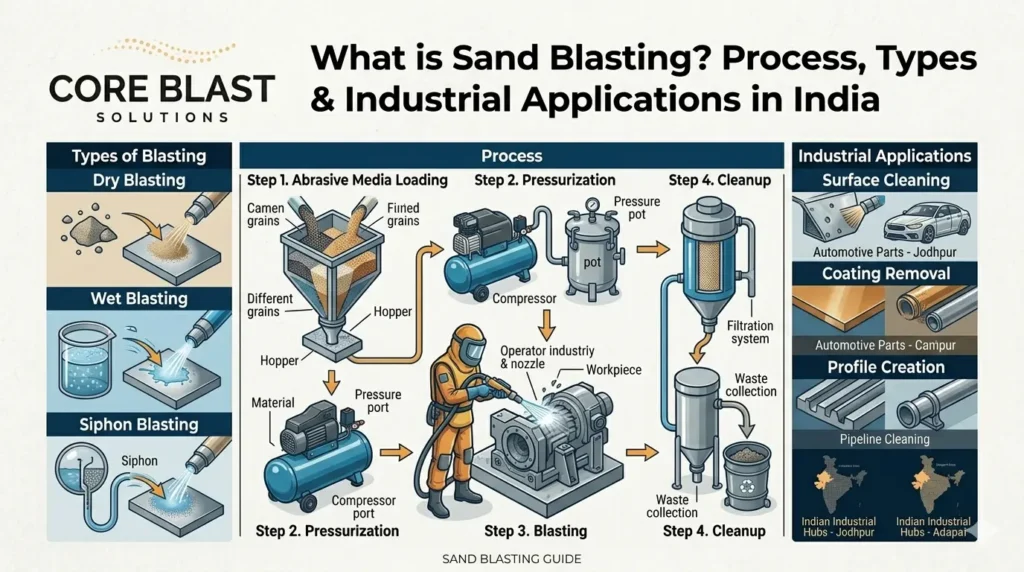
The process of using abrasive media is broadly referred to as abrasive blasting, shot blasting, or surface preparation. It is one of the most widely used industrial surface treatment techniques in the world, underpinning coating adhesion, corrosion protection, and product quality across a vast range of industries.
Abrasive blasting is used for:
- Removing rust, mill scale, old paint and coatings
- Cleaning castings, forgings and fabricated steel structures
- Creating a specific surface anchor profile for paint or thermal spray coatings
- Deburring, deflashing and finishing machined components
- Shot peening to induce compressive stress and improve fatigue life
- Decorative etching of glass, stone and wood
Did you know? The global abrasive blasting media market was valued at over USD 8 billion in 2024 and is expected to grow significantly through 2030, driven by infrastructure expansion, shipbuilding and automotive manufacturing growth in Asia and the Middle East. (Source: Industry estimates)
2. Types of Abrasive Media — A Complete Overview
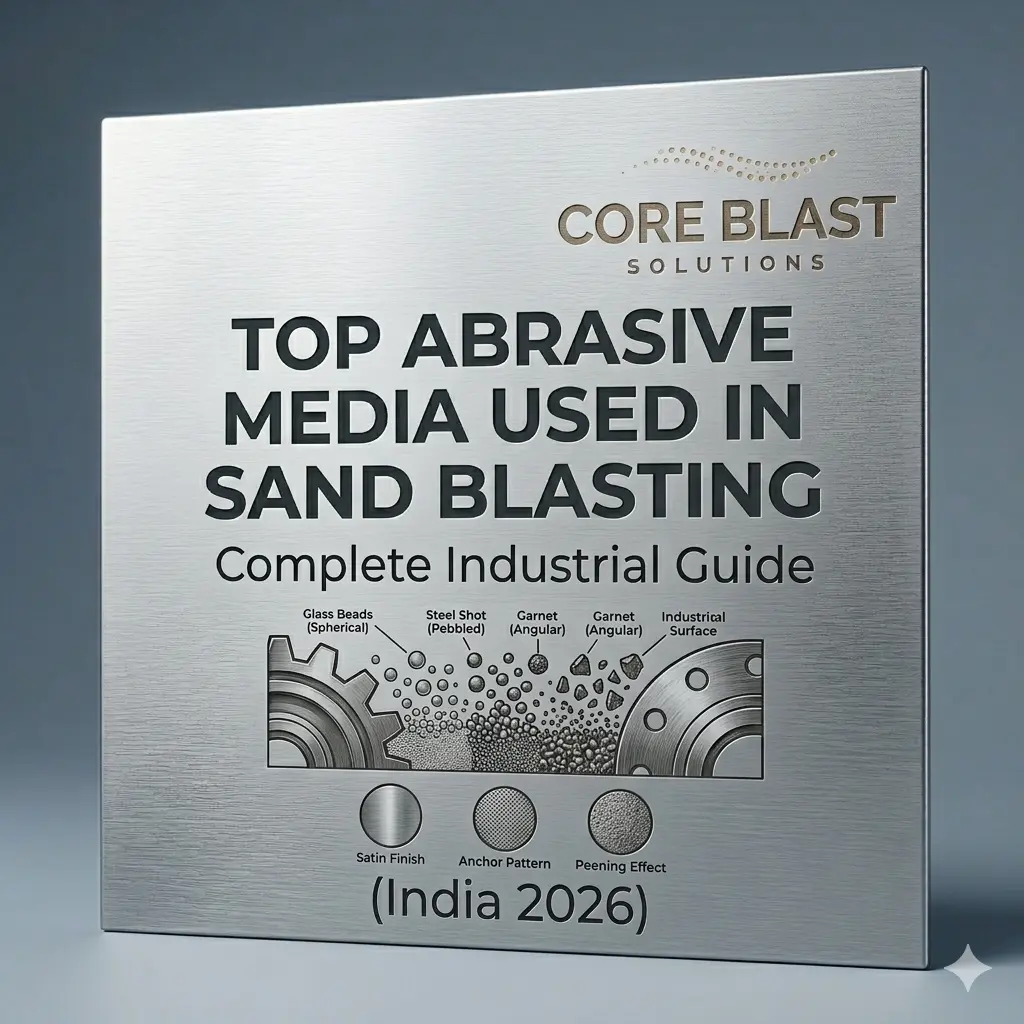
Abrasive media can be broadly classified into five categories based on their base material:
Steel Shot & Steel Grit
High-density metallic abrasives for heavy-duty industrial blasting and shot peening. Recyclable and cost-effective for wheel blast systems.
Garnet, Aluminium Oxide, Silicon Carbide
Natural and synthetic mineral abrasives offering high cutting efficiency. Widely used in precision finishing, waterjet cutting and aerospace.
Glass Beads, Crushed Glass, Plastic Media
Gentle to aggressive finishing options for softer substrates. Ideal for stainless steel, aluminium, aerospace components and automotive parts.
Walnut Shell, Corn Cob, Dry Ice
Soft, biodegradable media for delicate surfaces. Used in aviation paint stripping, food equipment cleaning and mould maintenance.
Copper Slag, Coal Slag, Nickel Slag
Low-cost industrial by-products used for one-pass open blasting. Common in construction, shipyards and pipeline projects.
3. Metallic Abrasives: Steel Shot, Steel Grit & Cast Iron
Steel Shot
Steel shot consists of small, spherical particles manufactured by atomising molten steel and solidifying the droplets into uniform balls. It is one of the most widely used abrasive media in the world.
Key properties: Spherical shape, high density (7.4–7.8 g/cm³), hardness range of 40–51 HRC (standard) or 55–66 HRC (high hardness), available in sizes from S-70 to S-780 per ISO 11124-3.
Applications: Shot peening of springs, gears and turbine blades; descaling of steel plates; cleaning of castings in wheel blast machines; preparation of steel structures for heavy-duty coatings.
Best for: Smooth, compressive surface finishes. Excellent recyclability — typically 200–300 cycles before breakdown.
Steel Grit
Steel grit is produced by crushing steel shot into angular, irregular fragments. The angular shape gives it a much more aggressive cutting action than spherical shot.
Key properties: Angular shape, high density, available in grades GL, GP, GH (Low, Pearlitic, High hardness) and sizes G10 to G120. Covered under ISO 11124-4.
Applications: Creating high anchor profiles for heavy-duty marine and industrial coatings; descaling of heavily rusted or pitted steel; structural steel fabrication and pipeline preparation.
Best for: Achieving Sa 2.5 or Sa 3 cleanliness with a defined surface roughness profile (Ra/Rz). Harder grades (GH) give deeper profiles and faster cut rates.
Cast Iron Grit & Shot
Cast iron abrasives are older media types, still used in some foundry applications but largely replaced by steel abrasives due to their higher brittleness and faster breakdown rate. Cast iron shot is harder than steel shot but fractures more readily, generating more dust.
Expert tip: For wheel blast systems operating on continuous production lines, steel shot typically offers the lowest cost-per-tonne of processed steel due to its exceptional recyclability. Always monitor your working mix hardness with a Rockwell tester at regular intervals.
4. Mineral Abrasives: Garnet, Aluminium Oxide & Silicon Carbide
Garnet
Garnet is a naturally occurring semi-precious mineral mined primarily in India, Australia and the USA. It is widely regarded as the premium natural abrasive for dry blasting and waterjet cutting due to its hardness (6.5–7.5 Mohs), low free silica content and consistent particle geometry.
Key properties: Sub-angular to angular shape, low dust generation, recyclable 3–5 times in controlled environments, hardness ~1360 HV.
Applications: Offshore oil & gas pipe coating preparation; waterjet cutting (80-mesh garnet); shipbuilding; bridge refurbishment; precision blasting in enclosed environments where dust control is critical.
Standards: Garnet blasting abrasives are governed by ISO 11126-10 (non-metallic blast cleaning abrasives — garnet).
Aluminium Oxide (Corundum)
Aluminium oxide (Al₂O₃) is a synthetic abrasive produced by fusing bauxite at high temperatures. Available in white, brown and pink grades, it is one of the hardest abrasives commercially available (9 Mohs), second only to diamond.
Key properties: Extremely hard and sharp, angular shape, high cutting efficiency, recyclable multiple times. Brown aluminium oxide is the most economical grade; white is purer and used for precision applications.
Applications: Aerospace component finishing; lapping and polishing; sandblast cabinets; surface preparation before thermal spray coatings; etching of ceramics and composites.
Silicon Carbide
Silicon carbide (SiC) is the hardest commercially produced abrasive after diamond (~9.5 Mohs). It is sharper than aluminium oxide and cuts faster, but is more brittle and expensive.
Applications: Cutting hard materials including tungsten carbide, ceramics and glass; precision lapping; wire sawing of silicon wafers in electronics manufacturing.
Important — Silica Sand Ban: Crystalline silica sand is banned for abrasive blasting in the UK, EU and many other jurisdictions due to the severe risk of silicosis — an incurable and potentially fatal occupational lung disease. Under the UK Control of Substances Hazardous to Health (COSHH) Regulations 2002, employers must substitute silica sand with safer alternatives such as garnet, steel grit, or crushed glass.
5. Glass & Synthetic Abrasives: Glass Beads, Crushed Glass & Plastic Media
Glass Beads
Glass beads are manufactured from lead-free soda-lime glass, precision-graded into tight size ranges. Their perfect spherical shape and smooth surface make them unique — they peen and polish simultaneously without significant material removal.
Key properties: Spherical, smooth, hardness ~6 Mohs, chemically inert, recyclable 30+ times in enclosed blast cabinets. Available from fine (10 µm) to coarse (850 µm) grades per ISO 11126-7.
Applications: Medical and surgical instrument finishing; stainless steel and titanium aerospace components; automotive parts (carburettors, engine blocks); decorative finishing and satin texture on jewellery and consumer products; shot peening of aluminium structures.
Best for: When you want a smooth, clean, bright finish without changing surface dimensions or introducing contamination.
Crushed Glass
Crushed glass abrasive is manufactured from 100% recycled post-consumer glass, making it one of the most sustainable blasting media available. It is angular in shape and provides a good cleaning and profiling performance.
Applications: Graffiti removal; general surface cleaning; rust and paint removal from structural steel; a direct replacement for copper slag in many applications.
Plastic Abrasive Media
Plastic blasting media is produced from urea, melamine or polyester resins in angular or irregular shapes. It is the softest engineered blasting abrasive, making it ideal for stripping coatings without damaging the substrate.
Applications: Aviation paint stripping from aluminium fuselages and composite panels; automotive plastic and fibreglass body panels; military vehicle and equipment maintenance.
Key advantage: Removes coatings selectively — aggressive enough to strip paint, but gentle enough to leave aluminium or composite substrates undamaged.
6. Organic Abrasives: Walnut Shell, Corn Cob & Dry Ice
Walnut Shell
Ground walnut shells produce a natural, biodegradable abrasive with a hardness of approximately 3–4 Mohs. The particles are angular and provide a gentle polishing and cleaning action.
Applications: Cleaning of turbine blades and engine components without dimensional change; polishing of soft metals and plastics; cleaning food processing equipment; mould cleaning in plastics manufacturing.
Corn Cob
Corn cob abrasive is even softer than walnut shell and is used when the most delicate possible cleaning is required. It is highly absorbent and is often used in wet blasting applications to clean and dry surfaces simultaneously.
Applications: Wood furniture and antique restoration; cleaning of firearms and military equipment; tumbling of jewellery and precious metal components.
Dry Ice Blasting
Dry ice blasting uses solid CO₂ pellets as the blasting medium. Upon impact, the pellets sublimate instantly — converting directly from solid to gas — lifting contaminants without leaving any residue.
Applications: Food production equipment cleaning (FDA-approved environments); electrical panel and motor cleaning without moisture risk; historical restoration where abrasion must be completely avoided.
Key advantage: Zero secondary waste — the CO₂ evaporates, leaving only the removed contaminant.
7. Side-by-Side Comparison Table
| Media Type | Shape | Hardness | Recyclability | Best Application | Relative Cost |
|---|---|---|---|---|---|
| Steel Shot | Spherical | 40–66 HRC | Very High (200+ cycles) | Peening, descaling, smooth finish | Medium |
| Steel Grit | Angular | 40–66 HRC | High (100+ cycles) | High anchor profile, heavy rust removal | Medium |
| Garnet | Sub-angular | 6.5–7.5 Mohs | Medium (3–5 cycles) | Offshore, waterjet, low dust | Medium–High |
| Aluminium Oxide | Angular | 9 Mohs | High (multiple cycles) | Aerospace, thermal spray prep, precision | Medium–High |
| Silicon Carbide | Angular | 9.5 Mohs | Medium | Hard ceramics, lapping, electronics | High |
| Glass Beads | Spherical | ~6 Mohs | High (30+ cycles) | Satin finish, medical, aerospace | Medium |
| Crushed Glass | Angular | ~6 Mohs | Low–Medium | General cleaning, rust removal | Low |
| Plastic Media | Angular | 3–4 Mohs | Medium | Coating strip, composites, aerospace | High |
| Walnut Shell | Angular | 3–4 Mohs | Low | Delicate cleaning, food equipment | Medium |
| Corn Cob | Irregular | 2–3 Mohs | Low | Ultra-gentle polishing, restoration | Low–Medium |
| Copper Slag | Angular | 6–7 Mohs | None (single-use) | Open blasting, construction | Low |
| Coal Slag | Angular | 6–7 Mohs | None (single-use) | Open blasting, structural steel | Very Low |
8. How to Choose the Right Abrasive Media
Selecting the wrong abrasive media can result in poor coating adhesion, substrate damage, excessive media consumption, health risks and project cost overruns. Use the following decision framework to make the right choice every time.
Step 1 — Define your substrate
The base material being blasted is the starting point for every selection decision:
- Carbon steel & structural steel: Steel shot, steel grit, garnet or crushed glass
- Stainless steel & aluminium: Glass beads, aluminium oxide or plastic media (avoid iron contamination)
- Composite & fibreglass: Plastic media, walnut shell or corn cob
- Concrete & masonry: Steel shot (wheel blast), copper slag or crushed glass
- Wood & antiques: Corn cob, walnut shell or dry ice
Step 2 — Define your surface preparation standard
The coating specification will define the required cleanliness grade and surface roughness. The dominant standards are:
- ISO 8501-1 — Visual cleanliness grades Sa 1, Sa 2, Sa 2.5, Sa 3
- ISO 8503 — Surface roughness (profile) measured as Ra or Rz
- SSPC / NACE — North American equivalent standards (SP 6, SP 10, SP 5)
For Sa 2.5 (the most commonly specified grade in heavy industry), angular steel grit or garnet is almost always required. Spherical steel shot alone will not reliably achieve Sa 2.5 on heavily pitted steel.
Step 3 — Consider your blasting system
- Wheel blast machines: Steel shot and steel grit only — the high centrifugal forces will destroy lighter media
- Pressure blast pots (air-driven): Compatible with nearly all media types
- Suction / siphon blast cabinets: Best with glass beads, aluminium oxide, garnet, plastic media
- Wet blasting / slurry systems: Garnet, glass beads, aluminium oxide
Step 4 — Consider environment and disposal
- Are you working in an enclosed blast room or open site? (affects dust management)
- Does the substrate contain lead paint or hazardous coatings? (waste classification changes)
- Is the spent media classified as hazardous waste under local regulations?
- Are you in a sensitive area requiring near-zero contamination (offshore, food, aerospace)?
- Is media recyclability critical to your cost model?
Pro tip: For offshore and subsea applications, many project specifications (e.g. Norsok M-501) mandate the use of garnet or metallic abrasives and prohibit slags entirely due to environmental and contamination concerns. Always check the project coating specification before ordering media.
9. International Standards & Regulations
Compliance with recognised international standards is essential for quality assurance, contractor qualification and coating warranty purposes. The key standards governing abrasive blasting media and surface preparation are:
ISO Standards (International)
- ISO 8501-1:2007 — Visual assessment of surface cleanliness; defines rust grades and preparation grades (Sa 1–Sa 3)
- ISO 8503-1 to 4 — Characterisation of surface profile using comparators and instruments
- ISO 11124 — Specifications for metallic blast cleaning abrasives (Parts 1–4 covering cast iron, high-carbon steel shot, low-carbon steel shot, stainless steel)
- ISO 11126 — Specifications for non-metallic blast cleaning abrasives (Parts 1–10 covering slag media, garnet, etc.)
- ISO 11127 — Test methods for non-metallic blast cleaning abrasives
UK & European Regulations
- COSHH Regulations 2002 (UK HSE) — Control of Substances Hazardous to Health; requires risk assessment for all blasting media, prohibits silica sand use
- HSE L5 — COSHH Approved Code of Practice
- HSE Respiratory Diseases — Silicosis — Guidance on occupational lung disease prevention
- EU REACH Regulation (EC) No 1907/2006 — Controls on chemical substances in abrasive media (relevant for slag media containing heavy metals)
North American Standards
- SSPC-SP 5 / NACE No. 1 — White metal blast cleaning (Sa 3 equivalent)
- SSPC-SP 10 / NACE No. 2 — Near-white metal blast cleaning (Sa 2.5 equivalent)
- SSPC-SP 6 / NACE No. 3 — Commercial blast cleaning (Sa 2 equivalent)
- OSHA Crystalline Silica Standard (29 CFR 1910.1053) — US regulatory standard setting permissible exposure limits for respirable crystalline silica
Indian Standards
- IS 9954 — Specification for abrasive blasting of steel surfaces
- Bureau of Indian Standards (BIS) — Governing body for product quality standards in India
- The Factories Act, 1948 (India) — Governs workplace safety requirements for industrial blasting operations
- DGFASLI — Directorate General Factory Advice Service & Labour Institutes — Provides guidance on safety in manufacturing, including abrasive operations
10. Health, Safety & Environmental Considerations
Silica dust and silicosis
The most serious occupational health risk in abrasive blasting is exposure to respirable crystalline silica (RCS) dust. When fine particles of crystalline silica are inhaled, they cause permanent, irreversible scarring of lung tissue — a condition called silicosis. There is no cure.
The UK Health and Safety Executive (HSE) and the US Occupational Safety and Health Administration (OSHA) both publish detailed guidance on silica dust control in blasting operations. Key controls include:
- Using silica-free blasting media (garnet, steel grit, glass beads, etc.)
- Respiratory protective equipment (RPE) — minimum P3 standard for blasting operators
- Enclosed blast rooms with negative pressure and air filtration
- Regular health surveillance and lung function testing for workers
Waste disposal and environmental compliance
Spent blasting media can be classified as hazardous waste if it is contaminated with heavy metals (e.g. lead from old paint), soluble salts or other regulated substances. In India, spent media disposal is governed by the Central Pollution Control Board (CPCB) Hazardous Waste Management Rules, 2016. In the UK, it falls under the UK Hazardous Waste Regulations.
Always conduct a waste characterisation test before disposal and engage a licensed waste carrier for contaminated spent media.
Personal protective equipment (PPE) requirements
- Operators inside blast rooms: Air-fed blasting helmet (EN 14594 or equivalent), gloves, full-body coverall, steel-capped boots
- Personnel outside blast zones: Minimum FFP3 dust mask, safety glasses
- Noise protection: Blasting operations typically exceed 85 dB(A) — ear defenders mandatory under UK Control of Noise at Work Regulations 2005
Regulatory reminder: Under the UK Management of Health and Safety at Work Regulations 1999 and India’s Factories Act 1948, employers are legally required to conduct a written risk assessment before commencing any abrasive blasting operation. Failure to do so can result in prosecution, unlimited fines, and — most critically — preventable worker injury.
11. Frequently Asked Questions
What is abrasive media?
Abrasive media refers to granular materials propelled at high velocity to clean, profile or finish surfaces. Common types include steel shot, steel grit, glass beads, garnet, aluminium oxide, silicon carbide and various organic media such as walnut shell and corn cob.
What is the most commonly used abrasive blasting media?
Steel shot and steel grit are the most widely used industrial abrasive media globally, due to their high durability, recyclability and cost-effectiveness in wheel blast systems. For precision applications and finer finishes, glass beads and aluminium oxide are the most popular choices.
Is silica sand still used for abrasive blasting?
No — silica sand is banned or heavily restricted for abrasive blasting in the UK, European Union, Australia and many other countries due to the risk of silicosis. In India, its use is regulated under the Factories Act 1948 and the Mines Act. Safer alternatives include garnet, steel grit, crushed glass and copper slag.
What is the difference between steel shot and steel grit?
Steel shot is spherical and produces a smooth, peened surface with compressive stress. Steel grit is angular (made by crushing steel shot) and creates a rougher, higher anchor profile more suitable for coating adhesion. Shot is used for peening and smooth finishes; grit is used when a defined surface roughness is required.
What surface preparation grade should I specify for heavy-duty coatings?
For most industrial and marine heavy-duty coating systems, Sa 2.5 per ISO 8501-1 (Near-white metal blast) is the minimum standard specified. Some offshore and chemical plant environments require Sa 3 (white metal). Always refer to the coating manufacturer’s product data sheet for the minimum required preparation grade.
How many times can abrasive media be recycled?
Recyclability varies significantly: steel shot and steel grit can last 100–300 cycles in a well-maintained wheel blast machine; glass beads typically last 30–50 cycles in a blast cabinet; garnet can be recycled 3–5 times in pressure blast applications; slag media (copper slag, coal slag) are single-use only.
Which abrasive media is best for stainless steel?
Glass beads or stainless steel shot are the preferred media for blasting stainless steel. Carbon steel abrasives must never be used on stainless steel as they introduce iron contamination that causes rust staining and can compromise corrosion resistance.
Need help selecting the right abrasive media for your project?
Our technical team has decades of experience in surface preparation. Contact us for a free media selection consultation and product samples.
Get a Free Consultation