
Premium High-Carbon Cast Steel Shots: The Definitive Technical Guide
1. Product Overview & Surface Engineering Mechanics
Cast Steel Shot is a spherical, metallic blast media engineered by melting high-quality steel scrap, which is then atomized into round liquid droplets, quenched, and tempered through controlled heat treatment. Unlike angular grit that strips surfaces via micro-cutting and shearing, spherical steel shot works through high-velocity deformation and kinetic energy transfer.
Upon perpendicular or near-perpendicular impact, each steel sphere strikes the metal substrate, delivering a uniform micro-peening action. This process compresses the surface layer, lifting away brittle oxides, mill scale, and carbon deposits while inducing residual compressive stress that significantly enhances the metal’s fatigue life without causing dimensional metal loss.
2. Material Chemistry & Physical Properties
Our high-carbon steel shot is strictly manufactured to exceed international benchmarks and national industrial regulations. You can verify the individual compliance testing frameworks directly via their official governing bodies:
-
Indian National Quality Standard: Fully compliant with the Bureau of Indian Standards (BIS), specifically matching the mandatory verification protocols of IS 4606.
-
Global Automotive & Aerospace Standards: Engineered to meet or exceed international sizing and metallurgical benchmarks cataloged by SAE International (SAE J827 and SAE J444).
-
European & Marine Specifications: Fully compliant with mechanical abrasive certifications mapped by the International Organization for Standardization (ISO) under the ISO 11124-3 framework.
Physical Properties
-
Microstructure: Highly refined and completely homogeneous Tempered Martensite (engineered to minimize retained austenite, preventing premature micro-cracking and fragmentation).
-
Minimum Density: Greater than or equal to 7.4 g/cm³ per IS 4606 specifications (Ensures maximum mass impact velocity; free from internal blowholes or structural shrinkage cavities).
-
Hardness Range: Standard Cleaning: 40–50 HRC (390–510 HV). Specialized configurations up to 60 HRC+ available for heavy-duty descaling.
-
Recyclability Profile: 2,800 to 3,000 cycles under nominal operating parameters before the particle size falls below operational limits.
Chemical Composition Breakdown (IS 4606 / SAE J827)
-
Carbon (C): 0.85% – 1.20%
-
Manganese (Mn): 0.60% – 1.20%
-
Silicon (Si): 0.40% – 1.20%
-
Sulfur (S): Less than or equal to 0.05%
-
Phosphorus (P): Less than or equal to 0.05%
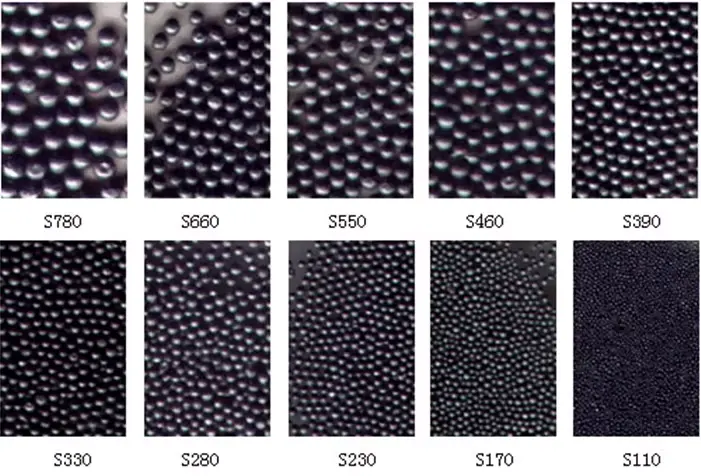
3. Master Size Chart & Sieve Retention Matrix (SAE vs. BIS)
This data matrix represents the exact screening parameters matching global (SAE J444) and Indian Standard (IS 4606 / BIS SS-Grades) regulatory certifications.
| SAE No. | BIS No. | Nominal Size (mm) | Primary Screen | Maximum Tolerance Screen | Target Retention Screen | Minimum Quality Screen |
| S-930 | SS-2400 | 2.400 mm | — | — | 2.40mm: Greater than or equal to 90% | 2.00mm: Greater than or equal to 97% |
| S-780 | SS-2000 | 2.000 mm | 2.80mm: All Pass | — | 2.00mm: Greater than or equal to 85% | 1.70mm: Greater than or equal to 97% |
| S-660 | SS-1700 | 1.700 mm | 2.40mm: All Pass | — | 1.70mm: Greater than or equal to 85% | 1.40mm: Greater than or equal to 97% |
| S-550 | SS-1400 | 1.400 mm | 2.00mm: All Pass | — | 1.40mm: Greater than or equal to 85% | 1.18mm: Greater than or equal to 97% |
| S-460 | SS-1180 | 1.180 mm | 1.70mm: All Pass | 1.40mm: Less than or equal to 5% | 1.18mm: Greater than or equal to 85% | 1.00mm: Greater than or equal to 96% |
| S-390 | SS-1000 | 1.000 mm | 1.40mm: All Pass | 1.18mm: Less than or equal to 5% | 1.00mm: Greater than or equal to 85% | 0.85mm: Greater than or equal to 96% |
| S-330 | SS-850 | 0.850 mm | 1.18mm: All Pass | 1.00mm: Less than or equal to 5% | 0.850mm: Greater than or equal to 85% | 0.710mm: Greater than or equal to 96% |
| S-280 | SS-710 | 0.710 mm | 1.00mm: All Pass | 0.850mm: Less than or equal to 5% | 0.710mm: Greater than or equal to 85% | 0.600mm: Greater than or equal to 96% |
| S-230 | SS-600 | 0.600 mm | 0.850mm: All Pass | 0.710mm: Less than or equal to 10% | 0.600mm: Greater than or equal to 85% | 0.500mm: Greater than or equal to 97% |
| S-170 | SS-425 | 0.425 mm | 0.710mm: All Pass | 0.600mm: Less than or equal to 10% | 0.425mm: Greater than or equal to 85% | 0.355mm: Greater than or equal to 97% |
| S-110 | SS-300 | 0.300 mm | 0.50mm: All Pass | 0.425mm: Less than or equal to 10% | 0.300mm: Greater than or equal to 85% | 0.180mm: Greater than or equal to 90% |
| S-70 | SS-180 | 0.180 mm | — | — | — | — |
Download Steel Shot Size Chart Here
4. Industry-Specific Applications & Deep Use Cases
A. Automobile Industry & Heavy Engineering
-
Use Case (Shot Peening): Engine valve springs, transmission gears, drive shafts, and leaf springs undergo massive cyclic loading. Blasting with fine shot grades (S-110 to S-230) creates uniform micro-dimples on the surface, converting residual tensile stress into compressive stress to shield components against metal fatigue and micro-cracking.
-
Use Case (Surface Preparation): Pre-conditioning vehicle chassis frames, brake discs, and axle assemblies inside continuous wheel-blast systems prior to powder coating or zinc phosphating.
B. Iron & Steel Foundries
-
Use Case (Casting Sand Removal): Post-pouring, large castings emerge with heavily fused molding sand and investment ceramic shells adhered to the surface. Utilizing coarse shot sizes (S-550 to S-780) inside tumble blast machines delivers the heavy impact mass required to break down and strip sand blocks cleanly.
-
Use Case (Forging Descaling): Removing heavy, brittle mill scale formed on hot-forged carbon steel components without altering the metallurgical structure underneath.
C. Steel Fabrication, Infrastructure & Shipyards
-
Use Case (Plate Blasting): Structural H-beams, plates, and large-diameter oil/gas pipelines are processed through automatic conveyor line blast machines using S-280 to S-460 shot. This achieves an Sa 2.5 or Sa 3 cleanliness profile, providing a high-friction anchor pattern for long-lasting anti-corrosion marine epoxies.
5. Master Technical Compendium: Cast Steel Shot FAQ
Section 1: Fundamental Mechanics & Surface Kinetics
Q1: What are the fundamental chemical parameters of high-carbon steel shot under IS 4606?
A: Under the national standard framework maintained on the official Bureau of Indian Standards Product Certification Portal, high-carbon cast steel shot must maintain a carbon content between 0.85% and 1.20%, manganese between 0.60% and 1.20%, and silicon between 0.40% and 1.20%. Sulfur and phosphorus impurities must strictly remain below 0.05% each to prevent hot shortness and brittle failures during operation.
Q2: How does spherical steel shot deform surfaces compared to angular steel grit?
A: Angular grit removes material through micro-cutting, abrasion, and shearing, which visibly erodes the base metal and alters substrate dimensions. Conversely, spherical steel shot transfers its kinetic energy via compression and displacement. It creates overlapping micro-dimples, pounding away scale and rust through dynamic impact while introducing protective compressive stress without altering base dimensions.
Read our full article on :- Glass Bead vs Steel Shot vs Steel Grit
Q3: What is the significance of the “Tempered Martensite” microstructure in steel shot?
A: Tempered Martensite provides an ideal balance of high hardness and impact toughness. During manufacturing, the steel is rapidly quenched to create a hard but brittle martensitic structure, which is then carefully tempered. This elimination of internal residual stresses guarantees that the shot resists shattering under high-velocity wheel impacts, maximizing its operational life to nearly 3,000 cycles.
Q4: How does density affect the cleaning efficiency of steel shot?
A: Density directly governs the kinetic energy equation (Energy = 0.5 * mass * velocity squared). Both Indian national protocols and international benchmarks mandate a minimum density of 7.4 g/cm³. If a shot batch has internal shrinkage cavities, hollow centers, or high porosity, its mass drops. Lower mass reduces impact energy, forcing longer blast cycles to clean the same surface area.
Q5: Why is high-carbon steel shot preferred over low-carbon alternatives for structural descaling?
A: High-carbon steel shot maintains a higher initial hardness profile (40–50 HRC) throughout its working cycle. Low-carbon steel shot tends to deform and flatten quickly upon impact rather than rebounding cleanly. This dampens the impact force, making high-carbon shot far more effective at fracturing tough, brittle mill scale on hot-rolled steel structures.
Section 2: Standards, Testing, and Compliance Certifications
Q6: Where can industrial procurement heads purchase or review the official IS 4606 documentation?
A: The complete, unedited standard text can be acquired directly via the official BIS Standards Sales Portal. This document serves as the regulatory foundation for calculating mass limits and legal quality verification within the Indian industrial market.
Q7: How do IS 4606 and SAE J444 sizing designations correspond?
A: They correspond precisely based on nominal micron sizes. For instance, SAE S-390 indicates a nominal diameter of 0.0390 inches (1.00 mm), which maps directly to the Indian designation SS-1000 (1000 micron nominal size). Similarly, SAE S-110 corresponds to SS-300.
Q8: How is the grain size distribution of steel shot verified in a laboratory under IS 4606?
A: Sieve verification uses a standard mechanical shaker with a calibrated nest of sieves. For example, testing SS-710 (S-280) requires that 100% of the sample passes through a 1.00 mm screen, a maximum of 5% retains on a 0.85 mm screen, at least 85% accumulates on the target 0.71 mm screen, and at least 96% stays above a 0.60 mm screen.
Q9: What are the permissible hardness variations for standard-grade steel shot?
A: For standard surface cleaning applications, both international and Indian frameworks require a hardness range of 40 to 50 HRC (approx. 390 to 510 HV). For specialized shot peening setups requiring higher intensity, customized batches can be heat-treated to 52–56 HRC or 60 HRC+.
Q10: What defines a “defective” steel shot particle under quality assurance protocols?
A: Defective particles include elongated or “tear-drop” shapes, hollow spheres with internal blowholes, cracked grains, and fused twin particles. Under strict military and aerospace guidelines, cracked or non-round particles must not exceed 10% to 15% of a sample, as irregular shapes cause uneven impact profiles and accelerate internal machine wear.
Section 3: Industry Applications & Selection Dynamics
Q11: Why is S-110 / SS-300 shot preferred for shot peening automotive leaf springs?
A: Fine shot grades like S-110 (SS-300) possess low individual mass, which creates shallow, tightly packed dimples. This creates a highly uniform layer of compressive stress across thin components like leaf springs without risking deep deformation, effectively doubling their fatigue limit against cyclic road stress.
Q12: Which steel shot size is best for structural steel descaling lines in India?
A: S-280 (SS-710) and S-330 (SS-850) are the standard selections. They offer an ideal balance between particle count per kilogram and kinetic energy, quickly lifting stubborn mill scale while delivering a consistent Sa 2.5 cleanliness profile that helps high-performance paint primers anchor perfectly.
Q13: Why must foundries handling heavy iron castings use large sizes like S-660 / SS-1700 or S-780 / SS-2000?
A: Heavy castings emerge from sand molds coated in tough, burnt-in molding sand and thick oxide layers. Smaller shots would simply bounce off these deposits without breaking them. Large sizes like S-660 or S-780 deliver the massive impact force required to smash sand shells and clean heavy workpieces quickly.
Q14: How does steel shot blast preparation prevent coating failures on LPG cylinders?
A: LPG cylinders require a flawless surface profile to ensure protective zinc coatings adhere properly. Automated wheel blast systems utilize S-230 (SS-600) or S-280 (SS-710) shot to strip away heat-treatment scale and create a dense anchor pattern, preventing premature peeling or blistering under harsh field conditions.
Q15: Why is high-carbon steel shot restricted from processing stainless steel or aluminum fabrications?
A: Blasting stainless steel or aluminum with carbon steel shot embeds microscopic iron particles into the non-ferrous surface. This sets up galvanic corrosion cells, causing the stainless steel or aluminum to form ugly rust streaks over time. Non-ferrous substrates should only be processed with glass beads, stainless steel shot, or aluminum oxide.
Section 4: Technical & Advanced Operational Processes
Q16: What is a “Balanced Operating Mix,” and why is it critical for wheel blast performance?
A: A balanced operating mix is a stable blend of large, medium, and small shot particles within the blast machine’s hopper. Large, fresh shot cracks open thick mill scale, while smaller, seasoned shot fills the gaps to provide dense, complete coverage per second. This mix speeds up cleaning times and reduces energy use.
Q17: How does an automated air-wash separator maintain the quality of the steel shot mix?
A: As steel shot circulates, it breaks down into fine dust and lifts contaminants like sand and rust scale. The air-wash separator uses a controlled vacuum air stream to draw these light, broken fines out of the system into a dust collector, while allowing reusable, heavy steel spheres to drop safely back into the storage hopper.
Q18: What happens to steel shot consumption if the air-wash separator velocity is set too high?
A: If the air velocity is set too high, the vacuum pull will drag perfectly usable fine steel shot (like S-110 or S-70) into the waste collector bin along with the dust. This drastically accelerates media consumption rates and drives up operational costs unnecessarily.
Q19: How do automated CNC wheel blast systems prolong the operational lifecycle of steel shots?
A: Automated wheel blast lines eliminate human error by locking in consistent parameters: workpiece conveyor speeds, precise wheel RPMs, and targeted blast angles. This prevents over-blasting, which shatters shot prematurely against bare machine liners, ensuring the media wears down evenly over its full 3,000-cycle life.
Q20: Can high-carbon steel shot be effectively utilized in slurry (wet) blasting setups?
A: No. High-carbon steel shot rusts almost instantly when mixed with water. This causes the spheres to oxidize and clump into a solid mass that clogs hoses, nozzles, and control valves. Wet slurry operations should instead utilize specialized stainless steel shot or non-metallic abrasives.
Section 5: Practical Problem Solving & Industrial Troubleshooting
Q21: PROBLEM: The blast machine’s cleaning speed has dropped significantly, leaving patches of scale on the steel. What is the fix?
A: * Root Cause: The operating mix has lost its fine particles, likely because an over-drafted air-wash separator is pulling good, small shot into the dust collector prematurely. Without small shot, the coverage density drops, leaving raw patches on the metal.
-
Remedy: Check the waste bins for usable shot. Turn down the air-wash separator damper gate until only fine, fractured dust and sand are evacuated, keeping smaller steel spheres in the working mix.
Q22: PROBLEM: Deep surface pitting is causing high paint consumption on structural steel plates. How do you adjust the process?
A: * Root Cause: The shot mix contains too much oversized media (e.g., heavy S-550 or S-660 sizes mixed in), which creates a deep surface profile (roughness) that drinks up expensive paint primers.
-
Remedy: Adjust the screen parameters and transition to a medium size grading like S-280 (SS-710) or S-330 (SS-850) to flatten the surface profile while keeping cleaning speeds high.
Q23: PROBLEM: The shot media inside the storage hopper has rusted into a solid mass overnight. How can this be prevented?
A: * Root Cause: Moisture contamination. High-carbon steel shot oxidizes quickly when exposed to humid air or condensation within compressed air lines.
-
Remedy: Install inline refrigerant or desiccant air dryers upstream from the blast enclosure. Store all backup 25 kg bags on elevated pallets away from damp floors, wrapped tightly in protective plastic stretching.
Q24: PROBLEM: Automated blast wheel blades are wearing down and cracking after only a few shifts. What is causing this failure?
A: * Root Cause: Sand contamination. If the air-wash separator fails to extract sand from casting desanding lines, that highly abrasive sand recirculates through the machine, quickly wearing out expensive alloy blades and liners.
-
Remedy: Clean out the separator screens and increase the vacuum draw to thoroughly lift sand away from the dense steel shot before it returns to the wheel.
Q25: PROBLEM: Steel shot is breaking down rapidly into dust within just a few cycles. What is the metallurgical issue?
A: * Root Cause: Poor material quality. The shot may have been poorly heat-treated, leaving behind brittle untempered martensite or high internal porosity (blowholes), which shatters easily on impact.
-
Remedy: Source high-carbon shot certified to IS 4606 / SAE J827 standards, ensuring a uniform density (Greater than or equal to 7.4 g/cm³) and an optimized tempered martensitic structure that resists shattering.

Core Blast team –
High-Volume Auto Component Forging
⭐⭐⭐⭐⭐ Exceptional descaling speed with zero premature particle fracturing.
“Our hot-forged transmission gears and connecting rods develop highly stubborn, abrasive mill scale that must be stripped cleanly before automated machining lines. We upgraded our continuous tumble-blast systems to Coreblast’s high-carbon steel shot to address severe cycle-time delays.
The structural density of this media consistently meets the mandatory ≥ 7.4 g/cm³ requirement, meaning every single sphere delivers maximum kinetic impact energy without shattering into useless dust. We have recorded a clear 30% drop in overall abrasive consumption this quarter because the tempered martensitic structure handles high-velocity impact beautifully. Our automated blast blades are running cooler and lasting significantly longer.”
— Sanjeev Kumar Production Head & Chief Forging Engineer, AutoDrive Components Ltd., Faridabad
Core Blast team –
Heavy Foundries & Castings (Focus: Fused Molding Sand Elimination)
⭐⭐⭐⭐⭐ Massive cleaning efficiency on heavy iron castings.
“Post-pouring, our heavy gray iron castings emerge from the foundry floors with heavily fused molding sand and thick oxide surfaces that used to ruin our blast wheels. We placed an order for Coreblast’s coarse-grade SS-1700 (SAE S-660) steel shots to handle the heavy impact mass required to fracture these sand shells.
The media strips the workpieces clean down to bare metal in half the time compared to lower-grade alternatives we tried earlier. Because the shot is thoroughly screened and completely free of irregular internal blowholes or shrinkage cavities, it rebounds smoothly and holds its shape for thousands of cycles. This shift has dramatically minimized our machine downtime and boosted daily output.”
— Rajesh Mehta Director of Operations, Mehta Iron & Steel Foundries, Sahibabad Industrial Area
Core Blast team –
Structural Steel Infrastructure & Marine Prep
⭐⭐⭐⭐⭐ Flawless Sa 2.5 anchor pattern for high-performance epoxy adhesion.
“As primary infrastructure contractors, passing strict third-party inspections for marine-grade anti-corrosive coatings requires absolute precision in our surface preparation. We utilize Coreblast’s SS-710 (SAE S-280) steel shot to treat large H-beams, structural plates, and pipeline networks.
The grain size distribution is remarkably consistent, producing a highly uniform Sa 2.5 surface roughness across the entire substrate without causing deep, erratic pitting that drinks up excessive paint primer. Our quality assurance team has zero friction clearing regulatory audits now, and our coating consumption metrics have finally normalized. This is easily the best commercial media option available for high-intent B2B steel preparation.”
— Arun Sharma QA/QC Manager, Apex Infrastructure & Marine Fabricators, Noida
Core Blast team –
⭐⭐⭐⭐⭐ Superb roundness profile with zero micro-notches on high-stress parts.
“We manufacture heavy-duty automotive leaf springs and engine valve springs that undergo continuous cyclic road stress. To induce the necessary residual compressive stress that prevents premature metal fatigue, we rely entirely on high-intensity shot peening with Coreblast’s ultra-fine SAE S-110 grade.
The spherical roundness of this media is top-tier; there are no sharp, irregular shards that risk creating micro-notches or surface distortion on high-stress components. It brings the fatigue limits of our spring steel up to our exact design benchmarks. Having a highly technical trader based in Delhi that reliably stocks specialized micro-grades has entirely secured our production timeline.”
— Vikramjit S. Ahluwalia Operations Chief & Metallurgist, PeakSpring Automotive Components, Gurgaon
Core Blast team –
LPG Cylinder Manufacturing Line for Surface Prep for Zinc Coating
⭐⭐⭐⭐⭐ Perfect surface profiling with rapid cycle-time reductions.
“LPG cylinder production lines demand a flawless surface profile to ensure protective zinc coatings and powder paints adhere permanently under harsh field handling. We integrated Coreblast’s SS-600 (SAE S-230) shots into our automated wheel-blast conveyor line.
The media breaks open heat-treatment scale instantly, leaving a dense, high-friction anchor pattern that maximizes coating grip. Since swapping to Coreblast, we have noticed fewer peeling rejections and a much cleaner blast enclosure because their shot doesn’t pulverize on impact. For an industrial facility running multi-shift operations, this media provides incredible cost-to-performance stability.”
— Amit G. Grewal Purchase Officer & Procurement Specialist, Indane-Compliant Cylinder Fabricators, Ghaziabad
Core Blast team –
High-Volume Industrial Steel Trading
⭐⭐⭐⭐⭐ Bone-dry material, robust packing, and flawless IS 4606 certification.
“In our industrial trade sector, product consistency and batch traceability are everything. We hold a rolling commercial contract with Coreblast Solutions for their high-carbon cast steel shot. Every single shipment arrives meticulously palletized and tightly wrapped in heavy-duty, moisture-proof plastic stretch wrap.
High-carbon steel shot is notoriously sensitive to humidity, but Coreblast delivers bone-dry, free-flowing media every time. Each batch comes fully backed by clear IS 4606 and SAE J444 test certifications, allowing us to pass quality checks instantly at our client sites. Their prompt logistics and competitive commercial pricing make them our primary trading partner.”
— Karan Malhotra Senior Partner & B2B Procurement Head, Malhotra Industrial Traders, Yusuf Sarai, Delhi