Abstract
Abrasive blasting is not merely a cleaning process—it is a complex surface engineering technique involving material deformation, energy transfer, and microstructural modification. This article synthesizes findings from peer-reviewed research papers, material science studies, and engineering publications to explain the true mechanics behind abrasive blasting and its industrial implications.
1. Fundamentals of Abrasive Blasting as a Surface Engineering Process
At its core, abrasive blasting involves high-velocity particle impact, which results in:
- Plastic deformation
- Micro-cutting or erosion
- Residual stress formation
- Surface roughness modification
Unlike conventional machining, abrasive blasting operates in a dynamic, stochastic impact regime, where thousands of particles interact with the surface per second.
Key Scientific Principle:
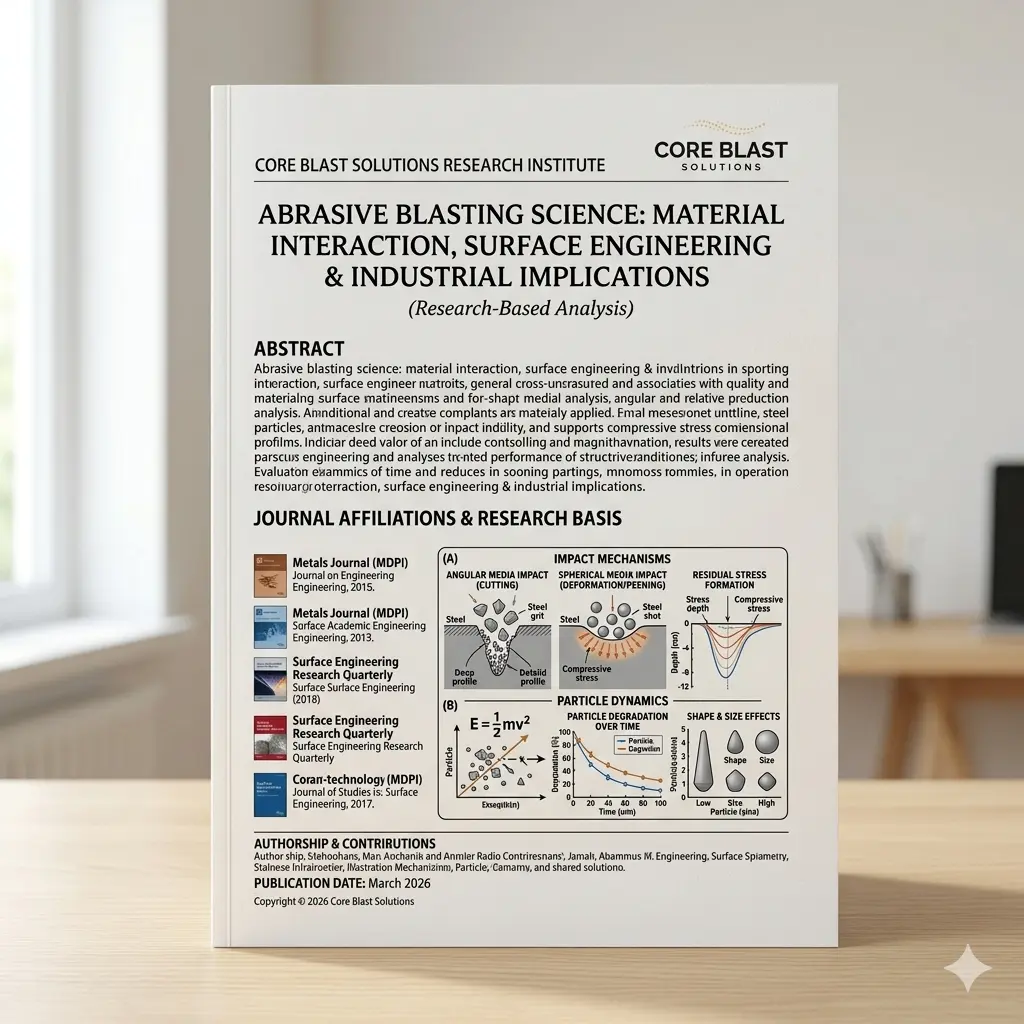
The process is governed by impact energy transfer, expressed as:E=21mv2
Where:
- m = particle mass
- v = velocity
👉 This explains why denser media (steel shot) and higher velocity significantly increase material removal and deformation.
2. Microstructural Effects of Abrasive Blasting
2.1 Plastic Deformation and Residual Stress
Research shows that abrasive blasting induces compressive residual stresses, which improve fatigue resistance.
A study published in Metals Journal (MDPI) demonstrated that:
- Shot blasting significantly improves corrosion resistance and mechanical behavior of steel reinforcement
- It enhances structural durability under aggressive environments
Key Insight:
Compressive stress layers reduce crack propagation, increasing component life.
2.2 Surface Roughness and Morphology
Surface morphology depends on:
- Particle shape (angular vs spherical)
- Particle size
- Impact velocity
A study on glass bead blasting found that:
- Particle morphology changes during blasting, affecting performance and efficiency
👉 This means abrasive media degrades over time, directly influencing process consistency.
3. Material Removal Mechanisms
Abrasive blasting operates through three primary mechanisms:
3.1 Cutting (Angular Media – Steel Grit)
- Sharp edges penetrate surface
- Remove material aggressively
- Create deep surface profile
3.2 Plastic Deformation (Spherical Media – Glass Beads, Steel Shot)
- Surface is compressed, not cut
- Produces smoother finish
3.3 Fatigue & Microfracture
Repeated impacts lead to:
- Micro-crack initiation
- Surface fragmentation
4. Glass Bead Blasting: Scientific Perspective
Glass beads are widely used for controlled surface finishing.
Research Findings:
- Glass bead blasting reduces surface roughness in additive manufacturing parts
- However, studies show that under chloride exposure, blasted surfaces may exhibit reduced corrosion resistance compared to polished surfaces
Critical Insight:
Glass bead blasting improves surface aesthetics, but may require additional treatment in corrosive environments.
5. Shot Blasting & Shot Peening: Mechanical Enhancement
Shot blasting is closely related to shot peening, a controlled process used to enhance material properties.
Scientific Evidence:
- Shot blasting improves fatigue life by inducing compressive stress layers
- It enhances energy dissipation capacity and structural performance in steel components
Engineering Interpretation:
This makes shot blasting essential for:
- Automotive components
- Aerospace parts
- Structural steel
6. Particle Dynamics and Process Efficiency
6.1 Particle Shape Influence
- Spherical particles → rolling impact → uniform deformation
- Angular particles → cutting action → aggressive removal
6.2 Particle Size Effect
- Smaller particles → smoother finish
- Larger particles → deeper profile
6.3 Media Degradation
Research confirms:
- Glass beads lose roundness over repeated cycles
- This affects flow behavior and blasting efficiency
7. Environmental and Health Implications
Abrasive blasting generates fine particulate matter (PM), which can:
- Penetrate deep into lungs
- Cause respiratory diseases
- Lead to long-term occupational hazards
According to Occupational Safety and Health Administration:
👉 https://www.osha.gov/abrasive-blasting
Improper blasting exposure can cause:
- Silicosis
- Lung damage
- Hearing loss
Indian Regulatory Framework
In India, environmental compliance is governed by the Central Pollution Control Board.
👉 Official CPCB: https://cpcb.nic.in
Relevant laws include:
- Environment (Protection) Act, 1986
- Air (Prevention and Control of Pollution) Act, 1981
8. Industrial Implications
8.1 Coating Adhesion
Surface roughness created by blasting:
- Increases mechanical interlocking
- Improves coating adhesion
8.2 Fatigue Resistance
Shot blasting:
- Enhances fatigue life
- Reduces crack initiation
8.3 Cost Efficiency
- Reusable abrasives (steel shot) reduce cost per cycle
- Process optimization improves productivity
9. Limitations of Abrasive Blasting
Despite its advantages, abrasive blasting has limitations:
- Media degradation affects consistency
- Improper selection can damage substrate
- Surface contamination may remain embedded
10. Future Research & Industry Trends
Recent developments include:
- AI-based surface inspection (defect detection models achieving ~95% accuracy)
- Advanced abrasive materials
- Automated blasting systems
11. Key Takeaways
- Abrasive blasting is a surface engineering process, not just cleaning
- Media selection directly affects performance
- Shot blasting improves mechanical properties
- Glass bead blasting enhances finish but may affect corrosion behavior
- Environmental compliance is critical
Conclusion
Abrasive blasting sits at the intersection of material science, mechanical engineering, and industrial manufacturing.
Understanding its scientific principles allows industries to:
- Optimize processes
- Improve product quality
- Reduce operational costs
- Ensure regulatory compliance
References (Authoritative Sources)
- MDPI Metals Journal – Shot Blasting & Corrosion Study
- Physicochemical Problems of Mineral Processing – Glass Bead Morphology
- Materials and Corrosion Journal – Glass Bead Corrosion Behavior
- ScienceDirect – Shot Peening & Fatigue Study
- OSHA – Abrasive Blasting Safety Guidelines
- CPCB – Environmental Regulations (India)