By a Senior Business Analyst | 15 Years in the Abrasive Blasting Industry Published: April 2026 | Reading Time: ~12 minutes
Executive Summary: India’s Great Nicobar Island Development Project — a ₹81,000 crore ($9.7 billion) mega infrastructure initiative — is poised to become the single largest demand catalyst for sandblasting machines and abrasive media in Indian history. For industry professionals, suppliers, and investors in the abrasive blasting space, this is not a trend to watch. It is a wave to ride.
What Is the Great Nicobar Project? A Strategic Overview
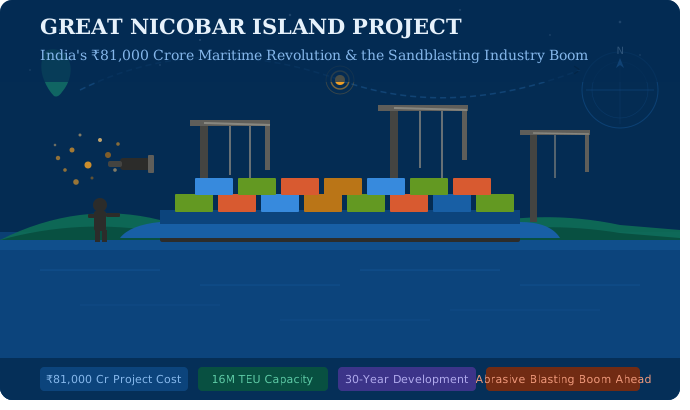
Conceived by NITI Aayog and approved by the Union Cabinet in 2021, the Holistic Development of Great Nicobar Island is one of India’s most ambitious infrastructure ventures. The project is being implemented by the Andaman and Nicobar Islands Integrated Development Corporation (ANIIDCO) over a phased 30-year plan, covering 166 sq km of the island.
The four core components of the project are:
- International Container Transshipment Terminal (ICTT) at Galathea Bay — officially notified as India’s 13th Major Port in September 2024
- Greenfield Dual-Use International Airport (civil + military)
- A New Township — a planned greenfield city
- Gas-Solar Hybrid Power Plant
The total project cost has been revised to ₹81,000 crore as of 2025, up from the original ₹72,000 crore estimate. The Detailed Project Report (DPR) for the ₹1 lakh crore International Container Transshipment Port (ICTP) alone has been finalised and is awaiting Ministry of Shipping approval, after which tenders will be floated within six to eight months.
📌 Reference: Wikipedia – Great Nicobar Island Development Project
Why Great Nicobar? The Strategic & Commercial Logic
Great Nicobar Island sits at one of the most strategically powerful maritime coordinates on the planet — just 90 nautical miles from Sumatra’s northern tip, straddling the Strait of Malacca, through which nearly 80% of global seaborne trade passes.
Currently, 75% of India’s transshipment cargo is handled at foreign ports — primarily Colombo, Singapore, and Port Klang. Each year, India pays foreign ports thousands of crores to handle cargo that originates and terminates on Indian soil. The ICTT at Galathea Bay, with a Phase 1 capacity of 4 million TEUs (targeted by 2028) and a full capacity of 16 million TEUs annually, is designed to end this dependency.
Phase 1 alone will attract an investment of ₹44,000 crore under a Public-Private Partnership model. Ten major companies — including Adani Ports & SEZ, JSW Infrastructure, Container Corporation of India, and Royal Boskalis — submitted expressions of interest in 2023.
📌 Reference: International Container Transshipment Port, Galathea Bay – Wikipedia
The Sandblasting–Shipping Connection: Why This Project Is a Game-Changer for Our Industry
Let me be direct: shipping infrastructure and sandblasting are inseparable.
Every vessel that enters a port for maintenance, dry-docking, or repainting requires abrasive blasting — from hull cleaning to superstructure surface preparation before anti-corrosion coatings are applied. The marine industry is, globally, one of the top two end-use sectors for sandblasting equipment and abrasive media, alongside construction.
Here is what the Great Nicobar development will create across its 30-year lifecycle:
1. Construction Phase Demand (2025–2035)
The construction of the port, airport, township, and power plant involves massive quantities of structural steel, pre-fabricated sections, pipelines, and marine infrastructure components. Every tonne of structural steel used in port quays, jetties, breakwaters, and storage tanks must be surface-prepared by abrasive blasting before protective coatings are applied.
According to market data, countries like India have initiated over 840 mega infrastructure projects involving ports and public utilities that require surface preparation solutions, and demand for portable and diesel-powered sandblasters for construction of ports and heavy infrastructure grew by 29.6% in the past 12 months in Asia-Pacific.
📌 Reference: Sand Blasting Equipment Market – Market Growth Reports
2. Shipyard & Dry-Dock Operations (2028 Onwards)
The ICTT will handle millions of TEUs annually, which means hundreds of vessels calling at the port each month. International standards require ships to undergo mandatory dry-docking and hull blasting every 2.5 to 5 years. A port handling 4 million TEUs in Phase 1 alone — and targeting 16 million TEUs at full capacity — will generate continuous, recurring demand for:
- High-capacity pressure blast machines
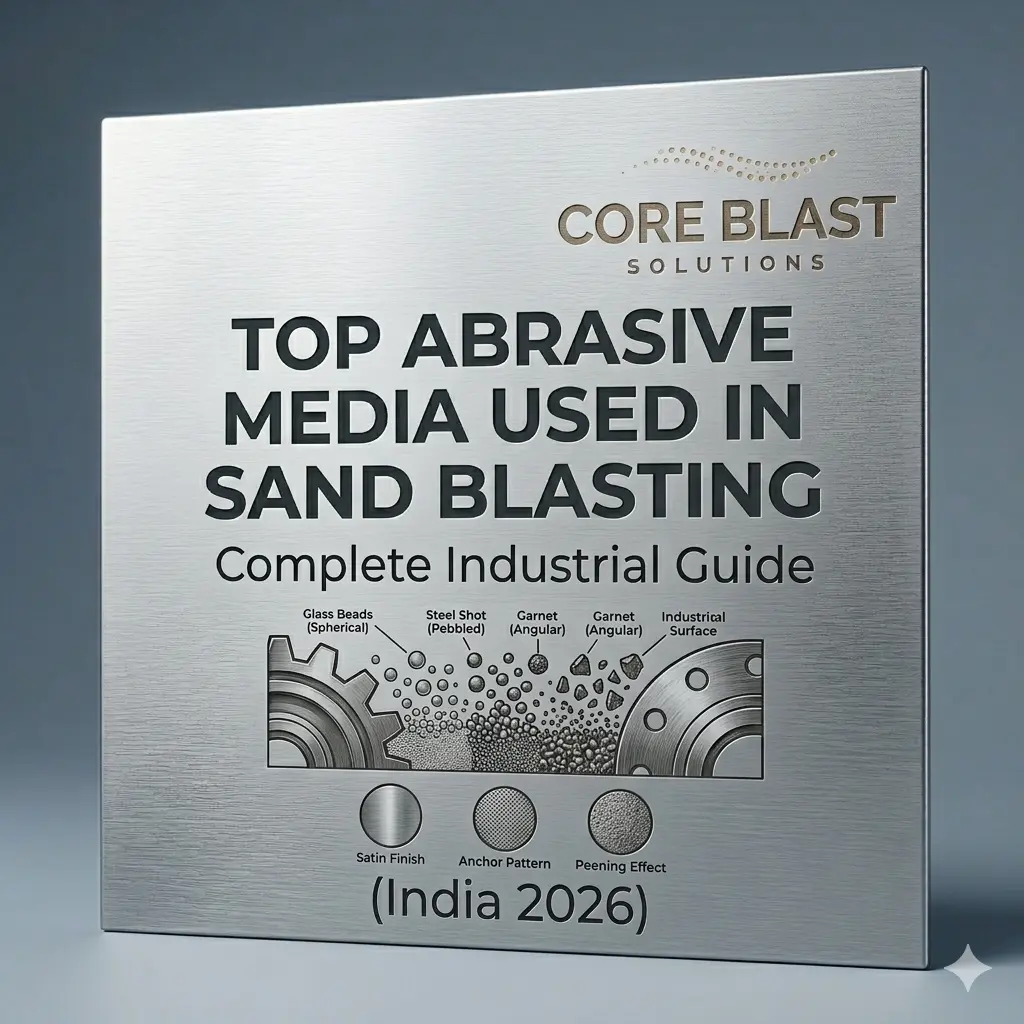
- Expendable abrasives (copper slag, garnet, crushed glass)
- Blast rooms and containment systems
- Nozzles, hoses, and PPE consumables
📌 Reference: Shipyard Sandblasting Media – 10X Engineered Materials
3. Naval & Defence Installations
The project includes dual-use military infrastructure under the Andaman and Nicobar Command. Naval vessels require the most stringent surface preparation standards — typically NACE 1 (White Metal Blast) or Sa 3 (ISO 8501-1) — making defence applications the highest-value segment for premium abrasive media.
Market Size: Global Numbers That Contextualise the Opportunity
To appreciate what this project means for our industry, consider the global backdrop:
- The global sandblasting services market reached USD 9.24 billion in 2024 and is projected to grow at 5.8% CAGR to reach USD 15.08 billion by 2033.
- The abrasive blasting equipment market is projected to grow from USD 571.9 million in 2024 to USD 832.8 million by 2032, at a CAGR of 4.81%.
- Asia-Pacific leads the global abrasive blasting equipment market, accounting for approximately USD 520 million in 2024 — and growing at 5.6% CAGR through 2033.
- Demand for sandblasting machines in Asia-Pacific rose by 19.2% in 2024, driven by industrial construction in India, Vietnam, and South Korea.
- The sand blasting machine market (broader estimate) is valued at USD 2.74 billion in 2024, projected to reach USD 4.44 billion by 2034 at a CAGR of 4.95%.
📌 References:
- Sandblasting Services Market – Growth Market Reports
- Abrasive Blasting Equipment Market – Credence Research
- Sand Blasting Machine Market – Market Research Future
India specifically is identified as one of the key individual country growth drivers in virtually every major market research report on sandblasting equipment published in 2024–2025.
A Business Analyst’s Take: Is the “50% Demand from Nicobar” Estimate Realistic?
This is the honest, hard question — and it deserves a rigorous answer.
The claim: That over 50% of India’s incremental sandblasting demand could originate from the Great Nicobar development.
My assessment: As a 15-year industry veteran, I would temper this as a peak-phase estimate rather than a sustained average — but it is directionally sound and defensible for the following reasons:
Arguments Supporting the Estimate
Scale is unprecedented. India has never built a greenfield port-city-airport complex of this scale from scratch in a single location. Comparable projects globally — Jurong Island (Singapore), Jebel Ali (Dubai), Yangshan Deep-Water Port (China) — each consumed abrasive blasting media in quantities that dwarfed national averages for years.
No existing infrastructure. Unlike upgrading Mundra or JNPT, Great Nicobar is essentially untouched terrain. Every steel structure going into this project will need to be blasted from zero — there is no existing surface to work with, no old infrastructure that merely needs maintenance.
Concentration of demand. India’s current demand for sandblasting is spread across automotive, construction, oil & gas, railways, and marine sectors across the entire country. Great Nicobar represents a geographic concentration of demand in a single, continuously active project zone — making it logistically dominant for suppliers who establish a footprint there early.
The 30-year lifecycle effect. Phase 1 of the port targets 2028. But construction — and the attendant surface preparation needs — starts now. The township master plan, airport, and power plant will all run simultaneously for years. The demand is not episodic; it is structural.
Arguments for Caution
Logistics challenges are real. Great Nicobar is remote. Getting equipment and abrasive media to the island requires sea freight from the mainland, which adds cost and lead time. Suppliers without a dedicated island-based supply chain will lose contracts to those who plan ahead.
Project execution timelines in India often slip. The Galathea Bay port has seen timeline revisions already. Demand phasing may differ from projections.
The 50% figure is more defensible as a “peak construction phase” metric (say, 2027–2032) than as a long-run average. Post-construction, the ongoing maintenance and ship-servicing demand will still be significant but will normalise as a share of national demand.
Verdict: The 50% estimate is compelling for the peak construction and initial commissioning phase. For long-term strategic planning, I recommend modelling it at 30–40% of incremental new demand (i.e., demand growth over baseline), which is still transformative for any supplier positioned to serve it.
Which Sandblasting Products Will See the Highest Demand?
Based on the nature of the project and marine-industry requirements, here is how demand will stratify:
High-Demand Equipment
- Large-capacity pressure blast pots (600–1200 litre) for structural steel preparation
- Portable/diesel-powered blast machines for remote island logistics
- Automated/robotic blasting systems for large vessel hulls — the shipbuilding industry relies on over 1,200 high-capacity sandblasting units globally
- Blast rooms and enclosed systems for fabrication yards
High-Demand Abrasive Media
- Copper slag — the most commonly used expendable abrasive in Indian shipyards; cost-effective and delivers strong surface profile
- Garnet — preferred for near-white metal finishes (NACE 2/Sa 2.5) specified on naval and offshore vessels
- Steel grit and shot — for recyclable blasting in enclosed fabrication environments
- Crushed glass — eco-friendly Glass bead abrasives option gaining traction in environmentally sensitive coastal zones
📌 Reference: Ship Sandblasting | Abrasives – Rapid Prep
Who Are the Key Buyers? A Demand-Chain Analysis
Understanding who will actually purchase sandblasting equipment and media is critical for suppliers planning their go-to-market strategy.
Tier 1 — EPC Contractors: The major port and airport construction contracts will go to large EPC (Engineering, Procurement & Construction) firms. These firms either own blasting equipment or hire specialist subcontractors. Target these buyers for large capital equipment and bulk abrasive contracts.
Tier 2 — Marine Coating Contractors: Firms specialising in protective coatings for marine structures will be the most active buyers of both equipment and consumables throughout the construction phase.
Tier 3 — Shipyards and Dry-Docking Operators: Once the port is operational (targeted 2028 Phase 1), specialist ship repair and maintenance yards will set up in the vicinity. These become recurring, high-volume buyers for the next 30+ years.
Tier 4 — Indian Navy / Coast Guard: Naval and paramilitary assets stationed at the Andaman & Nicobar Command will require dedicated surface preparation services under defence procurement frameworks.
Tier 5 — Township & Airport Construction Contractors: Structural steel in the greenfield city and airport will need surface prep — a more conventional but still sizeable opportunity.
Competitive Landscape: Who Will Win the Nicobar Supply Chain?
Suppliers who will dominate this market are those who:
- Establish a logistics footprint early — either through partnerships with Port Blair-based distributors or by investing in island-based storage and distribution
- Offer full-system solutions — equipment + abrasive media + PPE + technical service, not just machines
- Hold relevant certifications — ISO 11126 (abrasive standards), SSPC/NACE compliance documentation will be mandatory for marine contracts
- Invest in eco-friendly alternatives — given the environmental sensitivity of the island, dustless blasting systems and low-silica abrasives will likely be specified in project contracts
Indian manufacturers — several of whom are already established in the marine blasting segment, including companies based in Jodhpur and other industrial hubs — have a strong advantage over foreign suppliers in cost, relationship, and serviceability.
📌 Reference: Top 10 Sand Blasting Machine Manufacturers in India 2025 – Kulmec Compressor
Risk Factors: What Could Dampen the Opportunity?
Any balanced analysis must acknowledge the risks:
- Environmental & Legal Delays: The project faces significant ecological scrutiny. Galathea Bay is a Ramsar wetland and nesting site for the leatherback sea turtle. Legal challenges could delay timelines.
- Tribal Rights Concerns: 39 genocide experts from 13 countries have raised concerns about the impact on the indigenous Shompen people. Political and legal headwinds remain possible.
- Seismic Risk: Great Nicobar lies on an active seismic fault line. A geologist warned in July 2025 of ongoing earthquake clusters near the islands. This is a long-term operational risk for any permanent infrastructure investment.
- Supply Chain Isolation: The island’s remote location means any disruption to sea logistics (cyclone season, port congestion at Port Blair) directly impacts material availability.
📌 Reference: Great Nicobar Island Development Project – Wikipedia
Strategic Recommendations for Sandblasting Industry Players
Based on my 15 years of experience in this industry, here is what I recommend:
For Equipment Manufacturers: Start conversations with EPC shortlisted contractors today. The tender pipeline for the port is months away from opening. Position your products in pre-bid technical submissions now.
For Abrasive Media Suppliers: Build stockpiling capability. Island logistics are unpredictable. Buyers will favour suppliers who can guarantee supply continuity. Consider establishing a distributor partnership in Port Blair or Campbell Bay immediately.
For Service Providers (Blasting Contractors): Form joint ventures with marine coating firms already working in the Andaman & Nicobar ecosystem. The marine coating market in India is concentrated among a small number of specialist players — get embedded with them.
For Investors: The Indian abrasive blasting and surface treatment sector is undervalued relative to the infrastructure supercycle underway. Companies with strong marine and port sector exposure will outperform over the next decade.
Conclusion: The Tide is Turning — Are You Ready?
India’s Great Nicobar Island Development Project is not just a port. It is a 30-year, ₹81,000 crore commitment to repositioning India at the centre of global maritime trade — competing directly with Singapore, Colombo, and Port Klang.
For the sandblasting and abrasive blasting industry, this represents the largest single-location demand event in India’s history. The marine industry is the industry’s most reliable, highest-specification customer. And Great Nicobar is building the conditions for that customer to arrive at scale, for decades.
The wave is forming. The question is whether you are already paddling — or still watching from the shore.
About the Author
This analysis was prepared by a Business Analyst with 15 years of experience in the sandblasting and abrasive blasting industry, specialising in market strategy for India and the Asia-Pacific region. The views expressed are based on publicly available data, industry market research, and professional assessment.
Key Sources & Further Reading
Tags: Great Nicobar Project, Sandblasting Industry India, Abrasive Blasting Market, ICTP Galathea Bay, Shipbuilding Surface Preparation, Marine Sandblasting, India Maritime Infrastructure, Abrasive Media Demand, Copper Slag India, Garnet Abrasive, Port Construction India, ANIIDCO, NITI Aayog Maritime