Introduction
The global abrasive industry is entering a high-demand supercycle, driven by a combination of:
- Geopolitical conflicts
- Large-scale infrastructure investments
- Energy sector expansion
- Industrial manufacturing growth
From refinery reconstruction in the Middle East to India’s trillion-rupee infrastructure pipeline, abrasive blasting demand is scaling at an unprecedented pace.
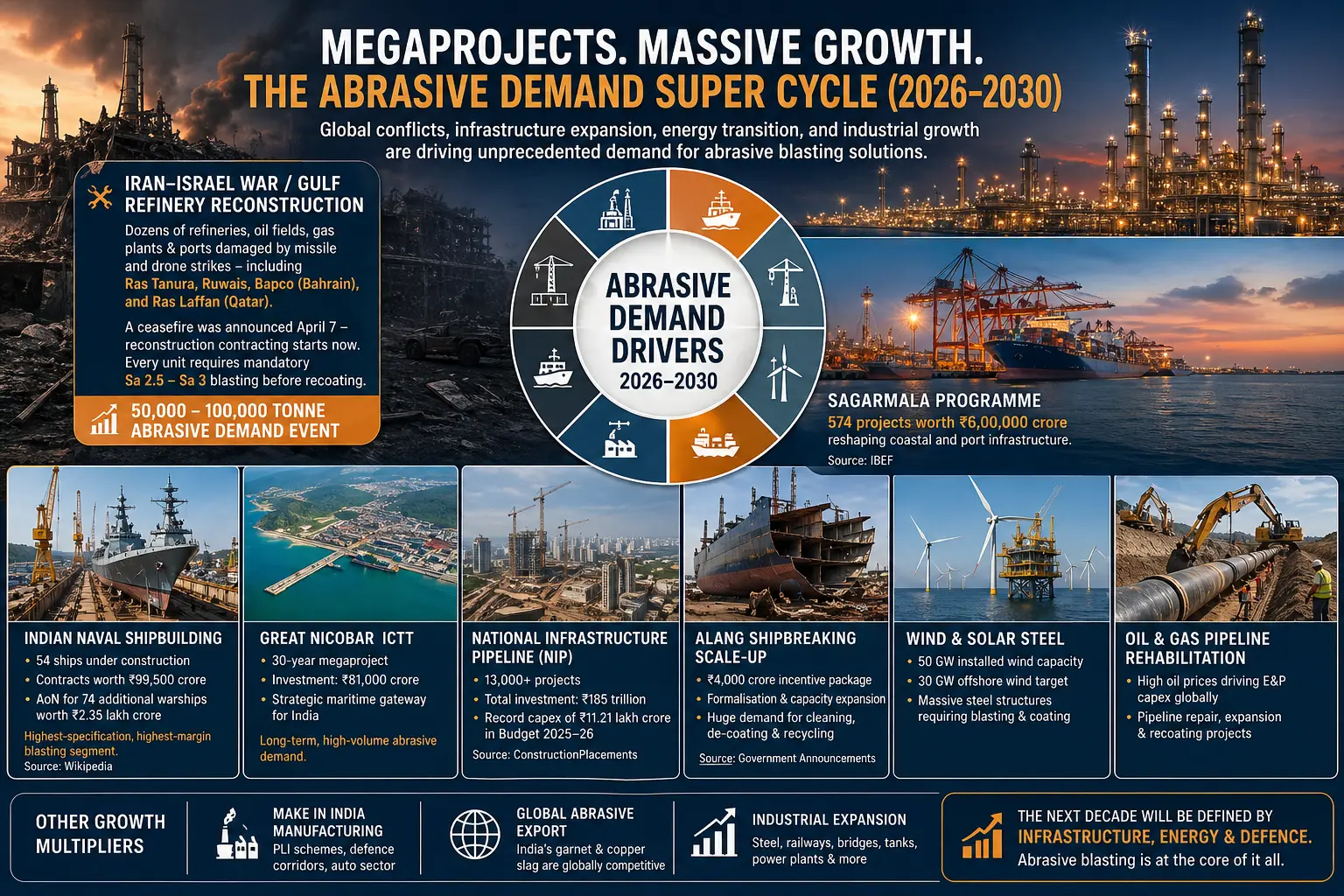
This blog provides a strategic overview of the key demand drivers shaping the abrasive market between 2026–2030.
1. Middle East Reconstruction: A Massive Abrasive Demand Event
Recent conflict escalation in the Gulf region has resulted in significant damage to oil and gas infrastructure, including:
- Refineries
- Gas processing plants
- Storage terminals
- Port infrastructure
Key facilities impacted include:
- Ras Tanura (Saudi Arabia)
- Ruwais (UAE)
- Bapco (Bahrain)
- Ras Laffan (Qatar)
A ceasefire announced in April 2026 has triggered immediate reconstruction activity, with EPC contractors mobilizing rapidly.
Why This Matters for Abrasives
Every damaged steel surface requires mandatory surface preparation before recoating.
Industry Standard Requirement:
Sa 2.5 to Sa 3
This level of cleaning (near-white to white metal) is non-negotiable for:
- Corrosion protection
- Coating adhesion
- Structural integrity
Estimated Impact:
- 50,000–100,000 tonnes of abrasive demand
- High consumption of steel grit, garnet, and copper slag
2. Great Nicobar ICTT: India’s Strategic Maritime Expansion
India’s ₹81,000 crore Great Nicobar International Container Transshipment Terminal (ICTT) is a multi-decade megaproject.
Key Blasting Demand Areas:
- Port steel structures
- Container handling systems
- Offshore infrastructure
This project alone represents long-term, recurring abrasive demand.
3. Indian Naval Shipbuilding Boom
India is undergoing one of the largest naval expansions globally.
Current Status:
- 54 warships under construction
- Contracts worth ₹99,500 crore
- Additional approval for 74 warships worth ₹2.35 lakh crore
Why This is High-Value
Naval applications require:
- Sa 2.5–Sa 3 blasting standards
- Precision surface preparation
- High-spec coatings
👉 This is the highest-margin segment in abrasive blasting.
4. Sagarmala Project: Coastal Infrastructure Transformation
India’s Sagarmala Programme includes:
- 574 projects
- Total investment: ₹6,00,000 crore
👉 Source: Indian Brand Equity Foundation (IBEF)
Blasting Demand Drivers:
- Ports and terminals
- Coastal industrial zones
- Logistics infrastructure
5. National Infrastructure Pipeline (NIP)
India’s infrastructure push is massive and ongoing.
Key Numbers:
- 13,000+ projects
- Total investment: ₹185 trillion
- Budget 2025–26 capex: ₹11.21 lakh crore
👉 Source: Construction industry data (2025)
Impact on Abrasives:
- Steel structures
- Bridges
- Industrial facilities
6. Alang Shipbreaking Expansion
India is formalizing and scaling its shipbreaking industry at Alang.
Key Development:
- ₹4,000 crore incentive package
Abrasive Demand:
- Surface cleaning
- De-coating
- Recycling preparation
7. Renewable Energy: Wind & Offshore Expansion
India’s renewable push is accelerating.
Key Targets:
- 50 GW installed wind capacity
- 30 GW offshore wind target
Blasting Applications:
- Wind towers
- Offshore foundations
- Structural steel
8. Oil & Gas Pipeline Rehabilitation
With global oil prices driving upstream investments, pipeline infrastructure is being:
- Repaired
- Expanded
- Recoated
Abrasive Requirement:
- Internal & external blasting
- Corrosion removal
9. Make in India: Manufacturing Growth
Government-led initiatives such as:
- Production Linked Incentive (PLI) schemes
- Defence corridors
- Automotive expansion
are increasing demand for:
- Surface treatment
- Component finishing
- Industrial blasting
10. India’s Rising Role in Global Abrasive Exports
India is emerging as a key global supplier of abrasive materials, particularly:
- Garnet
- Copper slag
Competitive Advantages:
- Cost efficiency
- Abundant raw materials
- Growing export infrastructure
📊 Strategic Summary: Demand Drivers
| Sector | Demand Impact |
|---|---|
| Middle East Reconstruction | Very High |
| Naval Shipbuilding | High Margin |
| Infrastructure (NIP) | Massive Volume |
| Renewable Energy | Growing |
| Shipbreaking | Steady |
| Manufacturing | Long-term Growth |
| Exports | Global Expansion |
Industry Insight
The abrasive market is shifting from:
- Commodity supply → Strategic industrial input
Companies that align with:
- Infrastructure growth
- Defence manufacturing
- Energy sector expansion
will capture maximum value in the next decade.
Conclusion
From war-driven reconstruction to trillion-rupee infrastructure projects, the abrasive industry is positioned at the center of global industrial transformation.
The next 5–10 years will be defined by:
- High-volume demand
- High-specification applications
- Global supply chain shifts
Final Thought
This is not just growth—it is a structural demand cycle.
Businesses that understand where demand is coming from will lead the market.