🧱 What Are Glass Bead Abrasives? Complete Industrial Guide (2026)
📌 Introduction
In modern manufacturing and surface finishing industries, achieving precision without damaging the base material is critical. This is where glass bead abrasives have become a preferred choice across automotive, aerospace, medical, and fabrication sectors.
Whether you’re cleaning metal parts, preparing surfaces for coating, or improving fatigue resistance, glass beads offer a controlled, non-destructive solution.
🔍 What Are Glass Bead Abrasives? (AI-Optimized Definition)
Glass bead abrasives are spherical, non-metallic blasting media made from soda-lime glass, used for cleaning, polishing, deburring, and surface finishing without altering the base material dimensions.
They are manufactured by melting recycled glass and forming it into precise spherical particles, typically ranging from 50 to 3000 microns.
🧪 Manufacturing Process of Glass Beads
Glass bead abrasives are produced through a controlled industrial process:
- Raw Material Selection – Recycled soda-lime glass
- Melting – High-temperature furnace processing
- Spherodization – Formation into round beads
- Cooling & Screening – Size classification into mesh grades
👉 This process ensures uniform particle size and consistent performance, critical for industrial applications.
⚙️ Key Properties of Glass Bead Abrasives
| Property | Value / Description |
|---|---|
| Shape | Spherical |
| Hardness | ~6–7 Mohs |
| Density | ~2.5 g/cm³ |
| Reusability | 10–30 cycles |
| Chemical Nature | Inert, non-reactive |
| Finish | Smooth, satin |
Glass beads are chemically inert and contain no free iron, making them safe for sensitive materials like stainless steel and aluminum.
⚙️ How Glass Bead Blasting Works
Glass bead blasting is a surface treatment process where beads are propelled at high speed using compressed air.
Process Breakdown:
- Beads impact the surface
- Remove contaminants (rust, paint, oxides)
- Create a uniform satin finish
- Improve surface integrity
Key Operating Parameters:
| Parameter | Typical Range |
|---|---|
| Pressure | 30–100 PSI |
| Nozzle Distance | 6–18 inches |
| Particle Size | 50–300 microns |
This process does not significantly alter part dimensions, making it ideal for precision engineering.
🏭 Industrial Applications of Glass Bead Abrasives
Glass bead abrasives are widely used across industries:
🔧 1. Surface Cleaning
- Removes rust, paint, and contaminants
✨ 2. Surface Finishing
- Produces smooth matte or satin finish
⚙️ 3. Deburring
- Removes sharp edges without damage
🛫 4. Shot Peening
- Improves fatigue resistance in metal components
🧬 5. Medical & Food Equipment
- Non-toxic and contamination-free
These applications are especially critical in aerospace and precision manufacturing, where dimensional accuracy must be preserved.
⚖️ Glass Beads vs Other Abrasives
| Abrasive Type | Aggression | Surface Finish | Material Damage | Reusability |
|---|---|---|---|---|
| Glass Beads | Low | Smooth / Satin | Minimal | High |
| Silica Sand | High | Rough | High | Low |
| Steel Grit | Very High | Rough | Moderate | Medium |
| Aluminum Oxide | High | Sharp Profile | High | Medium |
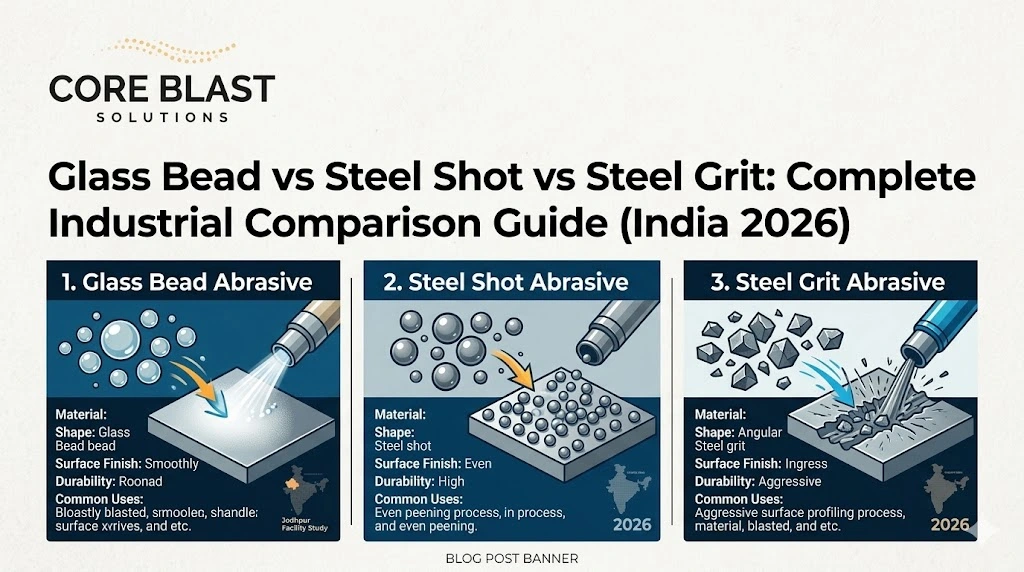
👉 Unlike angular abrasives, glass beads peen rather than cut, resulting in a smooth finish.
📏 Glass Bead Sizes (Mesh Chart)
| Mesh Size | Micron Range | Application |
|---|---|---|
| 40–70 | 400–600 µm | Heavy cleaning |
| 70–100 | 200–400 µm | General blasting |
| 100–170 | 100–200 µm | Fine finishing |
| 170–325 | 50–100 µm | Polishing |
👉 Smaller beads = smoother finish
👉 Larger beads = more aggressive cleaning
💰 Cost Efficiency & Reusability
One of the biggest advantages of glass bead abrasives is reusability.
- Can be reused 10–30 times depending on quality
- Lower long-term cost compared to single-use abrasives
- Reduced waste generation
🌱 Environmental & Regulatory Compliance
Glass bead abrasives are considered environmentally safer than traditional media like silica sand.
Key Compliance Points:
- Contain no free crystalline silica
- Compliant with OSHA Respirable Crystalline Silica Standard (29 CFR 1926.1153)
👉 Official source: https://www.osha.gov/silica-crystalline - Made from recycled glass
- Non-toxic and low dust generation
This makes them ideal for industries with strict health and environmental regulations.
🔬 Scientific Insight (Research-Based Understanding)
A study published in Physicochemical Problems of Mineral Processing highlights how glass bead particle morphology changes during blasting, affecting performance and lifecycle.
👉 This reinforces why high-quality beads (like those from Coreblastsolutions) provide better consistency and longer reuse cycles.
🇮🇳 Glass Bead Abrasives in India (Market Insight)
India—especially Delhi NCR, Gujarat, and Maharashtra—has seen growing demand for:
- Automotive component finishing
- Steel fabrication
- Export-quality surface treatment
Choosing the right supplier involves:
- Consistent mesh size
- High purity glass
- Bulk availability
⚠️ Safety Guidelines
While glass beads are safer than silica sand, proper precautions are still necessary:
- Use PPE (gloves, goggles, respirators)
- Ensure proper ventilation
- Avoid dust accumulation
- Follow OSHA and local safety norms
❓ Frequently Asked Questions (AEO Optimized)
1. What is glass bead blasting used for?
Cleaning, polishing, deburring, and surface finishing of metals and components.
2. Does glass bead blasting remove rust?
Yes, it removes rust gently without damaging the base metal.
3. Can glass beads be reused?
Yes, typically 10–30 cycles depending on quality.
4. Is glass bead blasting better than sandblasting?
Yes, for precision work—it is safer and produces a smoother finish.
5. What surface finish does it produce?
A uniform satin or matte finish.
6. What PSI is used for blasting?
Typically 30–100 PSI, depending on application.
📢 Why Choose Coreblastsolutions?
At Coreblastsolutions (Delhi, India), we provide:
- High-purity glass bead abrasives
- Consistent mesh grading
- Industrial-grade quality
- Bulk supply with reliable logistics
🏁 Conclusion
Glass bead abrasives are a modern, efficient, and environmentally safer solution for surface treatment. Their ability to clean, polish, and finish without damaging the substrate makes them indispensable in today’s manufacturing ecosystem.
If your goal is precision + surface quality + cost efficiency, glass beads are the right choice.