In the electronics sector, “contamination” is measured in parts per billion. The primary challenge is preparing surfaces—typically Oxygen-Free Copper, FR-4, and Gold-Plated Ceramics—without introducing metallic ions that cause electrical shorts or “dendritic growth” over time.
1. The Physics of Surface Energy and Adhesion
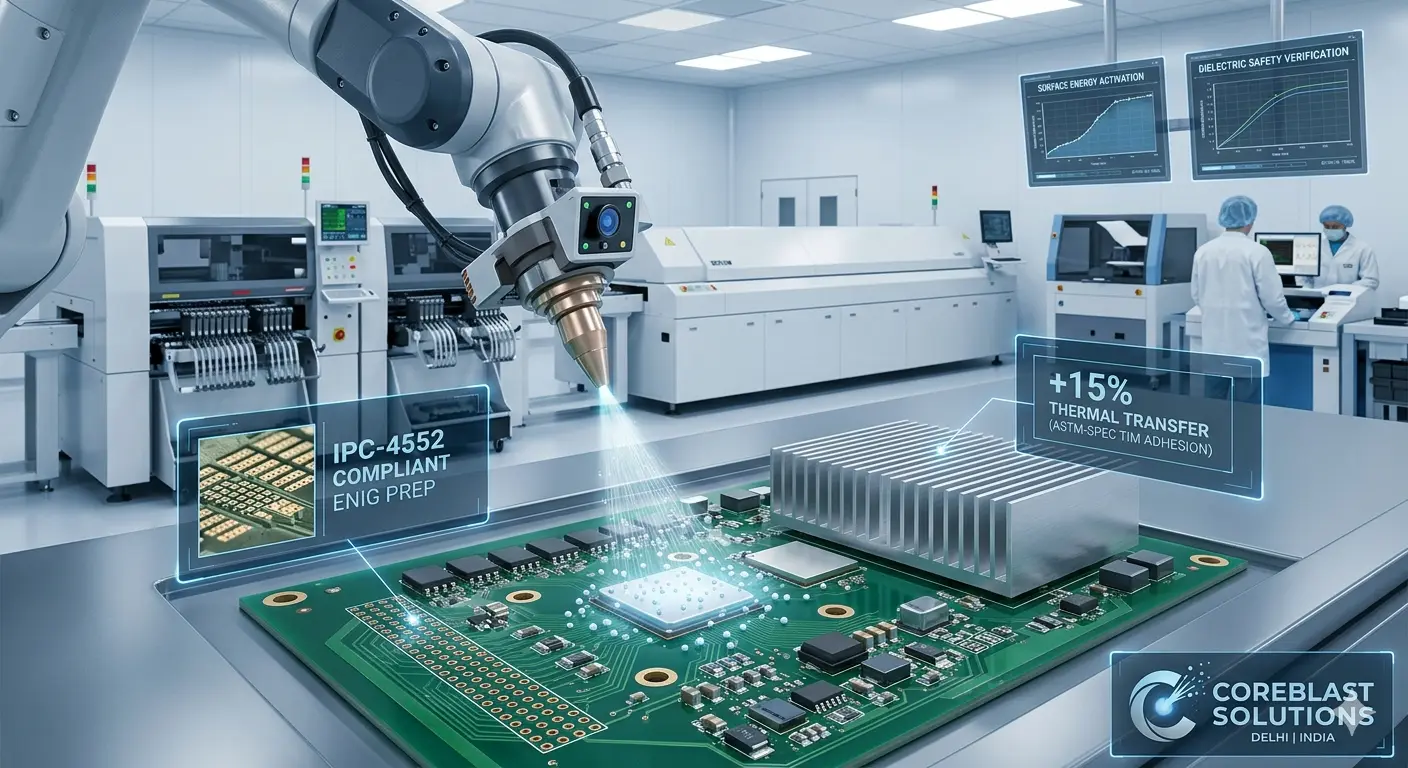
In precision manufacturing, we prioritize Surface Activation. According to the IPC-4552 standards for electroless nickel/immersion gold (ENIG), the surface must be chemically pure and topographically uniform to ensure a robust solder joint.
- Controlled Microporosity: Glass beads at the micro-scale (typically 20–50 µm) create a uniform, “peaked” surface topography. This increases the total surface area, which significantly improves the Peel Strength of adhesives and conformal coatings as defined by ASTM D3359.
- Removal of Burrs and Flash: Precision-molded plastic connectors often have “flash” (excess material). Micro-blasting removes this flash without altering the critical 0.1 mm tolerances required for high-speed data pins.
2. Technical Grade Selection for Electronics
When working with delicate electronics, the “Media Breakdown Rate” is critical; shattered glass creates dust that can clog micro-vias.
| Application Category | Target Material | Recommended Grade | Industry Standard |
| SMT Solder Pad Prep | Copper / Gold | AF Grade (Ultra-Fine) | IPC-A-610 (Acceptability) |
| Heat Sink Adhesion | Aluminum 6061 | AC / AD Grade | MIL-STD-883 (Microcircuits) |
| Connector De-flashing | LCP / PBT Plastics | Micro-Beads (<30µm) | ISO 9001 Quality Specs |
| Semiconductor Dies | Silicon / Ceramic | Nanobeads | SEMI E10 (Equipment Reliability) |
3. High-Performance Applications in 2026
A. Thermal Interface Material (TIM) Optimization
With the rise of high-power AI chips and 5G/6G infrastructure, managing heat is the number one priority. Research in the Journal of Electronic Packaging confirms that bead-blasted aluminum heat sinks provide a 12-15% improvement in thermal transfer compared to untreated surfaces. The satin finish creates more “contact points” for thermal paste, eliminating air pockets that act as insulators.
B. Conformal Coating Adhesion (MIL-I-46058C)
In aerospace and military electronics, boards are coated in resin to prevent moisture ingress. If the surface is too smooth, the coating “delaminates” or peels. Micro-bead blasting provides the mechanical “anchor” required to meet MIL-I-46058C standards, ensuring the board remains functional in extreme humidity or salt-spray environments.
C. Aesthetic Finishing for Consumer Electronics
For premium smartphones and laptops, the “Hand Feel” or haptic quality is dictated by the bead-blast profile. By utilizing specific grades of spherical glass, manufacturers achieve a consistent, fingerprint-resistant matte finish that feels smooth yet provides a high-end, diffused metallic look.
Why are glass beads safer than Alumina (Aluminum Oxide) for PCBs?
Alumina is a conductive mineral residue. If particles remain on a high-density board, they can cause electrical leakage or shorts between fine-pitch pins. Glass beads are dielectric (non-conductive) and chemically inert, making them the safer choice for sensitive circuitry as per IPC-TM-650.
Does micro-blasting affect the “Planarity” of solder pads?
When executed at controlled pressures (20-30 PSI), micro-blasting preserves the planarity of pads while removing oxides. This is essential for Ball Grid Array (BGA) assembly where even a 5-micron deviation can lead to “Open” solder joints.
About the Author
Senior Precision Manufacturing Consultant, Coreblast Solutions Specializing in micro-abrasive workflows and ESD-safe surface preparation, our author has over 15 years of experience serving the Electronics Manufacturing Services (EMS) hubs in Noida and Gurugram. Based in Delhi, Coreblast Solutions provides the ultra-fine, technical-grade media required for the next generation of Indian-made electronics.