Surface preparation is the single most important factor affecting the performance of any coating system. According to industry research, over 80% of coating failures are attributed to poor surface prep. To mitigate this risk, global authorities have established rigorous standards for both the process (cleanliness) and the media (abrasives).
1. India: The BIS Framework (Bureau of Indian Standards)
In the Indian domestic market, the Bureau of Indian Standards (BIS) defines the quality parameters for abrasives used in our foundries and workshops.
- IS 9139:1979: This is the core specification for Glass Beads used for cleaning and peening. It dictates chemical composition and roundness.
- IS 12187 / IS 12138: These govern the production and grading of Steel Shots and Steel Grit, ensuring that the media provides consistent kinetic energy transfer during high-volume blasting.
- IS 1477 (Part 1): The code of practice for the preparation of ferrous metal surfaces prior to painting.
2. United States: The AMPP (SSPC & NACE) Standards
The U.S. standards, managed by the Association for Materials Protection and Performance (AMPP), are the most cited globally in the oil, gas, and aerospace sectors.
- SSPC-SP 10 / NACE No. 2: Known as Near-White Metal Blast Cleaning, this is the “gold standard” for high-performance coatings in corrosive environments.
- MIL-S-13165C: Although a military spec, it remains a global benchmark for Shot Peening intensity and media quality in the automotive and defense sectors.
- ASTM D4940: The primary test method for determining the presence of water-soluble ionic contamination (salts) in abrasives—a critical check for preventing osmotic blistering.
3. Europe & International: The ISO 8501 Series
The International Organization for Standardization (ISO) provides the most comprehensive technical breakdown of surface topography and cleanliness.
- ISO 8501-1: The visual assessment of surface cleanliness. This standard introduces the “Sa” levels (Sa 1, Sa 2, Sa 2.5, Sa 3) that are now ubiquitous in Indian engineering tenders.
- ISO 8503: This defines the surface roughness (profile) characteristics. It utilizes comparators to categorize surfaces as “Fine,” “Medium,” or “Coarse.”
- ISO 11124 to 11127: A massive suite of standards governing the specifications and test methods for both metallic and non-metallic abrasives.
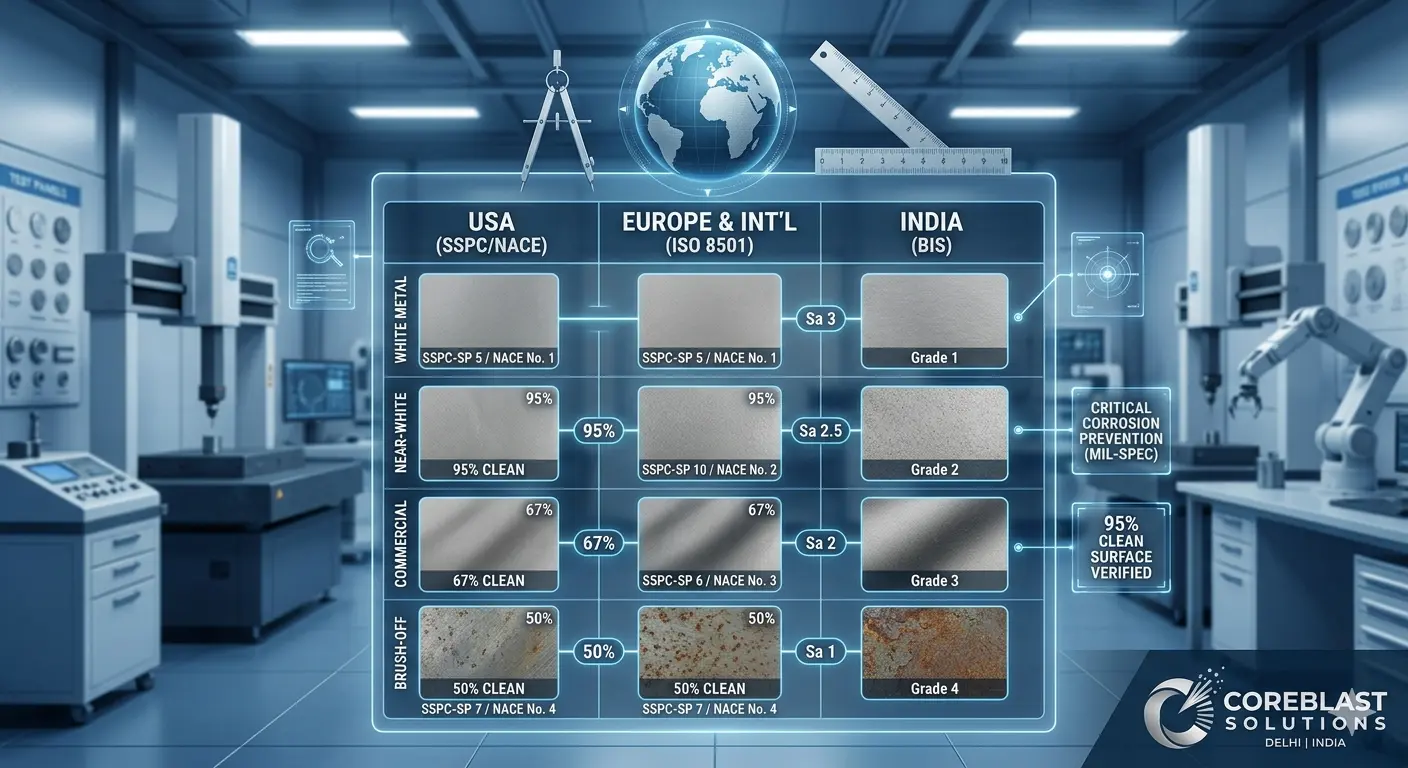
4. The Global Equivalency Table (2026 Reference)
For procurement officers, understanding how these standards overlap is essential for sourcing compatible media.
| Surface Cleanliness | Indian Standard (IS) | USA (SSPC/NACE) | International (ISO) |
| White Metal | Grade 1 | SSPC-SP 5 / NACE 1 | Sa 3 |
| Near-White Metal | Grade 2 | SSPC-SP 10 / NACE 2 | Sa 2.5 |
| Commercial Blast | Grade 3 | SSPC-SP 6 / NACE 3 | Sa 2 |
| Brush-Off Blast | Grade 4 | SSPC-SP 7 / NACE 4 | Sa 1 |
5. Technical FAQ: Standards in Practice
Which standard should I use for exporting parts to the EU?
Use ISO 8501-1. Specifically, ensure your surface reaches an Sa 2.5 cleanliness level, as this is the standard requirement for most European industrial equipment.
How do I verify the “roundness” of my glass beads for aerospace work?
Refer to AMS 2431/6. It requires that a minimum percentage of the beads (usually 85-90%) be true spheres to ensure uniform peening intensity without surface scarring.
Is there an Indian standard for salt contamination in abrasives?
While BIS covers many areas, most Indian labs follow the global ASTM D4940 for conductivity testing to ensure the abrasive won’t cause premature rust-back
About the Author
Technical Director, Coreblast Solutions With 15+ years of expertise in international abrasive trade and surface engineering, our author specializes in aligning Indian manufacturing workflows with ISO and SSPC/NACE standards. Based in Delhi, Coreblast Solutions provides the technical documentation and high-precision media required to help Indian foundries and fabricators compete on the world stage.