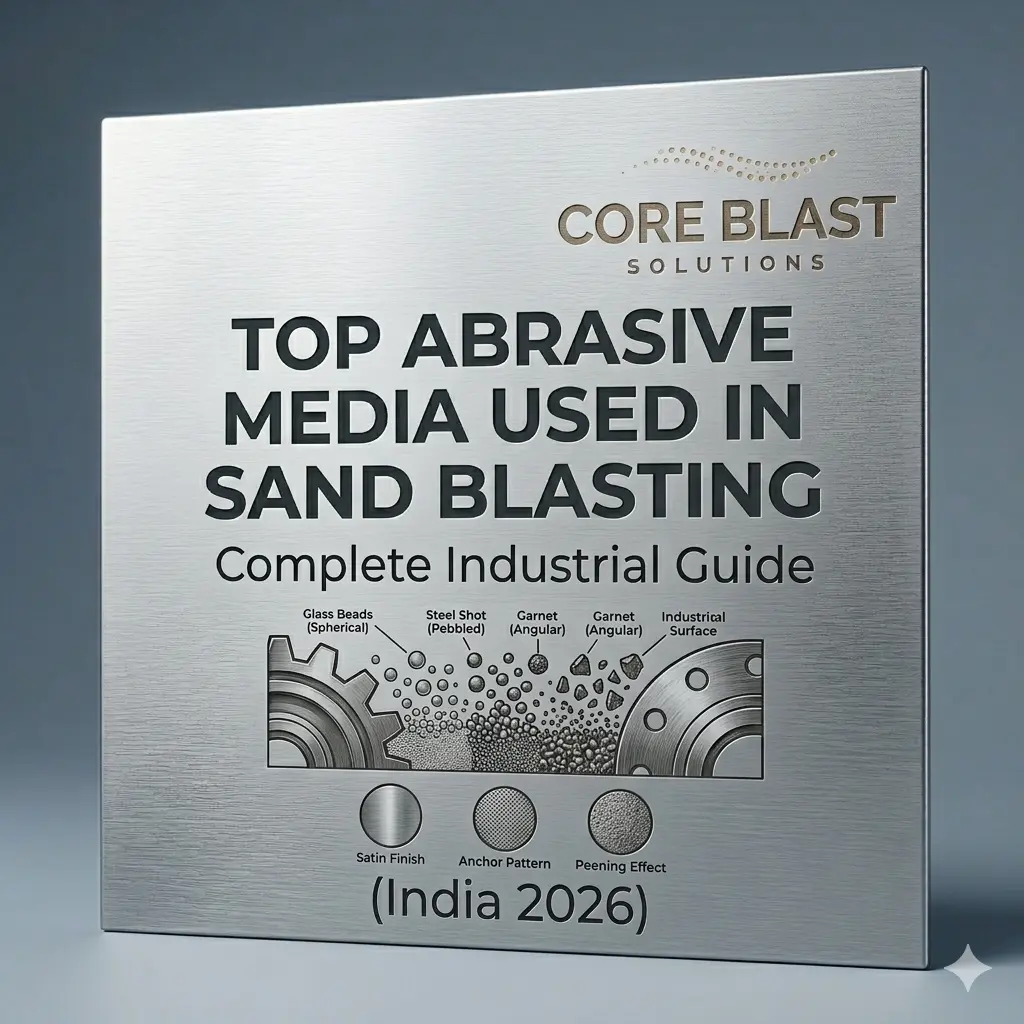
In the world of abrasives, glass beads are unique. Unlike metallic grits that cut, glass beads are designed to “peen” and “polish” without removing base material. To ensure this performance is consistent across the Indian subcontinent, the Bureau of Indian Standards (BIS) has developed a suite of codes that govern everything from chemical purity to the precise diameter of the microbead.
1. The Core Benchmark: IS 9139:1979
The primary standard governing our industry is IS 9139: Specification for Glass Beads for Cleaning and Peening. This document sets the mandatory threshold for industrial-grade beads.
Chemical Purity
Under IS 9139, beads must be manufactured from high-grade Soda-Lime glass. The standard ensures the silica content is high enough to remain chemically inert. This is critical for the Indian pharmaceutical and food processing sectors, where “ferrous contamination” can lead to localized rusting and regulatory failure.
Physical Morphology (The “Roundness” Factor)
A bead that isn’t round isn’t an abrasive; it’s a tiny knife. IS 9139 mandates a high percentage of true spheres. For cleaning applications, a minimum of 70–80% roundness is required. For precision peening, where consistent compressive stress is needed, the roundness requirements are even stricter to prevent surface scarring.
2. Road Safety & Retro-Reflectivity: IS 4306
While Coreblast Solutions focuses on industrial blasting, the Indian infrastructure boom of 2026 relies heavily on IS 4306: Specification for Gloss Beads for Road Marking Paints.
Unlike blasting beads, these are engineered for optics. They must have a Refractive Index of ≥ 1.50 to ensure that light from a vehicle’s headlights reflects back to the driver. While they look identical to the naked eye, using road-marking beads for industrial blasting is a common technical error that can lead to poor surface finishes due to different hardness levels.
3. Dimensional Accuracy: IS 460 (Part 1)
In India, we don’t just “guess” the size of a bead. Every grade we supply at Coreblast is measured using sieves that comply with IS 460: Specification for Test Sieves. Whether you are looking for a fine 50-micron powder or a coarse 800-micron peening media, IS 460 provides the metrological foundation that ensures your blast settings remain consistent batch after batch.
4. Technical Summary Table (IS 9139 Standards)
For procurement managers and QC engineers, these are the verified Indian data points for compliant glass beads:
| Property | IS 9139 Requirement | Why it Matters |
| Material | Soda-Lime Glass | Ensures zero metallic contamination. |
| Hardness | 40 – 50 HRC | Cleans without eroding the base metal. |
| Specific Gravity | 2.45 – 2.55 g/cm³ | Dictates the impact energy (Kinetic force). |
| Appearance | Clear & Transparent | Proves the absence of air bubbles (which cause bead shattering). |
5. Frequently Asked Questions (BIS Compliance)
Can I use Indian IS 9139 beads for US-spec Aerospace work?
While IS 9139 is technically robust, aerospace contracts often explicitly cite the American MIL-PRF-9954D. However, a high-quality IS 9139 bead often meets the chemical and physical requirements of the MIL-spec, provided it has been batch-tested for “roundness” and “broken particle count.”
Where can I download the official Indian Standards?
You can search for and purchase the latest versions of these standards directly from the BIS Standards Portal.
Does BIS regulate “Lead Content” in glass beads?
Yes. Under modern RoHS compliance (Central Pollution Control Board) and BIS guidelines, industrial glass beads must be lead-free to ensure worker safety and environmental protection during disposal.
Q: Does Coreblast Solutions provide a Certificate of Analysis (CoA) and MSDS for every batch?
Yes. Under the Globally Harmonized System (GHS) and Indian MSIHC Rules (1989), we provide a comprehensive Material Safety Data Sheet (MSDS) and a batch-specific Certificate of Analysis. These documents verify chemical composition, lead-free status, and adherence to IS 9139 physical parameters, ensuring your facility remains compliant during safety audits
Are your glass beads compliant with EU REACH and RoHS 3 directives?
Absolutely. As of 2026, our soda-lime glass beads are manufactured to be lead-free and do not contain substances of very high concern (SVHC) exceeding 0.1% by weight. This ensures that any components treated with our media can be legally exported to the European Union and the United States without violating REACH or RoHS environmental protocols.
Does the use of glass beads contribute to “Silicosis” risks under occupational health laws?
Unlike sandblasting with silica sand (which is strictly regulated/banned in many jurisdictions due to free silica), glass beads are manufactured from pre-fused glass. This means they contain no free crystalline silica, significantly reducing the legal and health risks associated with Silicosis, provided standard PPE and dust collection are utilized as per OSHA and DGMS guidelines.
How does glass bead blasting affect the fatigue life of high-strength alloys?
According to the principles of Shot Peening as defined in SAE AMS2431, the impact of spherical glass beads induces a layer of compressive residual stress on the component’s surface. This layer effectively halts the propagation of microscopic fatigue cracks. However, if the media contains “broken particles” (angular shards), it can introduce “surface notches” that act as stress concentrators, potentially reducing the fatigue life of aerospace or automotive components.
What is the risk of “Hydrogen Embrittlement” during the cleaning process?
Unlike chemical pickling or acid descaling, glass bead blasting is a mechanical, “dry” process. It eliminates the risk of hydrogen absorption into the metal lattice, which is a critical failure mode for high-tensile steel fasteners (Grade 10.9 or 12.9) under ASTM F519. Mechanical cleaning is the preferred regulatory path for avoiding embrittlement in safety-critical hardware.
Does the silica in glass beads pose a risk of “Free Silica” exposure?
No. There is a critical legal and chemical distinction between Crystalline Silica (found in sand) and Amorphous Silica (found in glass beads). Glass beads are manufactured by melting soda-lime glass, which converts the silica into a non-crystalline, amorphous state. Consequently, glass bead blasting does not fall under the strict prohibitive regulations applied to “sandblasting” by OSHA 29 CFR 1910.1000 or the Indian Factories Act, 1948.
How is “Ferrous Contamination” measured on stainless steel surfaces?
Post-blasting, surfaces intended for pharmaceutical or food contact should be tested according to ASTM A380 (Standard Practice for Cleaning, Descaling, and Passivation). A common method is the Ferroxyl Test, where a chemical reagent detects free iron. The use of “Virgin” Soda-Lime glass beads ensures that the surface remains free of iron particles, preventing localized galvanic corrosion (pitting).
What is the significance of the “Roundness” specification in industrial tenders?
Roundness is governed by MIL-PRF-9954D and IS 9139. Legally, the “Roundness” percentage determines the uniformity of the surface finish. If a batch falls below the specified percentage (e.g., <80% rounds), the blasting becomes abrasive (cutting) rather than peening (impact). This can lead to the rejection of parts during a Quality Assurance (QA) audit if the surface roughness (Ra) exceeds the engineering tolerance.
How are abrasive “Sieve Sizes” reconciled across different regions?
Sieve sizes are standardized globally through ISO 3310 and in India through IS 460. When a specification calls for a “US Mesh” vs. a “Micron” size, it refers to the nominal aperture of the wire cloth. Maintaining a calibrated sieve analysis is a legal requirement for ISO 9001-certified manufacturing units to ensure process repeatability.
What is the technical significance of the “Media Breakdown Rate” in process auditing?
In high-precision manufacturing, the breakdown rate of glass beads is a critical quality metric. As beads shatter into angular fragments, the process transitions from Peening to Erosion. According to SAE J444, a consistent percentage of round particles must be maintained to ensure the repeatability of the surface finish. Legally, failing to monitor media consistency can lead to “non-conformance” reports (NCRs) during aerospace or medical audits, as the resulting surface roughness ($Ra$) will deviate from the validated engineering specification.
How is “Almen Intensity” used to legally validate a blasting process?
Under SAE J442, Almen strips are the primary tool for measuring the kinetic energy delivered by the blast stream. By measuring the “arc height” of the strip after exposure, engineers can provide a forensic, physical proof of the compressive stress applied to a batch of parts. In the event of a structural failure, Almen test records serve as the legal “defensible data” proving that the surface was treated according to the required peening intensity.
How does “Cross-Substrate Contamination” impact product liability?
If a batch of glass beads is used to clean carbon steel and then reused on titanium or stainless steel, microscopic iron particles can become “smeared” into the noble metal surface. This triggers Galvanic Corrosion under ASTM G82. From a legal standpoint, if a medical implant or aerospace component fails due to such corrosion, the absence of a “Virgin Media” protocol or dedicated abrasive streams can be cited as a failure in Good Manufacturing Practice (GMP).
What are the traceability requirements for abrasives in 2026?
Modern quality systems like ISO 9001:2015 and AS9100D require full traceability from the raw material to the end-user. This means every bag of beads should be traceable to a specific production melt and sieve analysis report. This “Traceability Chain” is essential for Root Cause Analysis (RCA) if a defect is discovered post-distribution, allowing the manufacturer to isolate and recall specific batches.
Does “Spent Media” requires a Toxicity Characteristic Leaching Procedure (TCLP) test?
Yes. While virgin glass is non-toxic, the “spent” (used) media captures the dust of whatever it was cleaning. If you are blasting chrome-plated parts or nickel alloys, the dust may contain Hexavalent Chromium or Nickel Dust, both of which are regulated under the Hazardous Waste Management Rules (2016). Legally, the industrial unit must perform a TCLP test to determine if the waste must be disposed of at a TSDF (Treatment, Storage, and Disposal Facility).
How do “Dust Extraction” standards relate to worker safety laws?
Blast cabinets must maintain a specific air-change rate to ensure that the operator’s exposure to “nuisance dust” remains below the Threshold Limit Value (TLV) set by ACGIH and the Directorate General Factory Advice Service & Labour Institutes (DGFASLI) in India. Failure to provide validated dust collection systems can result in legal penalties under the Factories Act, regardless of whether the media itself is non-toxic