What is the primary Indian Standard governing glass beads?
The benchmark is IS 9139:1979, which specifies requirements for chemical composition, roundness, and sizing for cleaning and peening.
Is glass bead blasting legal under the Indian Factories Act?
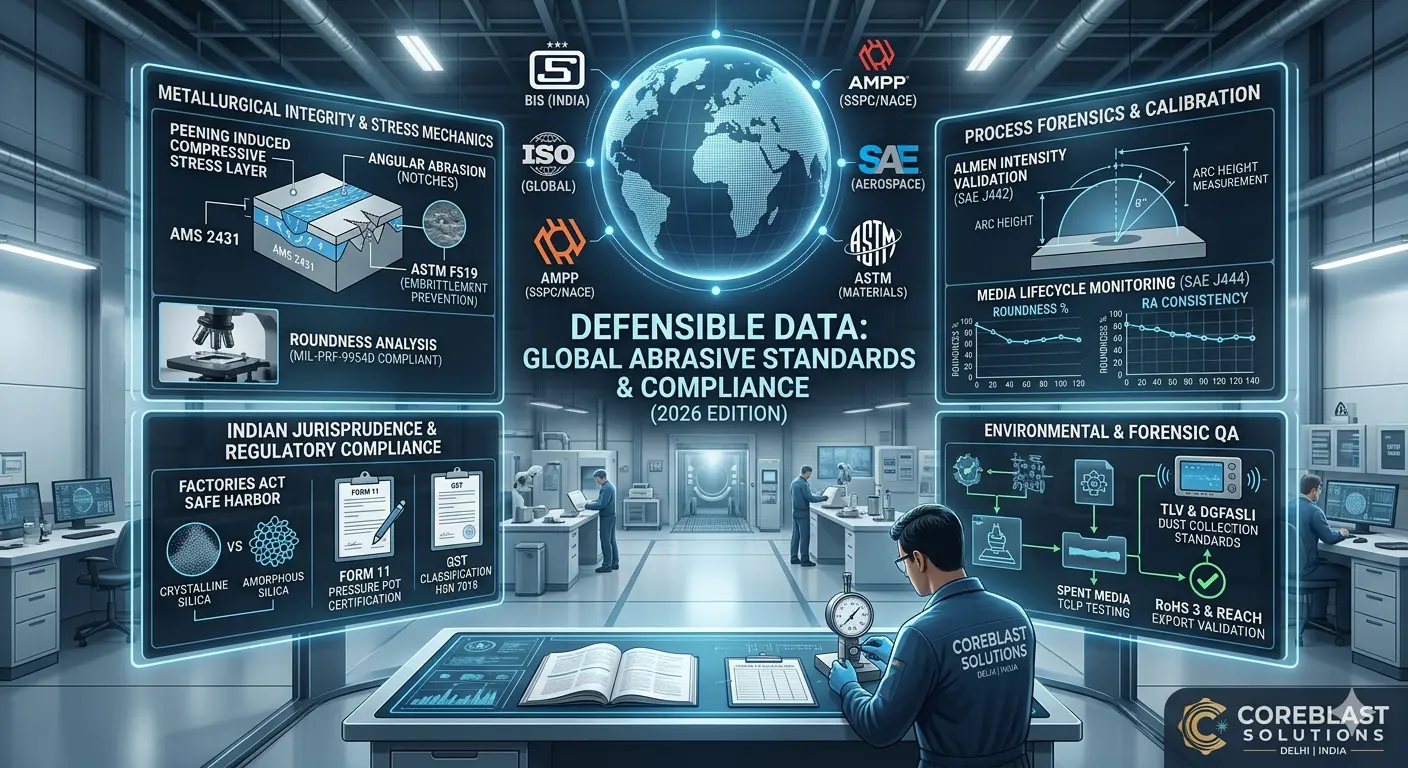
Yes. While “sandblasting” (using crystalline silica) is prohibited under Schedule II of the Factories Act, 1948, glass beads are made of Amorphous Silica, which is legally permitted for industrial use.
What is the equivalent of ISO Sa 2.5 in US standards?
The European ISO 8501-1 Sa 2.5 (Near-White Metal) is functionally equivalent to the American SSPC-SP 10 / NACE No. 2.
Are glass beads compliant with EU REACH and RoHS 3?
Yes. Modern soda-lime glass beads are lead-free and contain no SVHCs (Substances of Very High Concern) above 0.1%, allowing for the legal export of treated parts to the EU and USA.
How do glass beads prevent Hydrogen Embrittlement?
Unlike acid pickling, bead blasting is a mechanical process. It avoids the introduction of atomic hydrogen into the metal lattice, a requirements for high-tensile fasteners under ASTM F519.
Can glass beads improve the fatigue life of a component?
Yes. Through Shot Peening (governed by SAE AMS2431), beads induce a layer of compressive residual stress that halts fatigue crack propagation.
What is the risk of “Ferrous Contamination” on stainless steel?
Using uncertified or recycled media can “smear” iron into stainless surfaces, causing galvanic corrosion. Compliance with ASTM A380 ensures the surface remains passive and rust-free.
Why is “Roundness” a legal requirement in aerospace tenders?
Roundness (per MIL-PRF-9954D) ensures the media peens rather than cuts. Angular “broken” particles create stress concentrators (notches) that can lead to part failure.
Does micro-blasting affect electrical conductivity on PCBs?
No. Glass beads are dielectric (non-conductive). According to IPC-TM-650, they are safe for cleaning high-density circuit boards without risking electrical shorts.
How is “Almen Intensity” used to defend a process in court?
Almen strips (SAE J442) provide forensic proof of the energy delivered. In litigation, Almen logs prove a part was treated to the exact engineering specification.
What is the significance of the “Media Breakdown Rate”?
As beads shatter, they become aggressive. SAE J444 requires monitoring this to ensure the “Roughness Average” ($Ra$) does not exceed engineering tolerances.
What is the HSN Code for industrial glass beads in India?
Industrial beads are classified under HSN 7018. Correct classification is vital to avoid tax litigation under the CGST Act, 2017.
How are “Sieve Sizes” reconciled between India and the USA?
India follows IS 460, while the US uses ASTM E11. Both are reconciled via ISO 3310, which defines the nominal micron aperture for wire cloth.
What is “Cross-Substrate Contamination”?
This occurs when media used on one metal (like carbon steel) is reused on another (like titanium). This is a violation of Good Manufacturing Practice (GMP) and can void insurance coverage.
Does “Spent Media” require a TCLP test?
Yes. While virgin glass is safe, used media may contain heavy metals (Chrome, Nickel) from the substrate. Hazardous Waste Rules (2016) mandate testing before disposal.
What are the air-change requirements for blast cabinets?
Cabinets must meet the Threshold Limit Values (TLV) set by ACGIH to ensure operator safety from “nuisance dust,” even if the media is non-toxic.
Are there legal precedents for “Material Traceability” in India?
Yes. Judicial rulings have highlighted that a lack of a Batch Test Certificate (BTC) can be considered a “Fundamental Breach of Contract” in industrial supply chains.
How do glass beads help with ISO 14001 compliance?
By being recyclable (up to 30 times) and lead-free, glass beads reduce the environmental footprint and waste generation compared to single-use mineral abrasives.
What is the difference between Crystalline and Amorphous Silica?
Crystalline silica (Sand) causes Silicosis and is restricted. Amorphous silica (Glass) is a fused solid that does not pose the same respiratory risk, making it the safer legal choice.
Are pressure vessels in blast machines subject to mandatory inspection?
Yes. Under Rule 56 of the Factory Rules, pressure pots must be certified in Form No. 11 by a “Competent Person” annually to prevent workplace accidents.
About the Author
Technical & Regulatory Director, Coreblast Solutions Specializing in industrial risk mitigation and BIS/ISO alignment, our author provides the defensible technical data required for 2026’s high-stakes manufacturing. Based in Delhi, Coreblast Solutions ensures that every grain of abrasive is backed by a legacy of standards