In the high-intensity environments of foundry operations and heavy metal fabrication, the surface treatment stage is often the bottleneck between a raw casting and a market-ready product. For 2026, the industry is shifting away from aggressive, high-loss abrasives toward precision media that balance surface integrity with operational cost.
In my 15 years of observing floor operations, I’ve seen that the most successful foundries are those that stop treating “cleaning” as a chore and start treating it as a metallurgical refinement. For high-value castings—particularly those in Ductile Iron, Manganese Steel, and Aluminium Alloys—Glass Bead Blasting and Steel Shot/Grit combinations are the industry benchmarks for achieving SA 2.5 or SA 3.0 cleanliness levels.
1. The Engineering of Casting Cleanup: Beyond the Sand
When a component leaves the mold, it is often plagued by “Burn-on” sand, sintering, and heat scale. The challenge in fabrication is removing these contaminants without rounding off the sharp “as-cast” edges or affecting the critical tolerances of machined faces.
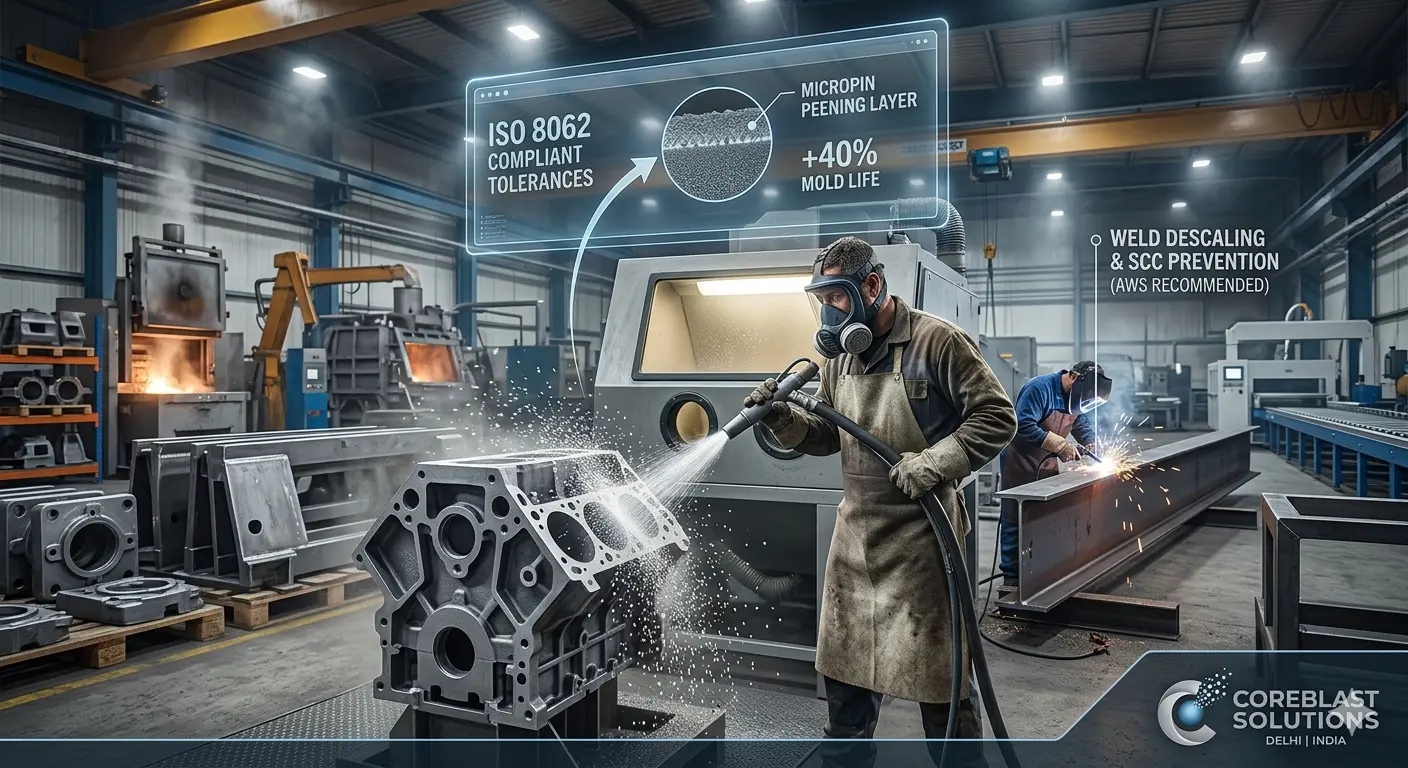
- Dimensional Integrity: According to ISO 8062 (Dimensional and Geometrical Tolerances for Castings), maintaining the structural geometry of a part during the finishing stage is critical. Glass beads are ideal here because they clean via impact rather than abrasion, satisfying the “Non-Destructive” requirement for precision-engineered components.
- Surface Hardening (Work Hardening): Research in the International Journal of Metalcasting suggests that spherical media blasting introduces a uniform layer of compressive stress on the casting skin. This helps mitigate the risk of Hot Tearing and surface porosity during the cooling phase.
2. Technical Grade Selection for Fabricators
Modern fabrication shops must select media based on the desired “Anchor Pattern” for subsequent painting, powder coating, or galvanizing.
| Application | Material | Recommended Media | Industry Standard |
| Precision Die Castings | Aluminium / Zinc | AH Grade Glass Beads | VDI 3400 (Surface Texture) |
| Heavy Structural Steel | Carbon Steel | Steel Shot / Grit Blend | SSPC-SP10 / NACE No. 2 |
| Stainless Fabrication | 304/316 Stainless | AC Grade Glass Beads | ASTM A380 (Passivation Prep) |
| Molds & Dies | Tool Steel | Fine Glass Beads | ISO 1302 (Nominal Roughness) |
3. High-Value Applications in 2026
A. Surface Preparation for Powder Coating
In metal fabrication, the longevity of a powder coat depends on the interfacial adhesion. Glass bead blasting provides a “Satin” surface topography that increases the surface area for the polymer to bond to, without creating the deep “peaks” that can lead to pinhole corrosion in harsher angular-blasted surfaces.
B. Descaling and Stress Relieving of Welds
Welding introduces high thermal stress and localized oxidation (Heat Tint). Using glass beads on stainless steel weldments effectively removes the oxide layer and “peens” the weld bead. This process, as referenced in AWS (American Welding Society) standards, helps prevent Stress Corrosion Cracking (SCC) in the Heat-Affected Zone (HAZ).
C. Mold and Die Cleaning
Foundry molds and extrusion dies represent massive capital investments. Cleaning them with aggressive sand can alter the mold’s dimensions over time. Glass beads effectively remove “release agent” buildup and carbon deposits without eroding the tool steel, extending the life of the mold by up to 40%.
About the Author
Senior Industrial Abrasive Consultant, Coreblast Solutions With a 15-year career spanning across North Indian industrial corridors—from Faridabad to Ludhiana—our author is an expert in streamlining foundry finishing lines. Based in Delhi, Coreblast Solutions provides the technical expertise and high-performance media required to meet the high-volume, zero-defect demands of 2026 metal fabrication.
Why should fabricators choose Glass Beads over Garnet for stainless steel?
Garnet is an angular mineral that can leave “embedded” particles in the surface. In 2026, the industry preference is Glass Beads because they are chemically inert and spherical, ensuring no ferrous or mineral contamination remains to trigger “Tea Staining” (localized rusting) on the stainless steel.
Does bead blasting satisfy the SA 2.5 “Near White Metal” standard?
Yes. Glass beads can achieve SA 2.5 and SA 3.0 (as per ISO 8501-1) by effectively removing all visible shadows and contaminants, leaving a uniform, bright metallic finish.
How does media roundness affect foundry costs?
High-roundness beads (like those supplied by Coreblast Solutions) break down much slower than cheaper, irregular beads. This reduces the “Breakdown Rate”, meaning you spend less on replacement media and generate less dust in the workspace.