As of 2026, the transition toward advanced biopharmaceuticals and patient-specific implants has made surface preparation a non-negotiable engineering step. Unlike heavy industrial blasting, which focuses on material removal, healthcare-grade blasting focuses on Kinetic Energy Transfer to refine the metal’s surface without compromising its chemical purity or dimensional integrity.
1. The Physics of the “Hygienic Surface”
The primary threat in pharmaceutical and medical environments is the formation of Biofilms. Research in the Journal of Materials Science demonstrates a direct correlation between surface roughness (Ra) and the risk of microbial attachment.
Traditional angular abrasives (like alumina or garnet) “cut” into the metal, creating microscopic “valleys.” Bacteria, which typically range from 1 to 2 µm in size, can “hide” in these crevices, effectively shielding themselves from high-velocity CIP (Clean-In-Place) fluids.
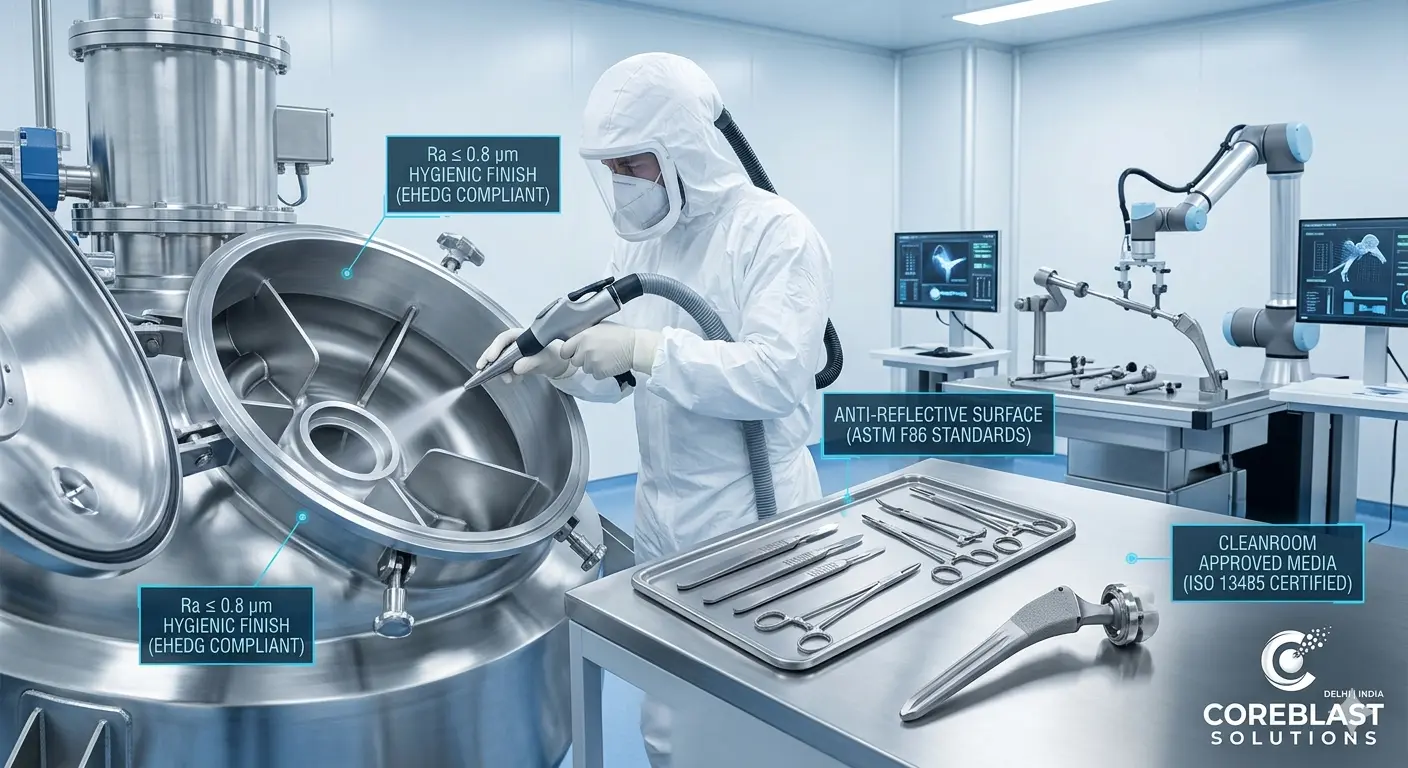
Glass beads, being perfectly spherical, utilize a peening action. They strike the surface to “flatten” microscopic peaks and “shallow” the valleys. According to EHEDG (European Hygienic Engineering & Design Group) and 3-A Sanitary Standards, surfaces in contact with sterile products should ideally have a roughness of Ra ≤ 0.8 µm. Glass bead blasting is the most efficient mechanical method to achieve this threshold, providing a uniform, non-directional “satin” finish that facilitates 100% effective sterilization.
2. Advanced Standards & Material Compliance
To pass a regulatory audit (FDA or CE), the media must be “Virgin Grade” to prevent cross-contamination from non-sterile materials.
| Application Category | Substrate | Target Finish | Technical Reference |
| Surgical Instruments | Stainless Steel (400 Series) | Non-Glare Satin | ASTM F86 (Surface Preparation) |
| Orthopedic Implants | Ti6Al4V-ELI | Controlled Roughness | ISO 5832-3 (Titanium Implants) |
| Bioprocessing Vessels | 316L Stainless Steel | Ra < 0.8 µm | ASME BPE (SF1 – SF3) |
| Lab-on-a-Chip Devices | Borosilicate / PMMA | Precision Etch | ISO 10993 (Biocompatibility) |
3. Critical Applications in Modern Medicine
A. Osteointegration & Implant Topography
For orthopedic implants like hip stems or dental anchors, the surface must be “moderately rough” (Sa 1.0–2.0 µm) to promote bone-forming cell response, a process known as Osteointegration.
A 2025 study in the Journal of Manufacturing and Materials Processing highlights that glass bead blasting successfully removes partially melted particles from Additively Manufactured (3D Printed) Titanium while maintaining the precise geometry required for surgical fit.
B. Anti-Reflective Surgical Instrumentation
In modern operating rooms (OR) using high-intensity LED lighting and robotic cameras, glint and glare from surgical tools can disrupt visual precision. Glass bead blasting provides a diffuse-reflective surface that meets the safety requirements for laparoscopic and robotic surgery tools, ensuring surgeons maintain focus without optical interference.
C. Bio-Purity in Pharmaceutical Mixers
In pharmaceutical fermentation and mixing, “Rouge” (a form of rouge-colored iron oxide) is a recurring contamination risk. Mechanical cleaning with glass beads effectively removes rouge without stripping the underlying Chromium-Enriched Passive Layer. This is vital for maintaining compliance with USP <1097> (Bulk Pharmaceutical Excipients) and ensuring the longevity of high-cost 316L stainless steel hardware.
Why is glass preferred over other media for ISO 13485 environments?
Glass beads are made from soda-lime glass, which is chemically inert and non-reactive. Unlike metallic abrasives, they do not leave “Ferrous Residue,” which can cause localized galvanic corrosion and compromise the sterility of a cleanroom (ISO Class 5-8).
Does bead blasting satisfy the ASME BPE “SF” designations?
Bead blasting is typically used to achieve SF1, SF2, or SF3 (mechanical polish) designations. For the smoothest SF4 finish, bead blasting acts as the critical preparatory step before final electropolishing.
Can glass bead blasting improve the fatigue life of medical implants?
Yes. According to SAE AMS 2431, the peening effect of spherical glass beads induces a layer of Compressive Residual Stress. This layer prevents the initiation of fatigue cracks in high-load components like artificial knee joints.
About the Author
Senior Regulatory & Technical Consultant, Coreblast Solutions With over 15 years of focus on ISO 13485 and ASME BPE compliance, our author specializes in optimizing surface finishing for the North Indian pharmaceutical and medical device manufacturing sector. Based in Delhi, Coreblast Solutions provides “Virgin-Grade” glass beads and technical consulting to ensure that every surface meets the zero-failure standards of modern medicine.