

Commercial Grade Brown Fused Alumina (BFA) • Pan-India Dispatch
Commercial Grade Aluminium Oxide Abrasive (Brown Fused Alumina)
A high-density, sharp angular synthetic mineral abrasive engineered for aggressive corrosion descaling, heavy mill-scale stripping, and cutting deep mechanical anchor tooth profiles (Rz profile: 45 to 75 microns) on carbon steel, cast iron, and structural fabrication. With an exceptional Mohs hardness of 9.0 (approx. 2000 HV), it cuts significantly faster than garnet or copper slag while maintaining continuous micro-fracturing recyclability (8 to 10+ passes in recovery systems).
•
✓ 94.5% to 96.5% Alumina Content
•
✓ 8 to 10+ Multi-Cycle Passes
•
✓ EN 10204 Type 3.1 MTC Certified
•
✓ Pan-India Regional Warehouses
⚡ Razor-Sharp Cutting Speed (Sa 2.5 / Sa 3)
Blocky, razor-sharp angular grain geometry breaks through stubborn hot-rolled mill scale, thick baked marine epoxy coats, and dense rust layers in half the cycle time required by rounded silica or soft slag media.
🎯 Deep Mechanical Anchor Tooth (Rz Profile)
Cuts a uniform, jagged mechanical anchor tooth profile (Rz 45 to 75+ microns) into steel surfaces, ensuring maximum adhesive peel strength for heavy-build epoxy primers, thermal spray metallizing, and rubber linings.
🔄 8 to 10+ Multi-Cycle Recyclability
Unlike copper slag or silica sand which shatters into fine dust on initial impact, commercial BFA features a micro-fracturing crystal lattice that resharpens itself during use, delivering 8 to 10+ recirculating cycles in recovery systems.
🛡 Silicosis-Safe & OSHA Compliant
Chemically bound electro-fused matrix containing less than 0.10% free crystalline silica. Meets OSHA 29 CFR 1910.1053 airborne safety thresholds, drastically reducing hazardous dust in enclosed blast rooms.
Engineering Performance Benchmarks & Infographics
Hardness & Surface Etch Velocity
MOHS SCALE
Hardness dictates the mechanical cutting velocity into tough rust and mill scale. Commercial Aluminium Oxide ranks at 9.0 Mohs, surpassed only by silicon carbide and diamond:
Recycle Lifecycle & Waste Reduction
RECOVERY PASSES
Number of reusable blasting passes in recovery systems before grain pulverization. Higher cycles directly reduce total media purchase tonnage and disposal costs:
Metallurgical Specifications & Constants (ASTM C169 / XRF)
| Chemical Formula & Matrix: | Electro-Fused Corundum (Al2O3) • Alpha-Phase Rhombohedral Crystal |
| Aluminium Oxide (Al2O3): | 94.50% to 96.50% (High Hardness Base) |
| Titanium Dioxide (TiO2): | 1.50% to 3.00% (Imparts Impact Toughness) |
| Silicon Dioxide (SiO2): | Max 1.50% (Chemically Bound Matrix) |
| Iron Oxide (Fe2O3): | Max 0.35% |
| Free Crystalline Silica: | Less than 0.10% (OSHA Silicosis-Safe Compliant) |
| Hardness (Mohs / Vickers): | 9.0 Mohs (approx. 2000 to 2050 HV) |
| Specific Gravity: | 3.90 to 4.05 g/cm3 |
| Bulk Density: | 1.65 to 1.95 g/cm3 (Varies by mesh grade) |
| Melting Point: | approx. 2,050 degrees Celsius |
| Grain Shape: | Sharp Angular / Dense Polyhedral Blocky |
| Packaging Format: | 25 kg HDPE Multi-Wall Bags / 1 MT Palletized Bulk Bags |
Standard Mesh Sizing & Surface Anchor Profile (Rz) Matrix
Select your required mesh size based on the thickness of surface rust, existing coating density, and target anchor tooth depth required by your coating specification:
| Mesh Size | Micron Range | Surface Anchor (Rz) | Primary Industrial Application |
|---|---|---|---|
| Mesh 16 / 20 | 850–1180 microns | 75 to 100+ microns | Heavy forge scale, thick rubber lining removal, deep weld root descaling. |
| Mesh 24 / 30 | 600–850 microns | 65 to 85 microns | Marine hull descaling, structural steel girders, bridge rehabilitation. |
| Mesh 36 / 46 (Flagship) | 355–500 microns | 50 to 75 microns | Universal Industry Standard: High-build epoxy primer anchor profile, thermal spray metallizing bond. |
| Mesh 54 / 60 | 250–300 microns | 40 to 55 microns | Toolroom deburring, casting cleaning, investment mold knock-off, automotive engine heads. |
| Mesh 80 / 100 | 150–180 microns | 25 to 40 microns | Thin plate metal descaling, glass decorative frosting, non-destructive surface texturing. |
| Mesh 120 / 150 | 106–125 microns | 15 to 25 microns | Precision electronics texturing, carbide insert cleaning, anodizing matte preparation. |
| Mesh 180 / 220 | 53–75 microns | Under 15 microns | Micro-lapping, optical glass lapping, high-precision deburring on miniature hydraulic components. |
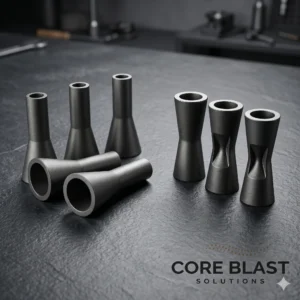
Critical Tooling Notice: Use Sintered Boron Carbide (B4C) Nozzles
Due to the extreme 9.0 Mohs hardness of Aluminium Oxide, standard Tungsten Carbide (TC) nozzle liners wash out rapidly in 20 to 40 blasting hours. When a nozzle throat erodes by just 1.5 mm, compressed air demand surges by 66% to 138%, overloading compressors and dropping cleaning pressure.
We strongly recommend pairing commercial BFA with Sintered Boron Carbide (B4C) Nozzles. B4C resists microhardness wear up to 3,200 HV, delivering 300 to 500+ operating hours (up to 10 times longer) and saving significant electricity costs.
Verified B2B Client Reviews
Verified B2B Purchase
“Exceptional Cutting Speed on Marine Girders”
We switched from single-pass copper slag to Mesh 36 Commercial Aluminium Oxide. The surface cleaning to Sa 2.5 is twice as fast, and the 65-micron anchor profile holds marine epoxy perfectly. Easily recycled 9 passes in our recovery blast room.
Verified B2B Purchase
“Certified MTC and Consistent Mesh Sizing”
Using Mesh 60 for plasma thermal spray preparation on turbine housing components. The angular tooth profile is uniform with zero pan dust fines. Every pallet arrived with EN 10204 3.1 MTC certificates and clean GST billing.
Verified B2B Purchase
“Clean, Low-Dust Blast Room Operation”
The free silica content is strictly under 0.1%, which keeps our enclosed blast room safe and our baghouse dust collector filters from blinding prematurely. Fast delivery from their regional hub.
Frequently Asked Questions (FAQ)
Q1: What is Commercial Grade Aluminium Oxide and how is it synthesized?
Commercial Grade Aluminium Oxide (Brown Fused Alumina / BFA) is synthesized by electro-fusing calcined bauxite, iron borings, and anthracite coal in an electric arc furnace at temperatures exceeding 2,050 degrees Celsius. The resulting crystalline block contains 94.5% to 96.5% Al2O3, with titanium dioxide (1.5% to 3.0%) imparting high toughness that prevents rapid grain shattering.
Q2: How does Brown Fused Alumina compare to White Fused Alumina?
Brown Fused Alumina contains 1.5% to 3.0% titanium dioxide, giving it superior fracture toughness for aggressive structural descaling, heavy rust stripping, and multiple recovery cycles. White Fused Alumina contains 99%+ Al2O3 with virtually zero iron, designed specifically for non-ferrous substrates like titanium implants, aircraft turbine blades, and electronics where zero iron contamination is strictly required.
Q3: How many times can Commercial Grade Aluminium Oxide be recycled?
In a recovery blast cabinet or blast room equipped with an abrasive reclaimer and cyclone separator, commercial BFA recycles 8 to 10+ passes when blasted at 70 to 90 PSI. Its self-sharpening crystal matrix micro-fractures to maintain sharp cutting edges rather than disintegrating into dust like slag media.
Q4: Which blast nozzle liner is recommended for Aluminium Oxide?
Due to the extreme 9.0 Mohs hardness of Aluminium Oxide, standard Tungsten Carbide (TC) liners wash out in 20 to 40 hours. Sintered Boron Carbide (B4C) nozzles are strongly recommended, lasting 300 to 500+ hours (up to 10 times longer) and saving compressor electricity by maintaining a calibrated orifice diameter.
Q5: Is Commercial Aluminium Oxide silicosis-safe?
Yes. Commercial Grade Aluminium Oxide contains less than 0.10% free crystalline silica. It is an electro-fused synthetic mineral conforming to OSHA 29 CFR 1910.1053, eliminating the health risks and regulatory liabilities associated with raw silica sand.
Need Volume Pallet Pricing or Specific Mesh Advice?
Connect directly with our engineering sales desk for lot-specific EN 10204 Type 3.1 MTC certificates, freight estimates from regional hubs, and proforma invoicing.


Reviews
There are no reviews yet.