Global Abrasive Blasting Industry Intelligence Brief:
Regulatory, Financial & Technological Shifts
// Executive Summary
The global abrasive blasting and industrial surface preparation market is experiencing a profound transition. What was historically treated as an uncalibrated, commodity-driven cleaning task has developed into an engineered, tightly controlled metallurgical process governed by three converging forces:
Aggressive enforcement of $50\ \mu\text{g/m}^3$ exposure thresholds and heavy-metal leachate scrutiny on single-pass slags.
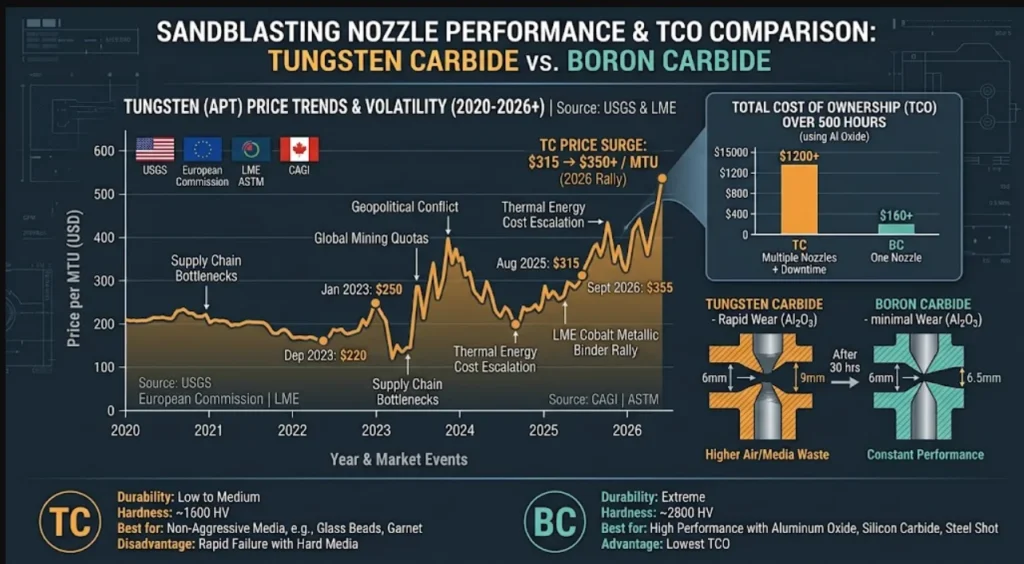
Strategic mineral quotas driving 45%–75% price hikes on Tungsten Carbide tooling, accelerating the switch to Boron Carbide ($B_4C$).
High-throughput crawler automation in maritime yards alongside surge demand for iron-free media in electric vehicle battery trays.
Financial & Market Valuation Trends (2026–2035)
Current Global Media Valuation
Independent industrial forecasts indicate the global abrasive blasting media sector is projected to reach $19.9 billion by 2034–2035, expanding at a compound annual growth rate (CAGR of 7.4%).
Annual Steel Surface Refurbishment
Industrial asset maintenance and preventive infrastructure protection expenditure has increased by 18%–22% globally. Abrasive blasting and corrosion profiling now capture approximately 18% of total plant refurbishment capex.
The Asia-Pacific (APAC) region controls more than 50% of worldwide media consumption. This concentration is driven by commercial shipbuilding in major coastal shipyards, large-scale highway and railway bridge fabrication, and precision electric vehicle (EV) automotive manufacturing hubs.
Market Share by Product Segment:
- Volume Leaders: High-Carbon Cast Steel Grit and Cast Steel Shot retain the highest tonnage volume share, maintaining dominance across enclosed centrifugal wheel-blast systems, heavy foundry casting descaling, and structural steel girder preparation.
- Growth Velocity Leaders: High-purity Micro Soda-Lime Glass Beads and Virgin Fused Aluminium Oxide represent the fastest-growing media segments by value, propelled by rapid growth in precision non-ferrous manufacturing (aerospace turbine MRO, titanium medical implants, and structural aluminum EV battery enclosures).
Regulatory & Environmental Compliance Shifts
⚖️ Zero-Tolerance Enforcement on Respirable Crystalline Silica
While statutory prohibitions on raw silica sand have existed in the United Kingdom and across Europe for decades, occupational health bodies worldwide have intensified compliance actions. Under standards enforced by the United States Occupational Safety and Health Administration (OSHA 29 CFR 1910.1053 / 1926.1153) and documented by the National Institute for Occupational Safety and Health (NIOSH), industrial employers face strict limits:
Operating with raw, unrefined silica sand now triggers mandatory written exposure control protocols, physical air-wash decontamination, continuous personal air monitoring, and multi-year health surveillance records. To eliminate liability and ensure worker safety, commercial fabricators and blast contractors have largely shifted to certified non-silica media alternatives ($< 0.05\%$ free crystalline silica), such as micro soda-lime glass beads, almandine garnet, and synthetic minerals.
🧪 Scrutiny on Single-Pass Expendable Slags & Heavy-Metal Leachates
Environmental regulators, including directives under the US Environmental Protection Agency (EPA) Resource Conservation and Recovery Act (RCRA), have significantly tightened testing on spent blast abrasives. Traditional single-pass metallurgical byproducts—specifically copper slag, coal slag, and nickel slag—are facing increased scrutiny under Toxicity Characteristic Leaching Procedure (TCLP) testing due to trace leachable heavy metals:
The Recyclable Media Mandate: Because spent slag that fails TCLP testing must be disposed of as hazardous solid waste—often carrying transportation tariffs exceeding $180–$320 per metric ton—manufacturing facilities are transitioning to closed-loop, recyclable media systems. Utilizing cast steel grit or engineered micro glass beads capable of 25 to 500+ recycling passes reduces total solid waste disposal volume by up to 85% and significantly curtails transport fees.
🏙️ Metropolitan Dust Suppression & “Vapor / Wet” Containment Directives
Municipal clean-air mandates across major industrial zones strictly restrict open-air dry sandblasting. Civil bridge painting, commercial building restoration, and marine port maintenance projects must now achieve a 60% to 70% reduction in visible airborne particulate dust. This shift has accelerated the adoption of negative-pressure containment curtains, shrouded vacuum-assisted blasting tools, and vapor abrasive blasting (wet blasting) systems that encapsulate abrasive grains in water droplets upon discharge.
Supply Chain & Critical Mineral Dynamics
The Tungsten Carbide (APT) Pricing Squeeze
Tungsten ($W$) remains tightly controlled under sovereign mining caps and is categorized as a critical defense mineral by the USGS Mineral Commodity Summaries and the European Commission Critical Raw Materials Act.
Spot prices for Ammonium Paratungstate (APT) rallied past $350+/MTU, amplified by high carburization energy tariffs and cobalt binder volatility. This has triggered a 45% to 75% pricing surge in finished Tungsten Carbide (TC) nozzles, forcing blast operators to transition to sintered Boron Carbide ($B_4C$) liners that deliver 5× to 10× longer wear life.
Electric Arc Tariffs & Fused Alumina Pressures
Manufacturing virgin fused mineral abrasives (such as White Alumina and Brown Fused Aluminium Oxide) requires high-temperature electric arc furnaces operating above 2,000°C.
Surging base industrial electricity tariffs have driven upward pressure on virgin mineral prices. Consequently, manufacturing facilities are fine-tuning cyclonic abrasive air-wash separators and media recovery classifiers to prevent reusable coarse abrasive grains from being drawn prematurely into dust collectors.
Technology & End-User Industry Developments
🤖 Robotics and AI Automation in Shipyards and Large-Scale Steel
Shortages of certified sandblasting operators, combined with rigorous maritime safety regulations regarding confined space entry, have driven major maritime shipyards to deploy magnetic crawlers, autonomous mobile robotics, and AI-guided robotic blast arms. Standardized under guidelines from the Association for Materials Protection and Performance (AMPP) and ISO 8501-1, automated blast systems account for roughly 58% of new high-throughput facility upgrades. These robotic platforms maintain strict surface profile uniformity ($R_z > 75\ \mu\text{m}$) while removing personnel from high-hazard vessel hulls and ballast tanks.
🔋 Electric Vehicle (EV) Battery Enclosures & Non-Conductive Media
The rapid expansion of electric vehicle manufacturing has created a high-value niche for specialized abrasive blasting consumables:
- Die-Cast Battery Enclosures: High-precision texturing of cast aluminum battery boxes and inverter housings is necessary to maximize the shear bonding strength of structural polyurethane adhesives and thermal interface materials (TIM).
- Ferrous Contamination Immunity: These assemblies require strictly 100% iron-free, non-conductive media (such as high-sphericity soda-lime glass beads with $< 0.1\%\ \text{Fe}_2\text{O}_3$ or virgin white alumina). Metallic residues can induce bimetallic galvanic pitting or release conductive debris that risks bridging high-voltage electrical packs.
🪖 Continuous-Flow PPE & Automated Micro-Metering Pots
Next-generation Type CE positive-pressure blast helmets now incorporate real-time carbon monoxide (CO) telemetry, ambient temperature conditioning, and acoustic dampening (Noise Reduction Rating $\text{NRR} > 25\ \text{dB}$) to satisfy occupational safety standards in enclosed work bays. Simultaneously, modern pressurized blast pots increasingly utilize digital micro-metering abrasive valves that eliminate operator over-choking—cutting hourly abrasive consumption by 15% to 20% while maintaining standard cleaning rates ($\text{ISO Sa 2.5}$).
Strategic Decision Matrix for Plant Superintendents & Purchasers
| Operational Domain | Industry Challenge / Regulatory Mandate | Recommended Strategic Action |
|---|---|---|
| Silica & Slag Compliance | Strict OSHA $50\ \mu\text{g/m}^3$ PEL enforcement; escalating hazardous waste transport tariffs for spent single-pass slag. | Standardize on certified non-silica media ($< 0.05\%$ free silica) and recyclable systems (MTC-verified micro glass beads and cast steel grit). |
| Blast Tooling & Energy | Tungsten Carbide prices surging 45%–75%; orifice bore erosion exponentially drives up compressor CFM demand ($Q \propto d^2$). | Upgrade high-wear blast stations to Sintered Boron Carbide ($B_4C$) venturi nozzles; gauge nozzle throats weekly with mechanical drill gauges. |
| High-Tech & EV Substrates | Growth in EV battery boxes and titanium medical texturing requires non-conductive, biocompatible surfaces. | Procure certified iron-free ($< 0.1\%\ \text{Fe}_2\text{O}_3$) high-sphericity ($\ge 80\%$) micro glass beads and virgin white fused alumina. |
| Plant Operations & Labor | Manual blasting technician shortages and stringent confined space safety regulations in ship hulls. | Adopt portable vacuum-recovery blasting units, negative-pressure dust curtains, and modular robotic crawlers. |
Frequently Asked Questions (FAQ)
Why are regulatory agencies enforcing zero-tolerance policies on silica sand?
Inhaling respirable crystalline silica causes irreversible silicosis, lung cancer, and chronic obstructive pulmonary disease (COPD). Regulators like US OSHA enforce a $50\ \mu\text{g/m}^3$ Permissible Exposure Limit (PEL) and a $25\ \mu\text{g/m}^3$ Action Level. Traditional silica sand fractures easily upon impact, producing dense clouds of sub-micron particles, whereas non-silica alternatives (such as micro soda-lime glass beads, garnet, and synthetic fused alumina) contain less than 0.05% free crystalline silica.
What environmental hazards are driving workshops away from expendable slag abrasives?
Traditional expendable slags, such as copper slag and nickel slag, frequently contain trace quantities of hazardous heavy metals, including arsenic, beryllium, lead, and cadmium. Tightening environmental protection leachate standards (such as TCLP testing under EPA RCRA guidelines) classify spent single-pass slag as potential hazardous waste, driving up hazardous disposal tariffs and prompting a transition toward closed-loop recyclable media.
Why is the price of Tungsten Carbide blast nozzles escalating across global markets?
Tungsten is designated as a critical strategic mineral subject to sovereign export quotas and concentrated refining capacity. Spot prices for Ammonium Paratungstate (APT)—the precursor for cemented tungsten carbide—have climbed significantly. Concurrently, high-temperature sintering electricity costs and cobalt binder price volatility have increased finished nozzle costs by 45% to 75%.
Why does electric vehicle (EV) battery manufacturing require non-ferrous, non-conductive blasting media?
Cast aluminum battery enclosures, inverter modules, and cooling trays require surface texturing for structural adhesive bonding and thermal management coatings. Blasting with ferrous media leaves embedded metallic iron particles that induce bimetallic galvanic corrosion and release conductive dust, which can bridge sensitive high-voltage circuits and cause electrical short circuits.
Upgrade Your Plant’s Media & Tooling Compliance
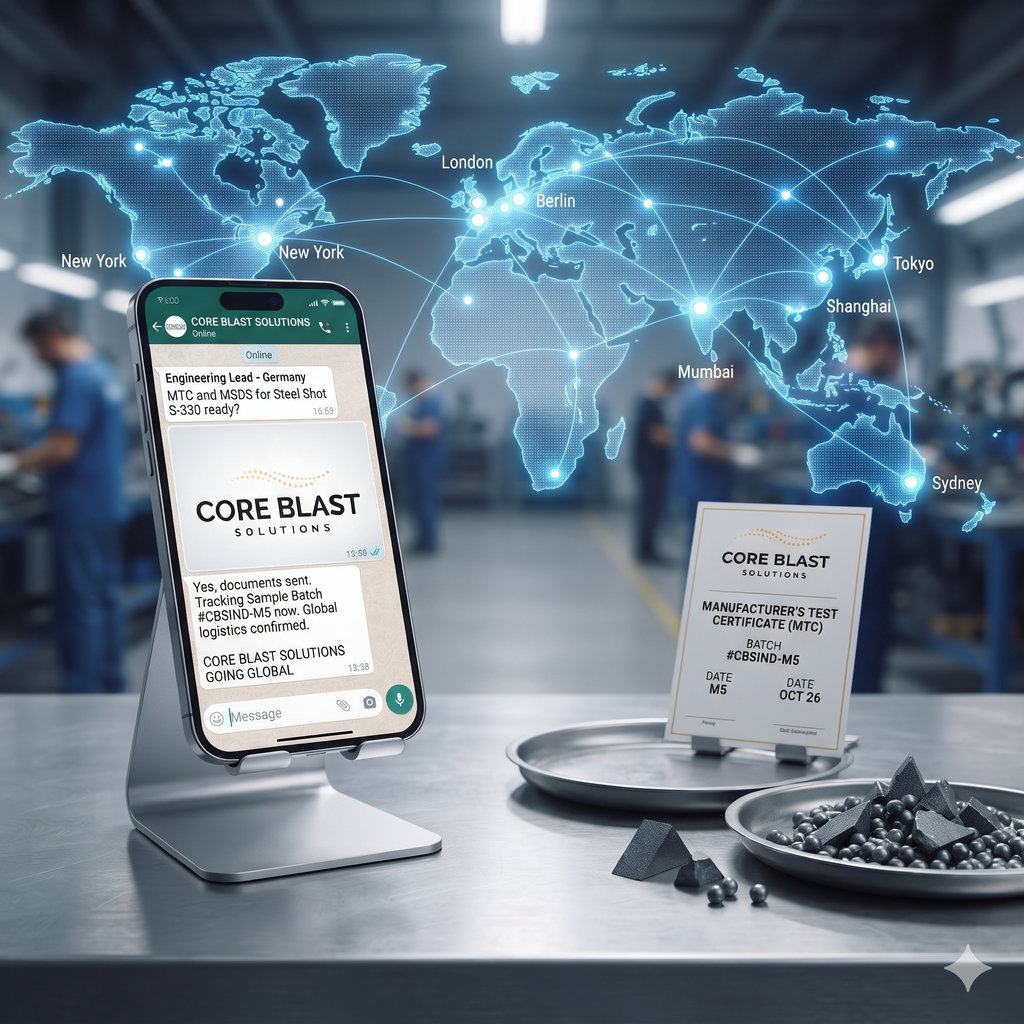
Core Blast Solutions manufactures and supplies certified industrial surface preparation consumables engineered for zero substrate dimensional loss ($0.000\text{ mm}$ erosion), low dust generation, and compliance with global safety standards.