

Why Tungsten Carbide Nozzle Prices Are Surging: The Engineering & Economic Case for Boron Carbide (B4C)
In industrial surface preparation, ship overhaul, structural steel fabrication, and foundry operations, the blast nozzle is the critical mechanical choke point where pneumatic energy converts into abrasive velocity. Yet across global supply chains, plant managers and procurement superintendents face an escalating challenge: the rapid, compounding price inflation of Tungsten Carbide (WC-Co) blast nozzles.
1. Macro Factors: Why Tungsten Carbide (TC) Prices Are Escalating
The price climb of Tungsten Carbide nozzles is not an isolated distributor markup. It is driven by systemic, global upstream pressures across the metallurgical supply chain. Buyers who treat TC liners as cheap, disposable consumables are discovering that escalating raw material costs are eroding shop-floor profit margins.
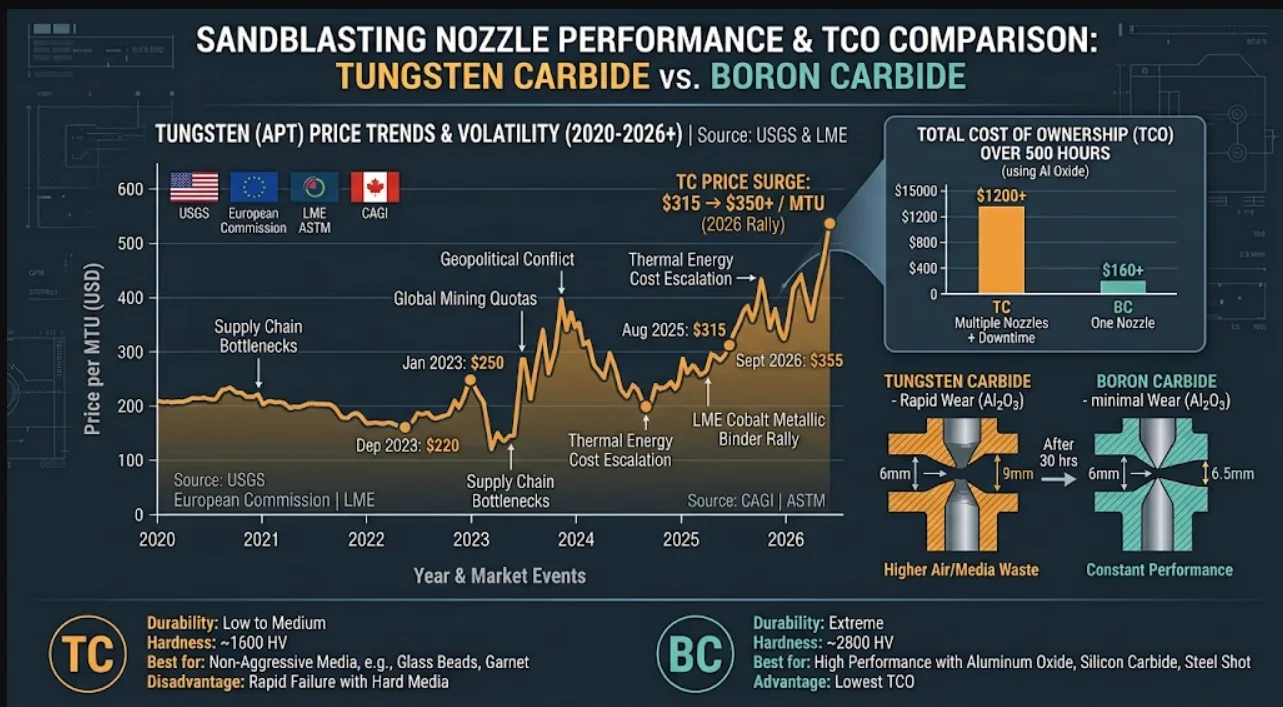
A. Strategic Mineral Quotas & Ammonium Paratungstate (APT) Inflation
Tungsten (W) is classified internationally as a critical strategic raw material due to its irreplaceable role in defense armor-piercing munitions, aerospace ballistics, and heavy CNC cutting tooling. According to the United States Geological Survey (USGS) Mineral Commodity Summaries for Tungsten, global tungsten mine production and refining capacity remain heavily concentrated, with single-nation dominance accounting for over 80% of refined global output.
Strict sovereign mining quotas, aggressive environmental audits, and export controls on raw Wolframite and Scheelite ores have restricted the availability of Ammonium Paratungstate (APT)—the primary chemical intermediate needed to synthesize pure tungsten carbide powder. Under the European Commission Critical Raw Materials Act, tungsten maintains a high supply-risk index, causing European and Asian APT spot pricing to rally significantly over recent quarters.
B. Energy-Intensive Sintering & Carburization
Synthesizing cemented carbide requires reacting sub-micron tungsten with carbon black inside hydrogen-atmosphere induction furnaces at temperatures between 1,400°C and 1,600°C. Rising industrial energy rates across key manufacturing regions have substantially pushed up the conversion processing cost per kilogram of sintered tungsten carbide.
C. Cobalt Binder Volatility
Cemented tungsten carbide is not pure tungsten; it relies on a metallic Cobalt (Co) binder (typically 6% to 12%) to cement the brittle tungsten grains together. Surging battery-sector demand for cobalt, tracked on the London Metal Exchange (LME), coupled with stringent supply-chain auditing, continues to inject pricing volatility into raw binder stock.
2. The Mechanics of Nozzle Failure: Why TC Wears Out Prematurely
To understand why rising TC prices damage workshop economics, we must analyze the physical degradation mechanisms occurring inside a blast nozzle throat under dynamic two-phase flow.
When accelerated abrasive particles pass through a Venturi restriction at velocities exceeding v ≈ 200 m/s (~720 km/h), standard cemented carbide fails through a two-step wear process:
- Binder Micro-Leaching & Scouring: Angular, sharp mineral abrasives (such as Fused White Alumina or Almandine Garnet) are harder than the ductile cobalt binder. The abrasive micro-gouges and washes out the metallic cobalt matrix first.
- Grain Pullout: Deprived of their binder matrix, unsupported tungsten carbide crystals break free from the liner body and are swept away in the supersonic air stream, causing rapid bore enlargement (throat flare).
The Service Life Reality Across Media Types
Under continuous industrial blasting conditions, the lifespan of standard Tungsten Carbide depends heavily on the abrasive media’s hardness, standardized in accordance with ASTM E384 Microhardness Testing Standards:
| Abrasive Media Type | Media Hardness (Mohs / HV) | Typical TC Liner Lifespan | Typical B4C Liner Lifespan | Relative Advantage |
|---|---|---|---|---|
| Micro Soda-Lime Glass Beads | 5.5–6.0 Mohs (500–550 HV) | 300–400 hours | 600–800 hours | 2× Longer |
| High-Carbon Cast Steel Shot | 6.0–6.5 Mohs (400–510 HV) | 300–400 hours | 500–750 hours | 1.5×–2× Longer |
| Almandine Garnet | 7.5–8.0 Mohs (1,100–1,300 HV) | 80–120 hours | 400–600 hours | 5× Longer |
| Virgin Fused Aluminium Oxide | 9.0 Mohs (≈ 2,000 HV) | 20–40 hours Critical Failure | 300–500 hours | 10×–12× Longer |
| Silicon Carbide (SiC) | 9.5 Mohs (≈ 2,500 HV) | 10–20 hours Rapid Washout | 200–350 hours | 15×–20× Longer |
When blasting with aggressive mineral media like Aluminium Oxide, a standard Tungsten Carbide nozzle washes out in just a few production shifts. Continuing to pay higher prices for TC nozzles that fail within 30 hours is unsustainable.
3. The Hidden Cost: How a Worn Nozzle Overburdens Your Air Compressor
The purchase price of a nozzle is small compared to the cost of the compressed air needed to operate it.
As established by fluid orifice mechanics and documented in technical engineering guidelines by the Compressed Air and Gas Institute (CAGI), the volumetric airflow (Q) demanded by a discharge nozzle scales directly with the square of its throat diameter (d):
When an abrasive stream wears a nozzle throat open by just 1.5 mm (1/16″), air consumption escalates rapidly:
The Triad of Losses from Running Worn TC Nozzles:
- Compressor Pressure Drop: If your plant’s rotary screw compressor cannot deliver the extra CFM demanded by an enlarged bore, delivery pressure at the nozzle drops from 100 PSI down to 70 PSI.
- Productivity Plummets: Cleaning productivity is non-linear; empirical blast testing proves that every 1 PSI drop in nozzle pressure causes a 1.5% loss in surface cleaning production. Blasting at 70 PSI instead of 100 PSI reduces square-meter output by 45%, doubling labor hours.
- Surging Energy Utility Bills: A compressor running continuously fully loaded to feed an oversized, worn orifice burns thousands of excess kilowatt-hours (kWh) in electricity every month.
4. Enter Boron Carbide (B4C): The Technical Superiority of “Black Diamond”
Boron Carbide (B4C) is an advanced structural ceramic synthesized by carbothermal reduction of boron oxide (B2O3) with pure carbon in an electric arc furnace at temperatures exceeding 2,000°C. It is recognized across materials science as the third hardest material known to engineering, surpassed only by diamond and cubic boron nitride (cBN).
Why Boron Carbide Outperforms Tungsten Carbide:
- Extreme Indentation Hardness (2,800–3,200 HV): Boron Carbide’s microhardness is roughly double that of cemented tungsten carbide. Fused white aluminium oxide (2,000 HV) simply cannot scratch or indent a hot-isostatically pressed B4C crystal matrix.
- Monolithic Ceramic Matrix (Zero Cobalt Binder): Unlike cemented carbides, Boron Carbide is a single-phase, binderless sintered ceramic. There is no soft metallic cobalt binder to leach away. Wear occurs only through gradual atomic erosion, keeping the throat diameter stable for hundreds of operating hours.
- Venturi Geometry Preservation: Because the internal convergent-divergent geometry remains intact, the nozzle maintains uniform supersonic particle distribution (v ≈ 200 m/s), ensuring consistent blasting speeds and anchor profile depths (Rz).
5. Head-to-Head Comparison: Tungsten Carbide vs. Boron Carbide
| Property / Metric | Tungsten Carbide (WC-Co) | Boron Carbide (B4C) | Advantage |
|---|---|---|---|
| Chemical Matrix | WC + Co Metallic Binder (6%–10%) | B4C (Monolithic, Binder-Free) | B4C Wins |
| Vickers Hardness (HV30) | 1,400–1,600 HV | 2,800–3,200 HV | 2× Harder |
| Mohs Scratch Hardness | 9.0 Mohs | 9.3–9.5 Mohs | B4C Wins |
| Material Density (ρ) | ≈ 14.5 to 15.0 g/cm³ | ≈ 2.45 to 2.52 g/cm³ | 6× Lighter |
| Weight (No. 5 Long Venturi) | ≈ 950–1,100 grams | ≈ 280–340 grams | 70% Less Mass |
| Fracture Toughness (KIC) | 9–12 MPa·m1/2 (High impact toughness) | 3–4 MPa·m1/2 (Brittle ceramic core) | TC Tougher |
| Drop / Knock Protection | Standard Aluminum Casing | Armored Aluminum + Polyurethane Buffer | Neutralized |
| Lifespan (Alumina / Garnet) | 20 to 100 Hours | 300 to 600 Hours | Up to 10× |
| Lifespan (Steel Shot / Beads) | 300 to 400 Hours | 500 to 800 Hours | 2× Longer |
| Operating Cost per Hour | High & Surging (Rapid replacement) | Lowest in Industry | Up to 80% Less |
6. The Ergonomic Advantage: Cutting Nozzle Weight by 70%
A rarely considered factor in workshop safety and square-meter output is operator fatigue.
Tungsten is a heavy metal, with a density approaching that of lead. A standard long-venturi Tungsten Carbide nozzle with a contractor thread encased in steel or thick brass weighs between 1.0 and 1.2 kg.
When an operator holds a blast hose under 100 PSI thrust for an 8-hour shift, handling that front-heavy weight causes severe forearm and shoulder strain. As fatigue sets in, operators drop their lance, leading to uneven standoff distances and irregular anchor profiles.
In contrast, Boron Carbide has a density of only ≈ 2.52 g/cm³—virtually identical to common glass. A modern armored Boron Carbide nozzle with an anodized aluminum jacket weighs under 320 grams.
This 70% to 75% weight reduction delivers better lance control, consistent sweeping motions, and higher operator productivity across long shifts.
7. Total Cost of Ownership (TCO): The Mathematical Proof
While Boron Carbide nozzles carry a higher upfront purchase ticket than Tungsten Carbide, evaluating tooling on a Cost-Per-Operating-Hour basis demonstrates that Boron Carbide is far more economical.
Consider an active industrial blast facility operating 500 hours annually using Fused Aluminium Oxide:
500-Hour Operational Cost Model (Aluminium Oxide Blasting)
Option A: Standard Tungsten Carbide (TC)
- Liner Service Lifespan: ~35 Hours
- Nozzles Consumed in 500 Hrs: 14 Units
- Unit Purchase Cost: $50.00 / Unit
- Direct Tooling Cost: $700.00
- Extra Compressor Power (Bore Flare): ~$450.00
- Maintenance Downtime (14 Swaps): ~3.5 Hours
- TOTAL DIRECT OPERATING COST: $1,150.00
Option B: Sintered Boron Carbide (B4C)
- Liner Service Lifespan: ~500 Hours
- Nozzles Consumed in 500 Hrs: 1 Unit
- Unit Purchase Cost: $160.00 / Unit
- Direct Tooling Cost: $160.00
- Extra Compressor Power (Calibrated Bore): $0.00
- Maintenance Downtime: ~15 Minutes
- TOTAL DIRECT OPERATING COST: $160.00
8. Addressing the Brittleness Concern: Modern Armored Composite Housings
Historically, the main objection to Boron Carbide was its brittleness. Pure B4C ceramic has low fracture toughness (KIC ≈ 3–4 MPa·m1/2); if dropped from scaffolding onto a steel floor, an unshielded ceramic core could crack.
Modern precision engineering has resolved this vulnerability through composite armor construction:
│ 1. Heavy-Duty Anodized Aluminum Outer Casing │
│ ┌───────────────────────────────────────────────────┐ │
│ │ 2. Shock-Absorbing Polyurethane / Nitrile Buffer │ │
│ │ ┌─────────────────────────────────────────┐ │ │
│ │ │ 3. Sintered Hot-Isostatically Pressed B4C│ │ │
│ │ │ ===> Supersonic Venturi Throat │ │ │
│ │ └─────────────────────────────────────────┘ │ │
│ └───────────────────────────────────────────────────┘ │
└─────────────────────────────────────────────────────────────┘
- Anodized Aircraft Aluminum Shell: Deflects exterior impacts, drops, and job-site knocks.
- Elastomeric Shock Buffer: A polyurethane or nitrile rubber sleeve isolates the inner ceramic liner, absorbing mechanical shock waves when dropped.
- Integrated Flange Gasket: High-compression rubber seals prevent air bypass and dampen vibrations from the nozzle holder.
This armored composite construction allows modern B4C nozzles to withstand demanding environments in shipyards, bridge scaffolding, and foundries.
9. Technical Orifice Sizing & Compressor Matching Guide (90–100 PSI)
When ordering Boron Carbide nozzles, it is vital to match your nozzle throat diameter with your air compressor’s actual output capacity:
| Nozzle Code | Bore Diameter (mm / Inches) | Airflow @ 90 PSI | Airflow @ 100 PSI | Minimum Compressor HP | Abrasive Flow Rate |
|---|---|---|---|---|---|
| No. 3 | 4.8 mm (3/16″) | 45 CFM | 50 CFM | 10–15 HP | 100–150 kg/hr |
| No. 4 | 6.5 mm (1/4″) | 81 CFM | 90 CFM | 20–25 HP | 200–300 kg/hr |
| No. 5 | 8.0 mm (5/16″) | 137 CFM | 150 CFM | 30–40 HP | 350–450 kg/hr |
| No. 6 | 9.5 mm (3/8″) | 196 CFM | 215 CFM | 50–60 HP | 500–650 kg/hr |
| No. 7 | 11.0 mm (7/16″) | 254 CFM | 280 CFM | 60–75 HP | 700–850 kg/hr |
| No. 8 | 12.7 mm (1/2″) | 338 CFM | 375 CFM | 75–100 HP | 900–1200 kg/hr |
Frequently Asked Questions (FAQ)
1. Contractor Coarse Thread (50 mm / 2″ – 4-1/2 UNC): Mounts directly onto standard nylon or aluminum contractor couplings.
2. Fine Thread (1-1/4″ / 32 mm NPSM): Direct fit for cabinet blast guns and standard industrial nozzle holders.
Upgrade Your Tooling via Our Engineering Desk
Avoid letting rising Tungsten Carbide prices and throat wear erode your production margins. Contact the technical surface engineering team at Core Blast Solutions to calculate your compressor airflow match and upgrade to certified Boron Carbide tooling: