Pneumatic Abrasive Containment Dynamics:
An Epidemiological, Aerodynamic, and Regulatory Analysis of Engineered Blasting Enclosures
Uncontained open-air abrasive blasting represents an extreme intersection of multiphase fluid mechanics, acute occupational toxicology, and off-site ecological contamination. Pneumatically projected abrasives exiting convergent-divergent Venturi nozzles at velocities exceeding $v \approx 200\text{ m/s}$ generate kinetic impacts with metallic substrates, triggering micro-fracturing and liberation of respirable crystalline silica (RCS, $PM_{2.5}$), aerosolized neurotoxic heavy metals ($\text{Pb}, \text{Cr}^{\text{VI}}, \text{Cd}, \text{Be}$), and broadband acoustic shock waves ($115\text{ to }125\text{ dBA}$). This monograph examines the biophysical kinetics of deep-lung alveolar phagocytosis failure, Stokesian atmospheric settling mechanics, negative-pressure differential containment engineering ($\Delta P = -50\text{ to } -125\text{ Pa}$), and provides an exhaustive review of statutory liability frameworks across the United States (OSHA/EPA), the European Union (Directive 2004/37/EC), the United Kingdom (COSHH Schedule 1), and India (Factories Act, 1948 & CPCB Environment Protection Rules).
Cellular Pathology, Particle Kinetics, and Toxicological Deposition
During industrial abrasive impact, the total kinetic energy dissipation ($E_k = \frac{1}{2}mv^2$) generates shockwave fracturing within both the abrasive grain matrix and the brittle surface oxide layers. This mechanically aggressive collision pulverizes macro-scale particles into sub-micron aerosolized particulate matter ($PM_{10}$, $PM_{2.5}$, and $PM_{1.0}$). Without hermetically sealed physical containment, these respirable plumes disperse directly into the operator’s microclimate and the ambient workshop troposphere.
1.1 Aerodynamic Equivalent Diameter ($d_{ae}$) and Pulmonary Deposition Fractions
The physiological site of particulate deposition within the human respiratory tract is dictated by the International Commission on Radiological Protection (ICRP 66) Human Respiratory Tract Model. Particle trajectory is governed by three physical deposition mechanisms: inertial impaction (dominant for $d_{ae} > 5\,\mu\text{m}$), gravitational sedimentation (dominant for $1\,\mu\text{m} \le d_{ae} \le 5\,\mu\text{m}$), and Brownian diffusion (dominant for sub-micron ultrafine particulate $d_{ae} < 0.5\,\mu\text{m}$).
| Respiratory Region | Aerodynamic Cutoff ($d_{ae}$) | Physical Clearance Mechanism | Pathological Consequence (Uncontained Blasting) | Efficacy of Blast Enclosure |
|---|---|---|---|---|
| Extrathoracic (Nasopharyngeal) | $> 10\,\mu\text{m}$ ($PM_{10+}$) | Nasal vibrissae impaction, mucus entrapment, ciliary clearance to pharynx. | Acute rhinitis, mechanical mucosal ulceration, epistaxis, upper airway mechanical obstruction. | 100% Inward Capture ($Q > 100\text{ fpm}$) |
| Tracheobronchial (Conducting Airway) | $2.5\,\mu\text{m} \le d_{ae} \le 10\,\mu\text{m}$ | Mucociliary escalator upward escalation via pseudostratified ciliated columnar cells. | Chronic obstructive bronchitis, severe goblet cell hyperplasia, bronchial mucosal epithelial dysplasia. | > 99.9% Exhaust Filtration (HEPA/PTFE) |
| Pulmonary Alveolar (Gas-Exchange Sacs) | $< 2.5\,\mu\text{m}$ ($PM_{2.5}$ / $PM_{1.0}$) | No cilia present. Phagocytosis strictly dependent upon resident alveolar macrophages. | Macrophage apoptosis, lysosomal membrane permeabilization, irreversible pulmonary nodular fibrosis (Silicosis). | Negative-Pressure Plume Extraction |
1.2 Cellular Pathogenesis of Respirable Crystalline Silica (RCS): The NLRP3 Inflammasome Cascade
When unprocessed river sand or low-grade mineral abrasives fracture under high velocity ($v \ge 200\text{ m/s}$), the crystalline lattice of quartz ($\alpha\text{-SiO}_2$) cleaves, generating freshly fractured silica surfaces loaded with highly reactive, surface-bound free radicals: silicon-based dangling bonds ($\equiv\text{Si}\cdot$) and silicon-peroxyl radicals ($\equiv\text{Si-O-O}\cdot$).
Upon inhalation into the non-ciliated terminal alveolar sacs ($d_{ae} \le 2.5\,\mu\text{m}$), these reactive micro-crystals trigger an irreversible inflammatory cascade:
- Phagocytic Frustration & Lysosomal Rupture: Resident alveolar macrophages engulf the sharp, polygonal silica particles via scavenger receptors. Unable to digest the inorganic crystalline silicate lattice, the engulfed particles mechanically lacerate and destabilize the phagolysosomal membrane, leading to lysosomal membrane permeabilization (LMP).
- NLRP3 Inflammasome Activation: The resulting leakage of hydrolytic enzymes—specifically Cathepsin B—into the macrophage cytosol triggers the assembly and activation of the NLRP3 inflammasome complex.
- Pro-Inflammatory Cytokine Secretion: Cleavage by Caspase-1 results in the hyper-secretion of interleukin-1$\beta$ ($\text{IL-1}\beta$) and tumor necrosis factor-alpha ($\text{TNF-}\alpha$), driving lytic cell death (pyroptosis) of the macrophage and releasing the intact silica crystal back into the alveolar space to perpetuate the cycle.
- Irreversible Fibrogenesis: Hyper-stimulated pulmonary fibroblasts transition into myofibroblasts, overexpressing transforming growth factor-beta 1 ($\text{TGF-}\beta_1$) and depositing dense bundles of Type I and Type III collagen. This forms the classical concentric, hyalinized silicotic nodule, culminating in progressive massive fibrosis (PMF), permanent pulmonary gas diffusion impairment, respiratory failure, and adenocarcinoma.
1.3 Heavy Metal Aerosolization and Systemic Neurotoxicity
Industrial maintenance operations frequently blast structural steel pre-coated with legacy anti-corrosive primer systems. Stripping these coatings releases toxic heavy metals that aerosolize into sub-micron fractions. Unlike coarse dust that deposits in the upper nasopharynx, sub-micron heavy metal particles cross the thin ($0.2\text{ to }0.5\,\mu\text{m}$) alveolar-capillary membrane directly into systemic circulation:
Inhaled fine lead dust binds directly to erythrocytes, crossing the blood-brain barrier. It inhibits delta-aminolevulinic acid dehydratase ($\delta\text{-ALAD}$), disrupting heme synthesis and inducing irreversible peripheral motor neuropathy, chronic nephropathy, and severe encephalopathy.
Classified by IARC as a Group 1 human carcinogen. Chromate anions ($\text{CrO}_4^{2-}$) cross cellular membranes via sulfate non-specific permeases, undergoing intracellular reduction to $\text{Cr}^{\text{III}}$, inducing DNA inter-strand crosslinks, chromosomal breaks, and bronchogenic carcinoma.
Present in unrefined copper and nickel slag abrasives. Inhalation triggers acute chemical pneumonitis and fatal pulmonary edema, while chronic low-level exposure induces osteomalacia, proximal renal tubular atrophy, and chronic beryllium disease (CBD).
Fugitive Aerosol Dispersion Modeling and Soil-Aquifer Ecotoxicity
In uncontained open-air blasting, fine particulate matter behaves as a colloidal atmospheric suspension. The aerodynamic residence time of these fugitive emissions is governed by classical fluid mechanics and micro-meteorological atmospheric transport.
2.1 Stokesian Settling Velocity and Off-Site Atmospheric Plume Transport
For spherical particles moving through a viscous fluid at low Reynolds numbers ($Re < 0.1$), the terminal gravitational settling velocity ($v_s$) is calculated via Stokes’ Law:
| Particle Size ($d_p$) | Calculated Settling Velocity ($v_s$) | Time to Fall $3\text{ Meters}$ (Still Air) | Dispersion Distance ($10\text{ km/h}$ Wind) | Environmental Fate Without Containment |
|---|---|---|---|---|
| $100\,\mu\text{m}$ (Coarse Grain) | $0.25\text{ m/s}$ ($250\text{ mm/s}$) | $12.0\text{ seconds}$ | $33.3\text{ meters}$ | Local ground deposition; contamination of adjacent workshop floor bays. |
| $20\,\mu\text{m}$ (Medium Dust) | $0.012\text{ m/s}$ ($12\text{ mm/s}$) | $4.16\text{ minutes}$ | $694.0\text{ meters}$ | Off-site drift over adjacent industrial facilities; settles on paint booths. |
| $10\,\mu\text{m}$ ($PM_{10}$ Boundary) | $0.003\text{ m/s}$ ($3.0\text{ mm/s}$) | $16.6\text{ minutes}$ | $2.77\text{ kilometers}$ | Inhalation hazard for surrounding commercial and residential neighborhoods. |
| $2.5\,\mu\text{m}$ ($PM_{2.5}$ Respirable) | $0.00019\text{ m/s}$ ($0.19\text{ mm/s}$) | $4.38\text{ hours}$ | $43.8\text{ kilometers}$ | Regional transboundary air pollution; chronic community air quality violations. |
The physics detailed above underscores an uncomfortable operational reality: an uncontained blast nozzle operating outdoors in a light $10\text{ km/h}$ breeze releases fine respirable plumes ($PM_{2.5}$) that remain suspended for over 4 hours, traveling dozens of kilometers off-site before settling.
2.2 Soil Acidification and Heavy Metal Leaching (EPA Method 1311 / TCLP)
Spent blast media deposited onto open ground does not remain inert. Atmospheric exposure accelerates chemical oxidation of metallic matrix components. In regions subject to acidic rainfall ($\text{pH} \le 5.0$), sulfide minerals within smelter slags oxidize, generating localized acid mine drainage conditions:
Acid generation liberates previously bound heavy metal ions ($\text{Pb}^{2+}, \text{Cd}^{2+}, \text{AsO}_4^{3-}$) from the silicate slag phase.
Under the standard Toxicity Characteristic Leaching Procedure (TCLP / EPA Method 1311), uncontained spent media frequently exceeds regulatory thresholds: Lead concentrations routinely exceed the $5.0\text{ mg/L}$ hazardous waste limit, and Cadmium exceeds $1.0\text{ mg/L}$. Migrating ions penetrate the vadose soil zone, irreversibly contaminating underlying municipal aquifers and bio-accumulating in aquatic food webs.
Fluid Dynamic Architecture of Negative-Pressure Blast Enclosures
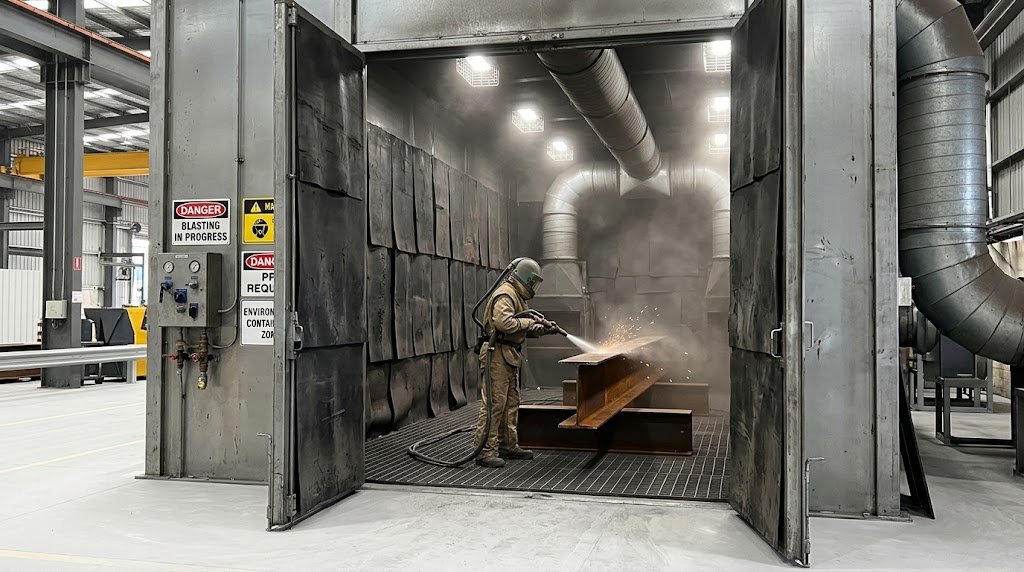
An industrial abrasive blast room is fundamentally an aerodynamic separation and environmental filtration reactor. Containment is not achieved by the structural wall skin alone, but through active fluid-dynamic boundary control.
3.1 The Physics of Negative Pressure Differential ($\Delta P < 0$)
To guarantee zero outward fugitive dust migration, the ventilation exhaust volume ($Q_{exhaust}$) must exceed the natural ambient intake airflow ($Q_{intake}$):
By maintaining a negative differential pressure, the static pressure outside the room is continuously higher than inside. According to Bernoulli’s principle, if any structural discontinuity occurs—such as a worn door gasket, floor seam crack, or operator pass-through port—the resulting velocity vector ($v_{inward}$) forces ambient air to rush inward into the room:
This inward air velocity barrier exceeds the kinetic dispersion velocity of airborne dust fines, making outward fugitive emission aerodynamically impossible.
3.2 Volumetric Ventilation Dynamics: Cross-Draft vs. Down-Draft Sweeps
Industrial blast rooms must continuously flush airborne dust away from the technician’s breathing zone to maintain visibility and prevent spatial disorientation. Air exchange calculations follow strict occupational hygiene standards:
Air enters through sound-baffled intake louvers on the rear wall, sweeps horizontally across the component length, and exits through floor-level exhaust plenums behind the blast zone.
Governing Minimum Velocity (OSHA 1910.94a): $v_{capture} = 100\text{ ft/min}$ ($0.51\text{ m/s}$) for fine or toxic particulate.
Air enters through perforated ceiling plenums and sweeps vertically downward toward grating hoppers. Gravity works in synergy with the air vector, pulling rebounding abrasive and heavy scale downward.
Governing Minimum Velocity: $v_{down} = 60\text{ to }80\text{ ft/min}$ ($0.30\text{ to }0.41\text{ m/s}$). Aerodynamically superior for heavy descaling.
3.3 Pulse-Jet Cartridge Filtration and High-Efficiency Particulate Air (HEPA) Purity
Extracted air streams carrying up to $15,000\text{ mg/m}^3$ of suspended dust pass through a dedicated reverse pulse-jet dust collector. Cartridge media selection is governed by Darcy’s modified filtration resistance equations:
Engineered filtration systems deploy nanofiber-coated spunbond polyester or PTFE-membrane cartridges certified to MERV 15 to MERV 16 standards, capturing $\ge 99.97\%$ of particulate down to $0.3\,\mu\text{m}$. High-pressure compressed air manifolds ($P \approx 90\text{ to }100\text{ PSI}$) fire sonic shock pulses through the filter cores, dislodging accumulated dust cakes into sealed collection drums while maintaining continuous negative room pressure. Clean exhaust air discharges with a residual particulate burden of $< 5.0\text{ mg/m}^3$, satisfying international Clean Air Act emissions thresholds.
Kinetic Shock Dissipation and Acoustic Jet Noise Attenuation
Beyond toxicological containment, engineered blast rooms resolve two acute physical hazards that cannot be mitigated during uncontained open blasting: kinetic ricochet injury and aerodynamic acoustic trauma.
4.1 Viscoelastic Kinetic Energy Absorption (Hanging Gum Rubber Curtains)
Abrasive media exiting a Venturi nozzle under $100\text{ PSI}$ possesses substantial kinetic energy ($E_k$). When striking interior structural weld gussets, angle irons, or flange roots, errant particles ricochet at high velocity:
With an abrasive mass flow rate of $400\text{ kg/hr}$, the room interior absorbs over $2.9\text{ Megajoules}$ of kinetic impact energy every operating hour. Blast enclosures absorb this energy using suspended **abrasive-resistant pure gum rubber curtains** ($6\text{ mm to }10\text{ mm}$ thick, $40\text{ to }50\text{ Durometer Shore A}$). The hyper-elastic polymer chains undergo reversible viscoelastic shear deformation upon impact, deadening the particle rebound velocity ($v_{rebound} \approx 0\text{ m/s}$) and preventing wall perforation.
4.2 Aerodynamic Jet Noise Attenuation ($115\text{ to }125\text{ dBA} \longrightarrow < 80\text{ dBA}$)
The sudden volumetric expansion of compressed air exiting a convergent-divergent Venturi nozzle generates continuous aerodynamic quadrupole jet noise governed by Lighthill’s eighth-power law ($W_{acoustic} \propto \frac{\rho_0 \cdot v^8 \cdot d^2}{c_0^5}$), with sound pressure levels measuring between $115\text{ and }125\text{ dBA}$—far exceeding the OSHA $85\text{ dBA}$ Action Level.
Uncontained field blasting exposes non-blasting personnel, crane operators, and assembly crews to continuous acoustic trauma, causing permanent Noise-Induced Hearing Loss (NIHL). Engineered blast rooms deploy acoustic sandwich wall panels (perforated internal steel sheet, high-density $100\text{ kg/m}^3$ mineral wool core, and solid exterior steel casing) that attenuate external sound levels to below $80\text{ dBA}$ outside the enclosure, eliminating shop-floor acoustic hazards.
Comparative Jurisprudential Analysis: Statutory Enclosure Mandates
Operating uncontained sandblasting is not merely an occupational safety violation; it triggers direct regulatory, civil, and criminal liability across major international jurisdictions:
| Jurisdiction | Statutory Authority & Reference | Core Enclosure & Emission Mandate | Statutory Penalty / Liability |
|---|---|---|---|
| United States |
OSHA 29 CFR 1910.94(a) 29 CFR 1910.1053 EPA 40 CFR Part 63 (Subpart XXXXXX) |
Mandates negative pressure ventilation in all indoor blast booths; restricts RCS exposure to $50\,\mu\text{g/m}^3$ PEL ($25\,\mu\text{g/m}^3$ Action Level). EPA NESHAP mandates enclosed blast chambers vented to $\ge 98\%$ capture devices for metals containing $\text{Cr}, \text{Pb}, \text{Mn}, \text{Ni}, \text{Cd}$. | “Willful” violations incur fines up to $161,323 per occurrence; immediate federal stop-work orders; toxic tort civil litigation. |
| United Kingdom |
COSHH Regulations 2002 (Schedule 1, Item 1 Prohibition) |
Absolute statutory prohibition on using raw sand or materials containing $> 1\%$ free silica as an abrasive in any blasting apparatus; requires Local Exhaust Ventilation (LEV) verification every 14 months under Regulation 9. | Criminal prosecution under Health and Safety at Work etc. Act 1974; unlimited corporate fines; director disqualification. |
| European Union |
Directive 2004/37/EC (Amended by 2017/2398/EU) EN 60335-2-69 |
Strict biological and occupational exposure limits for Carcinogens and Mutagens at Work; establishes binding RCS limit of $0.1\text{ mg/m}^3$; requires sealed negative-pressure capture at source and certified H-Class dust extraction. | National transposition penalties, industrial operating permit revocations, civil compensatory liabilities for occupational diseases. |
| India |
Factories Act, 1948 (Sec 14) Environment (Protection) Rules, 1986 CPCB Guidelines for Dust Abatement |
Section 14 mandates internal exhaust extraction for dust/fumes to prevent inhalation. CPCB enforces ambient limits ($PM_{10} \le 100\,\mu\text{g/m}^3$, $PM_{2.5} \le 60\,\mu\text{g/m}^3$); prohibits dry open sandblasting of large structures without wet suppression or containment. | Factory closure under Section 40; environmental damage compensation tariffs levied by National Green Tribunal (NGT). |
The Financial Multiplier: Closed-Loop Media Recovery Economics
While regulatory compliance and occupational health justify blast enclosure installation, containment is also a high-yield capital investment. Open blasting forces facilities to use low-grade single-pass disposable media because recovery is impossible. In contrast, an enclosure transforms the operation into a closed-circuit recirculating manufacturing system.
6.1 Mathematical Media Conservation via Closed-Loop Air-Wash Recovery
In a recovery blast room equipped with an automated mechanical floor (screw conveyor or oscillating scraper floor), bucket elevator, and cyclonic air-wash separator, spent media is dynamically separated into reusable abrasive grains and broken waste dust. The net waste volume generated ($M_{waste}$) decreases inversely with the reusability cycle index ($N_{cycles}$):
| Abrasive Media Classification | Operating Environment | Recyclability Potential ($N_{cycles}$) | Media Consumed (per $100\text{ MT}$ Blasting) | Hazardous Waste Disposal Burden |
|---|---|---|---|---|
| Expendable Copper / Coal Slag | Open-Air Blasting (Uncontained) | 1 Single Pass (0% Reclaim) | $100.0\text{ Metric Tonnes}$ | $100.0\text{ MT}$ of contaminated solid waste disposal fees. |
| Virgin Fused Brown Aluminium Oxide | Enclosed Blast Cabinet / Room | 8 to 10+ Multi-Pass Cycles | $10.0\text{ to }12.5\text{ Metric Tonnes}$ | 88% reduction in total waste tonnage. |
| Micro Soda-Lime Glass Beads | Enclosed Blast Cabinet ($45\text{ PSI}$) | 25 to 30 Clean Cycles | $3.3\text{ to }4.0\text{ Metric Tonnes}$ | 96% reduction in total solid waste volume. |
| High-Carbon Cast Steel Shot / Grit | Engineered Blast Room System | 100 to 500+ Cycles (SAE J444) | $0.2\text{ to }1.0\text{ Metric Tonnes}$ | Up to 99% solid waste reduction! Massive freight savings. |
6.2 Environmental Control via Dew Point Isolation
Open field blasting is constrained by outdoor atmospheric weather swings. Moisture condensation on raw, freshly blasted steel triggers rapid oxidation, violating the universal **3°C Dew Point Rule** (ASTM E337 / ISO 8502-4):
If ambient relative humidity exceeds $85\%$, pristine reactive iron ($Fe^0$) flash-rusts within minutes, requiring complete re-blasting. An enclosed blast room isolates the steel substrate from external weather. Integrated desiccant dehumidification systems allow facilities to hold blast cleanliness at ISO 8501-1 **Sa 2.5 / Sa 3** for days without oxidation, enabling structured coating application schedules.
Standard Operating Procedures: Containment Audit Checklist
An engineered blasting enclosure requires consistent preventative maintenance to ensure continuous negative-pressure containment and filtration efficiency:
Verify static differential pressure across the cartridge dust collector. Operating window: $2.0\text{ to }4.0\text{ in. w.g.}$ ($500\text{ to }1,000\text{ Pa}$). Readings above $6.0\text{ in. w.g.}$ indicate severe filter cake blinding; readings below $1.0\text{ in. w.g.}$ signify torn cartridges or blown seals.
Trace smoke pencils along all door perimeter neoprene seals, floor joints, and pass-through openings. Inward smoke deflection verifies proper negative pressure and confirms zero outward dust leakage.
Inspect hanging gum rubber curtains for tears, gouges, or detachment. Replace curtains before abrasive rebound strikes the structural steel wall plates to avoid wall perforation.
Verify that duct air velocity exceeds $v_{duct} \ge 20\text{ m/s}$ ($4,000\text{ ft/min}$). Sub-critical air velocities cause heavy abrasive dust to settle within duct work, leading to duct collapse from particulate accumulation.
Engineered blast enclosures perform at their peak when paired with certified, low-dusting abrasives. Learn more about certified Micro Soda-Lime Glass Beads, SAE Cast Steel Shot, and Virgin Alumina with EN 10204 Type 3.1 MTCs.