
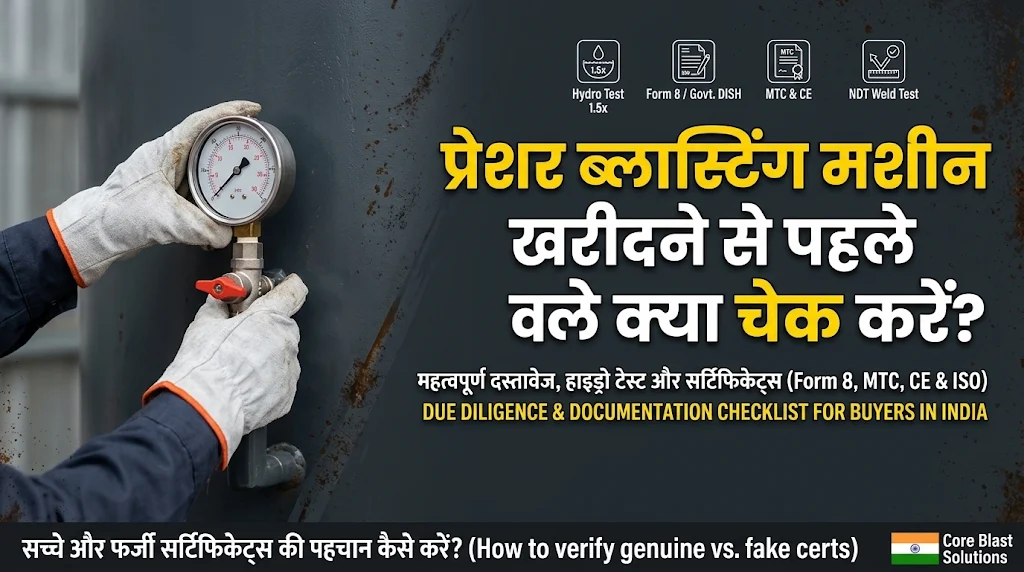
Things to Check Before Buying a Pressure Sandblasting Machine in India:
Hydro Test, Form 8, CE & ISO Verification Checklist
A direct-pressure sandblasting pot operating at 100 PSI (7 bar) is legally classified as a high-energy industrial pressure vessel. In India’s unorganized fabrication market, substandard pots welded from thin commercial scrap plates routinely fail factory audits—or worse, rupture catastrophically. Before releasing a Purchase Order, always demand and independently verify six core proofs: a 1.5× Hydrostatic Test Certificate (Form 8), Steel Plate MTC (IS 2062 / SA 516 Gr. 70), Weld NDT Reports, NABL Safety Valve Calibration, an IAF/NABCB-accredited ISO 9001 certificate, and a NANDO-verified CE (PED) certificate.
Why an Uncertified Blast Pot Is a Legal & Financial Liability
Unlike a suction (siphon) blast cabinet, a direct-pressure sandblasting machine pressurizes the entire steel tank containing 150 kg to 1,000 kg of abrasive media to 7–8.5 bar (100–125 PSI). Because compressed air stores enormous elastic energy, a weld seam rupture turns the tank into lethal shrapnel.
Under DGFASLI / The Factories Act, 1948 (Section 31: Pressure Plant), any industrial vessel operating above atmospheric pressure must be fabricated to an approved pressure code (BIS IS 2825 or ASME BPVC Section VIII Div. 1), fitted with a calibrated safety valve, and inspected by a State Government DISH-approved Competent Person. Operating an undocumented pot can lead to immediate factory sealing, invalidation of industrial fire/accident insurance claims, and criminal liability for the Factory Occupier/Director.
7 Mandatory Test Certificates to Demand Before Paying the Final Balance
1. Hydrostatic (Hydro) Test Certificate & DISH Form 8
NON-NEGOTIABLENever accept a “pneumatic-only” air test as a substitute for a hydrostatic test. The vessel must be completely filled with water and pressurized to 1.5 × Maximum Allowable Working Pressure (MAWP) per ASME Section VIII Div. 1 or BIS IS 2825.
- Example: For a 125 PSI (8.6 bar) MAWP pot, hydro test pressure must be 188–225 PSI (13–15.5 bar) held for a minimum of 30 minutes with zero pressure drop and zero weld sweating.
- Indian Compliance: Must include Form 8 (or state-equivalent Pressure Vessel Examination Report) signed and stamped by a Government-approved Competent Person, valid for 12 months.
2. Pressure Vessel Steel Plate MTC (EN 10204 Type 3.1)
METALLURGY PROOFMany low-cost fabricators use cheap commercial mild steel (MS) scrap sheets that crack under cyclic pressurization. Demand the steel mill’s Material Test Certificate (MTC) confirming boiler-quality or structural pressure-grade steel: ASTM A516 Grade 70 (BQ Plate) or BIS IS 2062 Grade B / IS 2002, with minimum shell thickness of 6 mm to 8 mm (depending on pot diameter) and matching heat numbers.
3. Weld Inspection & NDT Reports (DPT / Radiography / UT)
STRUCTURAL INTEGRITYVerify that longitudinal and circumferential seams on the tank shell and torispherical dish ends were welded by qualified welders (ASME Section IX) and subjected to Dye Penetrant Testing (DPT) and at least 10% Spot Radiography (RT) or Ultrasonic Testing (UT) to ensure zero internal porosity or slag inclusions.
4. NABL-Traceable Calibration Certificates (PRV & Pressure Gauge)
SAFETY INTERLOCKEvery pressure pot must include a spring-loaded Pressure Relief Valve (PRV / Safety Valve) set at or slightly below the pot’s MAWP (e.g., 125 PSI / 8.5 bar) and a glycerin-filled pressure gauge. Both must have calibration certificates traceable to NABL (National Accreditation Board for Testing and Calibration Laboratories).
5. Permanent Stamped Metallic Nameplate & GA Drawing
The pot must carry a riveted/welded stainless steel nameplate permanently stamped with: Serial Number, Year of Manufacture, Design Code (IS 2825 / ASME), Shell Thickness (mm), MAWP (PSI/Bar), Hydro Test Pressure, and Manufacturer Name. Ensure the Serial Number matches the Form 8 certificate exactly.
How to Verify CE, ISO 9001, ASME & Vendor Certificates in India (Spot Fakes in 2 Minutes)
In the Indian industrial machinery market, “pay-and-print” certificates are widespread. Many brokers hand out impressive-looking PDFs with fake CE and ISO logos that hold zero legal validity during a Tier-1 EPC, Oil & Gas, or Factory Inspector audit. Use these official government and global databases to verify every document before buying:
The Common Indian Scam: Unaccredited local agencies sell ₹5,000 “Voluntary CE Certificates” that mean nothing legally. For a pressurized sandblasting machine, genuine CE certification requires compliance with the Pressure Equipment Directive (PED 2014/68/EU) and Machinery Directive (2006/42/EC).
- Look for a 4-digit Notified Body (NB) number next to the CE mark (e.g., TÜV, SGS, Bureau Veritas, DNV).
- Visit the official European Commission NANDO Database and search that 4-digit number.
- Confirm that the Notified Body is specifically authorized under Directive 2014/68/EU (PED). If the issuer is not in NANDO, the CE certificate is invalid.
The Common Indian Scam: Non-IAF “paper mills” issue ISO 9001 certificates in 24 hours without ever auditing the factory floor.
- Check the accreditation logo on the certificate: in India, the official national body is NABCB (Quality Council of India). Recognized global equivalents include UKAS (UK), DAkkS (Germany), ANAB (USA), and JAS-ANZ.
- Go to the official global registry IAF CertSearch (iafcertsearch.org) and type the supplier’s company name or certificate number.
- Verify the Scope of Certification actually says “Design and Manufacture of Blasting Equipment / Pressure Vessels” (not “General Trading”).
If a supplier claims their blast pot is “ASME Certified” (as opposed to merely “designed as per ASME”), only an ASME-authorized shop can stamp the vessel and issue a Form U-1A Data Report.
- Ask for the manufacturer’s ASME Certificate of Authorization Number.
- Verify it live on the official ASME Certificate Holder Directory.
- Confirm the certificate is active (not expired) and covers the ‘U’ (Pressure Vessels) stamp.
Always validate both the third-party inspector who signed the Hydro Test (Form 8) and the legal registration of the machine supplier:
- DISH Competent Person Check: Check the inspector’s approval number on your respective State Directorate of Industrial Safety & Health (DISH) website (e.g., DISH Maharashtra, DISH Gujarat, Labour Dept. Delhi/Tamil Nadu).
- GSTIN & Track Record: Verify the supplier’s 15-digit GSTIN on the Official GST Portal to confirm active filing status, legal entity age, and registered factory/business address.
Physical Pre-Dispatch Inspection (PDI): 8 Mechanical Checks Before Delivery
Even with clean paperwork, poor accessory selection will ruin blasting productivity and cause constant media clogging. Inspect these eight physical components before accepting delivery:
Never buy a blast pot without a pneumatic or electric Deadman Handle (OSHA 1910.244b). If the operator trips or drops the hose, blasting must stop instantaneously within 1–2 seconds.
Check whether the pot uses a cheap cast-iron gate valve (which wears out in days) or a proper Pinch Valve, Flat Sand Valve, or Thompson Valve designed for hard abrasives like Steel Grit and Aluminium Oxide.
Air inlet and pusher piping must be at least 1-1/4″ (32 mm) or 1-1/2″ (38 mm) heavy-duty Schedule 40/80 pipe. Undersized 3/4″ piping starves the nozzle and cuts cleaning speed by 30%+.
Inspect the rubber-coated pop-up cone inside the top filling port. It must seat cleanly against the vulcanized rubber gasket so the pot pressurizes instantly without hissing air leaks.
In India’s humid climate and monsoon months, compressed air carries heavy water vapor. Confirm a high-CFM centrifugal moisture separator is mounted right at the blast pot inlet.
Verify the supplied blast hose is ISO 3861 static-dissipative rubber (ID 3×–4× nozzle bore) fitted with external couplings and steel safety whip-check cables.
A side clean-out inspection door (handhole) is essential to clear damp media bridges safely. Always insist on a top mesh sieve screen and weather lid to block bag strings and stones.
Confirm whether the quote includes a cheap ceramic nozzle or an industrial Tungsten Carbide / Sintered Boron Carbide (B4C) Long-Venturi nozzle, plus a NIOSH-grade Type CE Air-Fed Helmet.
Master Pre-Purchase Verification Scorecard (India)
| Document / Certificate | Governing Code | Priority | Exact Way to Verify |
|---|---|---|---|
| Hydrostatic Test & Form 8 | Factories Act Sec 31 / IS 2825 | Mandatory | Verify 1.5× MAWP test pressure, vessel serial number match, and Competent Person license on State DISH portal. |
| Steel Plate MTC & Weld NDT | IS 2062 / SA 516 Gr. 70 | Mandatory | Cross-check mill heat number, 6–8 mm plate thickness (confirm via ultrasonic thickness gauge), and DPT/RT report. |
| PRV & Pressure Gauge Calibration | NABL / ISO 17025 | Mandatory | Check NABL lab certificate number and confirm pop-off set pressure ≤ MAWP. |
| ISO 9001:2015 Certificate | ISO 9001 (QMS) | High Value | Verify live on iafcertsearch.org; confirm NABCB / UKAS / DAkkS accreditation. |
| CE Certificate (PED / Machinery) | 2014/68/EU & 2006/42/EC | Export / Tier-1 | Verify 4-digit Notified Body number on the official EU NANDO database. Reject non-NANDO certificates. |
| ASME ‘U’ Stamp (Form U-1A) | ASME BPVC Sec VIII Div. 1 | Oil & Gas / EPC | Verify Certificate of Authorization on caconnect.asme.org. |
Frequently Asked Questions Before Buying a Sandblasting Machine
Q1: How often does a sandblasting pot require hydro testing in India?
Under the Indian Factories Act, 1948, pressure vessels require external inspection every 6 months, internal visual inspection every 12 months, and a full Hydrostatic Pressure Test (Form 8 renewal) every 2 to 4 years (or immediately after any weld repair or if internal wall thinning is detected by ultrasonic thickness gauging).
Q2: Is a CE certificate legally required to operate a sandblasting machine in India?
No—CE marking is a European Union statutory requirement, not an Indian legal mandate. In India, BIS IS 2825 / ASME Sec VIII design compliance and Factories Act Form 8 are legally binding. However, many multinational plants and EPC tenders in India request genuine NANDO-verified CE certification as an additional international safety benchmark.
Q3: Can I use any abrasive media in a standard pressure sandblasting machine?
Yes, provided the metering valve and nozzle bore are matched to the media. Direct-pressure pots efficiently run Cast Steel Shots & Grit, Virgin Fused Aluminium Oxide, Garnet, and Micro Soda-Lime Glass Beads (at reduced 40–55 PSI pressure). Always ensure the media is backed by an EN 10204 Type 3.1 MTC to prevent valve jamming and silica hazards.