The Complete Guide to Sandblasting & Shot Blasting Standards:
Surface Prep, Abrasives, Nozzles, Motors, Hoists & Dust Collection
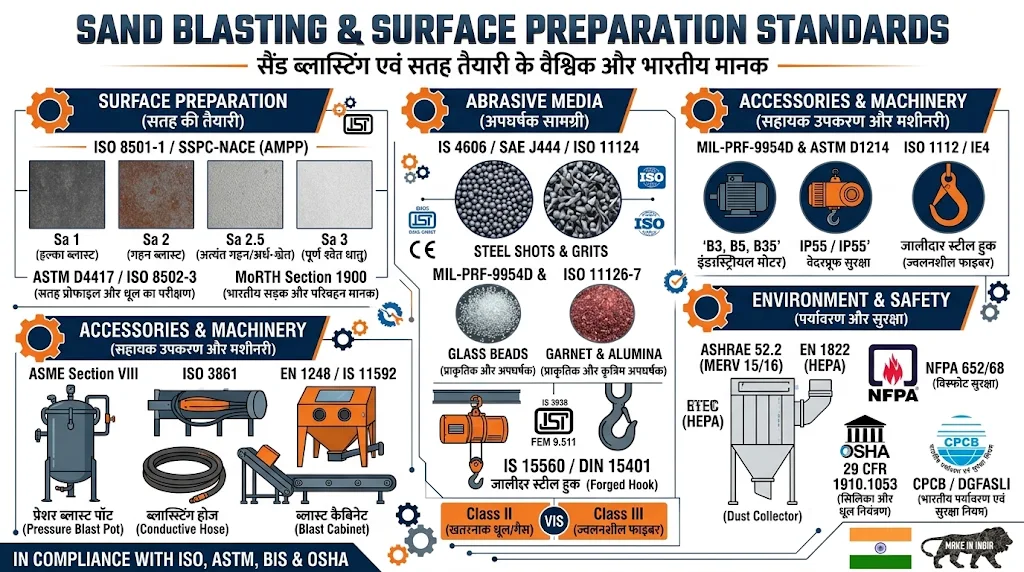
Industrial abrasive blasting is governed by an interlocking ecosystem of global and Indian engineering codes. Surface cleanliness is defined by ISO 8501-1 (Sa 1 to Sa 3) and AMPP (SSPC/NACE); abrasive media follow SAE J444 / IS 4606 (Steel Shots), MIL-PRF-9954D (Glass Beads), and MIL-P-85891A (Plastic Media); pressure pots require ASME Section VIII; blasting motors adhere to IEC 60034 (B3/B5 mountings, IE2/IE3 efficiency, IP55/IP65 & Class I/II/III protection); hoists follow IS 3938 / FEM 9.511; and dust collectors comply with ASHRAE 52.2, NFPA 652, OSHA, and CPCB regulations.
Surface Treatment & Cleanliness Standards (ISO 8501-1, SSPC & NACE / AMPP)
Before any protective epoxy, zinc silicate, or thermal spray coating is applied, steel substrates must be cleaned to a verifiable visual standard and given a measurable mechanical anchor profile (Rz). Globally, the three dominant frameworks—ISO 8501-1, SSPC, and NACE (now unified under AMPP — Association for Materials Protection and Performance)—are cross-referenced in every industrial tender:
| ISO 8501-1 Grade | SSPC Standard | NACE Standard | Cleanliness Definition | Primary Industrial Use |
|---|---|---|---|---|
| Sa 1 | SSPC-SP 7 | NACE No. 4 | Brush-Off Blast: Removes loose mill scale, loose rust, and loose paint; tightly adhered scale remains. | Mild atmospheric exposure, temporary touch-ups. |
| Sa 2 | SSPC-SP 6 | NACE No. 3 | Commercial Blast: Removes all oil, grease, and most mill scale; up to 33% of surface may show light staining. | General structural steel, non-critical dry interiors. |
| Sa 2.5 | SSPC-SP 10 | NACE No. 2 | Near-White Metal: 95% of every square inch completely free of scale, rust, and paint; only faint shadows allowed. | Global industrial benchmark: bridges, refineries, ship hulls, offshore steel. |
| Sa 3 | SSPC-SP 5 | NACE No. 1 | White Metal Blast: 100% uniform silvery metallic luster; zero shadows, zero streaks, zero oxide traces. | API 653 crude oil tank linings, chemical immersion, thermal metallizing. |
ASTM D4417 (Method A: Comparator, Method B: Depth Micrometer, Method C: Testex Replica Tape) & ISO 8503-1/2. Target Rz is typically 50–85 μm for heavy epoxies.
ISO 8502-6 / 8502-9 (Bresle Patch Test for chlorides < 20–50 mg/m²) and ISO 8502-3 (Pressure-sensitive Dust Tape Test, Class 1 or 2 max).
ISO 8502-4 / ASTM E337 (ΔT ≥ 3°C above dew point, RH < 85%), reinforced in India by BIS IS 1477 and MoRTH Section 1900.
Standards for Abrasive Media: Steel Shots, Steel Grit, Glass Beads & Plastic Media
Unverified trade-grade abrasives cause premature breakdown, excessive dust, and iron contamination. Every commercial consignment supplied by Core Blast Solutions is tested and certified via EN 10204 Type 3.1 Manufacturer’s Test Certificates (MTC) against these exact international and Indian specifications:
| Abrasive Media Type | Governing Global & Indian Standards | Mandatory Quality Parameters | Key Industrial Applications |
|---|---|---|---|
|
Cast Steel Shots (S-110 to S-780) |
BIS IS 4606:1983 (India) SAE J444 (Sizing) & SAE J827 (Quality) ISO 11124-3 / SSPC-AB 3 |
Carbon 0.80–1.20%, Hardness 40–50 HRC (400–510 HV), Density ≥ 7.0 g/cm³, Tempered Martensite microstructure, 500+ recycle durability. | Shot peening (AMS 2430 / Almen strips), foundry casting descaling, forging cleanup. |
|
Angular Cast Steel Grit (GP, GL, GH Tiers) |
SAE J1993 & SAE J444 ISO 11124-3 & ISO 11125 (Test methods) BIS IS 4606 |
Hardness tiers: GP (40–50 HRC), GL (53–60 HRC), GH (64–68 HRC). Sharp angular edges for deep Rz profile cutting. | Heavy rust/mill scale removal, Sa 2.5/Sa 3 tank linings, shipbuilding, rubber-to-metal bonding. |
|
Micro Glass Beads (GB-0 to GB-13) |
MIL-PRF-9954D (US Mil-Spec) ASTM D1214 (Sieve) & ASTM D1155 (Roundness) ISO 11126-5 / ASTM C169 (Chemistry) |
≥ 80% true spherical roundness, 5.5–6.0 Mohs, Iron Oxide (Fe2O3) ≤ 0.10%, Free Crystalline Silica < 0.05% (Silicosis-safe), 0.000 mm metal loss. | CNC mold cleaning, stainless steel 304/316L satin finishing, aerospace turbine peening, medical implants. |
|
Plastic Media Abrasive (PMA) (Types II, III, V) |
MIL-P-85891A (US DoD) SAE AMS 2431 |
Type II (Urea, 3.5 Mohs), Type III (Melamine, 4.0 Mohs), Type V (Acrylic, 3.5 Mohs). Specific gravity 1.15–1.52 g/cm³. Zero substrate warping. | Aviation MRO aircraft paint stripping (composite & thin aluminum skins), electronic deflashing. |
| Fused Aluminium Oxide & Garnet |
ISO 11126-7 (Fused Alumina) ISO 11126-10 (Almandine Garnet) FEPA 42-1 (Grit sizing) / SSPC-AB 1 |
Alumina: 9.0 Mohs, ≥ 95% (Brown) or ≥ 99% (White) Al2O3. Garnet: 7.5–8.0 Mohs, free silica < 1%, water-soluble chlorides < 25 ppm. | Thermal spray prep, titanium & stainless etching (iron-free), shipyard open/wet blasting. |
Standards for Sandblasting Nozzles, Hoses & Pressurized Blast Pots
- Orifice Airflow Calibration (CAGI Standards): Nozzle bores are numbered in increments of 1/16 inch (e.g., No. 4 = 6.4 mm / 81 CFM; No. 5 = 7.9 mm / 137 CFM; No. 6 = 9.5 mm / 196 CFM at 100 PSI). Air consumption follows the quadratic law (Q ∝ d²).
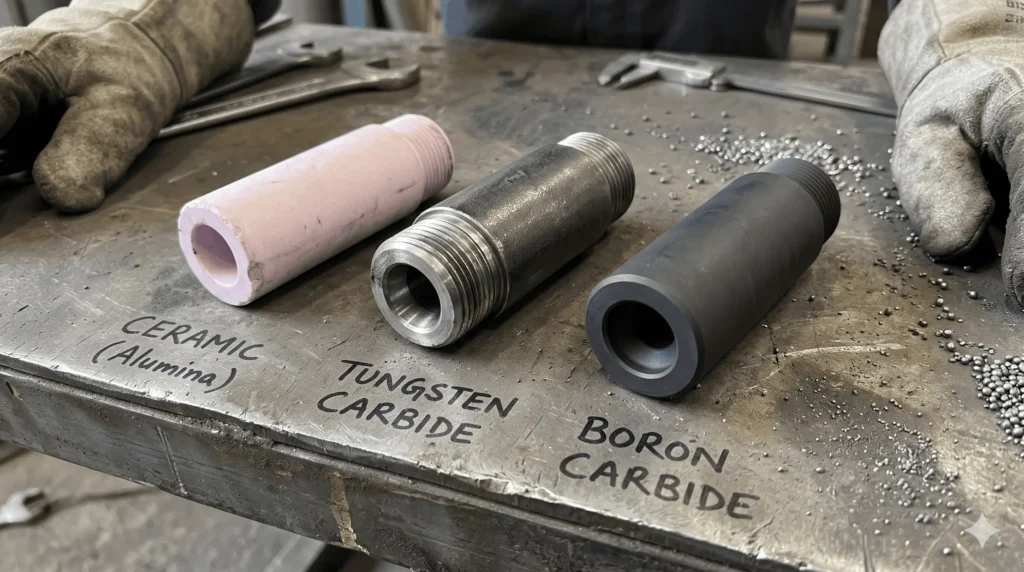
- Liner Hardness (ASTM E384): Ceramic (~1,500 HV), Tungsten Carbide WC–Co (~1,650 HV), and Sintered Boron Carbide B4C (2,800–3,200 HV). Replace immediately once the throat wears by +1.5 mm (1/16″).
- Thread Geometry: Standardized globally to 50 mm Coarse Contractor Thread (for high-production blast hoses) or 1-1/4″ NPS Fine Thread.
- Pressure Vessel Certification (ASME BPVC Section VIII, Div. 1 & EU PED 2014/68/EU): Every direct-pressure blast pot must carry an ASME “U” stamp (or Indian IS 2825 compliance) rated to 125–150 PSI MAWP with hydro-test certification and calibrated Pressure Relief Valves (PRV).
- Conductive Blast Hoses (ISO 3861 / EN ISO 3861): Must be 2-ply or 4-ply static-dissipative rubber (electrical resistance R < 106 Ω) to prevent electrostatic shocks.
- Deadman Interlocks (OSHA 29 CFR 1910.244(b)): Blast cleaning nozzles must have an operating valve held open manually (deadman switch) that instantaneously halts media flow if dropped.
Standards for Blast Cabinets, Conveyors, Overhead Electric Hoists & Hooks
Modern automated shot blasting lines—such as hanger-type machines, roller-conveyor structural lines, and enclosed cabinets—rely on heavy material handling accessories that operate inside abrasive, dust-laden zones. Selecting compliant accessories prevents fatal load drops and premature mechanical seizure:
| Machine / Accessory | Governing Standards | Critical Engineering & Safety Requirements |
|---|---|---|
| Sandblasting Cabinets & Blast Rooms |
EN 1248 (EU Machinery Safety) OSHA 29 CFR 1910.94(a) ISO 12100 (Risk Assessment) |
Mandatory door limit-switch safety interlocks (stops blasting instantly when door opens), negative pressure (−50 to −125 Pa), minimum 500 lux dust-tight LED illumination, and manganese steel or 6–10 mm gum rubber wall liners. |
| Roller, Screw & Belt Conveyors |
CEMA (Conveyor Equipment Mfrs. Assoc.) ISO 5048 & BIS IS 11592 |
Heavy-duty hardened manganese steel roller sleeves inside the blast chamber; labyrinth dust-sealed pillow-block bearings; VFD-controlled variable pass speeds (0.5–4.0 m/min) synchronized to Sa 2.5 cleaning dwell time. |
| Overhead Electric Hoists (Hanger Machines) |
BIS IS 3938 (Wire Rope Hoists) IS 6547 (Chain Hoists) FEM 9.511 / ISO 4301-1 ASME B30.16 |
Must be rated FEM 2m / ISO M5 (Class II/III Heavy Duty) for continuous foundry/blasting cycles. Requires fail-safe electromagnetic disc brakes, upper/lower limit switches, overload limiters, and IP55 dust-proof control pendants. |
| Lifting Hooks, Shackles & Spinner Yokes |
BIS IS 15560 (Forged Hooks) DIN 15401 / EN 1677-2 ASME B30.10 |
Drop-forged alloy steel (Grade 80 / Grade 100) with mandatory spring-loaded safety latch. In hanger shot blasting machines, the hook assembly must include a manganese steel blast-shield cone to protect the hoist wire rope and hook shank from direct abrasive wear. |
Electric Motor Standards in Shot Blasting: B3 vs. B5, IE2/IE3, Class II vs. Class III Protection & Top Brands
Shot blasting machines rely heavily on 3-phase squirrel-cage induction motors—powering centrifugal blast wheels (7.5 HP to 40 HP), bucket elevators, screw conveyors, and dust collector blowers. All industrial motors are governed by IEC 60034 globally and BIS IS 12615 / IS 2253 in India.
5.1 Motor Mounting Standards: B3 vs. B5 vs. B35 (IEC 60034-7 / IS 2253)
Features rigid mounting feet cast at the base of the motor frame with no front flange. Bolted horizontally onto a flat steel baseplate or slide rails.
Where Used in Blasting: Belt-driven centrifugal blast wheels, rotary screw air compressors, and dust collector exhaust fans.
Has no bottom feet; features a machined front flange with through-holes (FF) that bolts directly onto the driven equipment housing.
Where Used in Blasting: Direct-drive blast wheel turbines (impeller mounted directly on motor shaft), geared screw conveyors, and bucket elevator gearboxes.
Combines both bottom mounting feet and a B5 front flange for maximum rigidity under heavy radial and axial shock loads.
Where Used in Blasting: Heavy-duty direct-drive blast turbines (≥ 20 HP) and high-torque tumblast barrel drives.
- Ingress Protection (IEC 60529 / IS/IEC 60529): Never use IP44 motors in a blasting bay. Minimum requirement is IP55 (Dust-protected & water-jet protected), with IP65 (100% Dust-Tight) strongly recommended for motors located near media reclaim hoppers and fine alumina dust.
- Efficiency Class (IEC 60034-30-1 / IS 12615): IE2 (High Efficiency) is the statutory minimum in India, while IE3 (Premium Efficiency) and IE4 (Super Premium) are standard for continuous 24/7 blast rooms and VFD-driven compressors.
- Thermal Insulation Class (IEC 60085): Specify Class F Insulation (155°C max) with Class B temperature rise limit, or Class H (180°C) for high-ambient Indian foundries and Middle Eastern refineries.
5.2 Class II vs. Class III Protection: What Are the Exact Differences?
In sandblasting engineering, “Class 2” and “Class 3” protection appear in two distinct international standards—Electrical Shock Protection (IEC 61140) and Hazardous Location Dust Protection (NFPA 70 / OSHA). Understanding both prevents fatal specification errors:
| Classification System | Class II (Class 2) | Class III (Class 3) |
|---|---|---|
|
A. Electrical Shock Protection (IEC 61140 / EN 61140) |
Double / Reinforced Insulation: Equipment has two independent layers of electrical insulation (marked with double-square symbol). Requires no protective earth (ground) wire. Used in handheld control pendants and dry inspection instruments. | Safety Extra-Low Voltage (SELV): Powered strictly at ≤ 50V AC or ≤ 120V DC (commonly 12V or 24V). Cannot cause lethal electric shock even in wet conditions. Mandatory for blast-room helmet lights, pneumatic/electric deadman handles, and confined wet-tank blasting controls. |
|
B. Hazardous Location Dust Protection (NEC / NFPA 70 / OSHA 1910.307) |
Combustible Dust Atmospheres: Locations hazardous due to suspended explosive dust (e.g., Group E: Aluminum, Magnesium, Titanium blasting dust; Group G: Plastic media/walnut shell dust). Requires Explosion-Proof / Dust-Ignition-Proof Motors (ATEX Zone 21/22 equivalent). | Ignitable Fibers & Flyings: Locations hazardous due to easily ignitable fibers (such as textile lint, wood shavings, or corn-cob/cellulose blasting residues) that settle on motor housings and can smolder if motor surface temperature is too high. |
5.3 Major Trusted Industrial Brands for Blasting Motors & Accessories
ABB, Siemens, CG Power (Crompton Greaves), Bharat Bijlee, Kirloskar Electric, Havells, and WEG.
Demag, Konecranes, Bajaj Indef, ElectroMech, and Kito (FEM 2m / IS 3938 certified).
Donaldson Torit, Camfil APC, Nederman, and AAF Flanders (MERV 15/16 Nanofiber).
Core Blast Solutions (EN 10204 3.1 Glass Beads, Steel Shots/Grit, B4C Nozzles & Air-Fed Helmets).
Standards for Dust Collectors, Cartridge Filtration & Environmental Compliance
Unfiltered blasting exhaust carries lethal respirable crystalline silica (PM2.5) and toxic heavy metals (Lead, Hexavalent Chromium). Engineered reverse pulse-jet cartridge collectors and baghouses must comply with strict filtration, explosion-safety, and environmental statutes:
- Filter Efficiency Standards (ASHRAE 52.2 / ISO 16890 / EN 1822): Blast room cartridge filters must be rated at least MERV 15 to MERV 16 (capturing ≥ 99.9% of particles down to 0.5 μm). When stripping lead paint or chromium primers, a secondary HEPA H13/H14 after-filter (99.97% at 0.3 μm per EN 1822) is mandatory.
- Combustible Dust Explosion Standards (NFPA 652, NFPA 68 & NFPA 484): Blasting aluminum, titanium, magnesium, or plastic media produces explosive dust clouds. Dust collectors handling combustible metals must be equipped with calibrated explosion vent panels (NFPA 68), isolation flap valves (NFPA 69), and grounded anti-static filter cartridges—or use wet-scrubber collectors.
- OSHA Occupational Hygiene (29 CFR 1910.1053 & 1910.134): Restricts Respirable Crystalline Silica exposure to a Permissible Exposure Limit (PEL) of 50 μg/m³ (Action Level 25 μg/m³) and mandates NIOSH Type CE continuous-flow supplied-air respirators with Grade D Breathing Air (CO < 10 ppm).
- Indian Environmental & Factory Laws (CPCB & DGFASLI): Under Section 14 of the Factories Act, 1948 and the Environment (Protection) Rules, 1986, industrial units in India must maintain ambient boundary particulate limits below PM10 ≤ 100 μg/m³ and PM2.5 ≤ 60 μg/m³, with stack outlet emissions below 30–50 mg/Nm³.
Frequently Asked Questions on Sandblasting Standards
Q1: What is the difference between ISO 8501-1 Sa 2.5 and SSPC-SP 10?
They are functionally equivalent international standards representing Near-White Metal Blast Cleaning (also identical to NACE No. 2). Both require at least 95% of each square inch to be completely free of visible oil, grease, dirt, mill scale, and rust.
Q2: Why should I choose a B5 flange motor over a B3 foot-mounted motor on a shot blasting wheel?
On modern direct-drive centrifugal blast wheels, a B5 flange-mounted motor bolts directly to the turbine housing, eliminating V-belts, pulleys, belt guards, and belt-slip energy losses (boosting mechanical efficiency by 4–6%). B3 foot-mounted motors remain preferred for belt-driven turbines where the motor must sit isolated away from extreme heat or abrasive splash.
Q3: Does Core Blast Solutions supply EN 10204 Type 3.1 MTC reports with abrasive orders?
Yes. Every commercial consignment of Cast Steel Shots, Angular Steel Grit, Micro Glass Beads, and Virgin Aluminium Oxide is dispatched with a lot-traceable EN 10204 Type 3.1 Manufacturer’s Test Certificate detailing Ro-Tap sieve distribution, hardness, and XRF chemical purity.
Authoritative Standards Bodies & Government Citations
- International Organization for Standardization (ISO): ISO 8501-1, ISO 8502-4, ISO 11124-3 & ISO 11126-5 Standards.
- Bureau of Indian Standards (BIS, Govt. of India): IS 4606 (Cast Steel Shot/Grit), IS 1477, IS 3938 (Hoists), IS 15560 (Hooks) & IS 12615 (Motors).
- Association for Materials Protection and Performance (AMPP): Unified SSPC & NACE Surface Preparation Specifications (SP 5, SP 6, SP 7, SP 10).
- U.S. Occupational Safety and Health Administration (OSHA.gov): 29 CFR 1910.94(a) Ventilation & 29 CFR 1910.1053 Crystalline Silica Standard.
- Central Pollution Control Board (CPCB, Govt. of India) & DGFASLI: CPCB Ambient Dust Limits & DGFASLI Industrial Safety Guidelines.
- ASME, IEC & NFPA Codes: ASME BPVC Sec VIII, IEC 60034 / 61140 Motor & Electrical Safety, and NFPA 652 Combustible Dust Standard.