
Wear-Life Physics, Airflow Economics & Total Cost of Ownership (TCO)
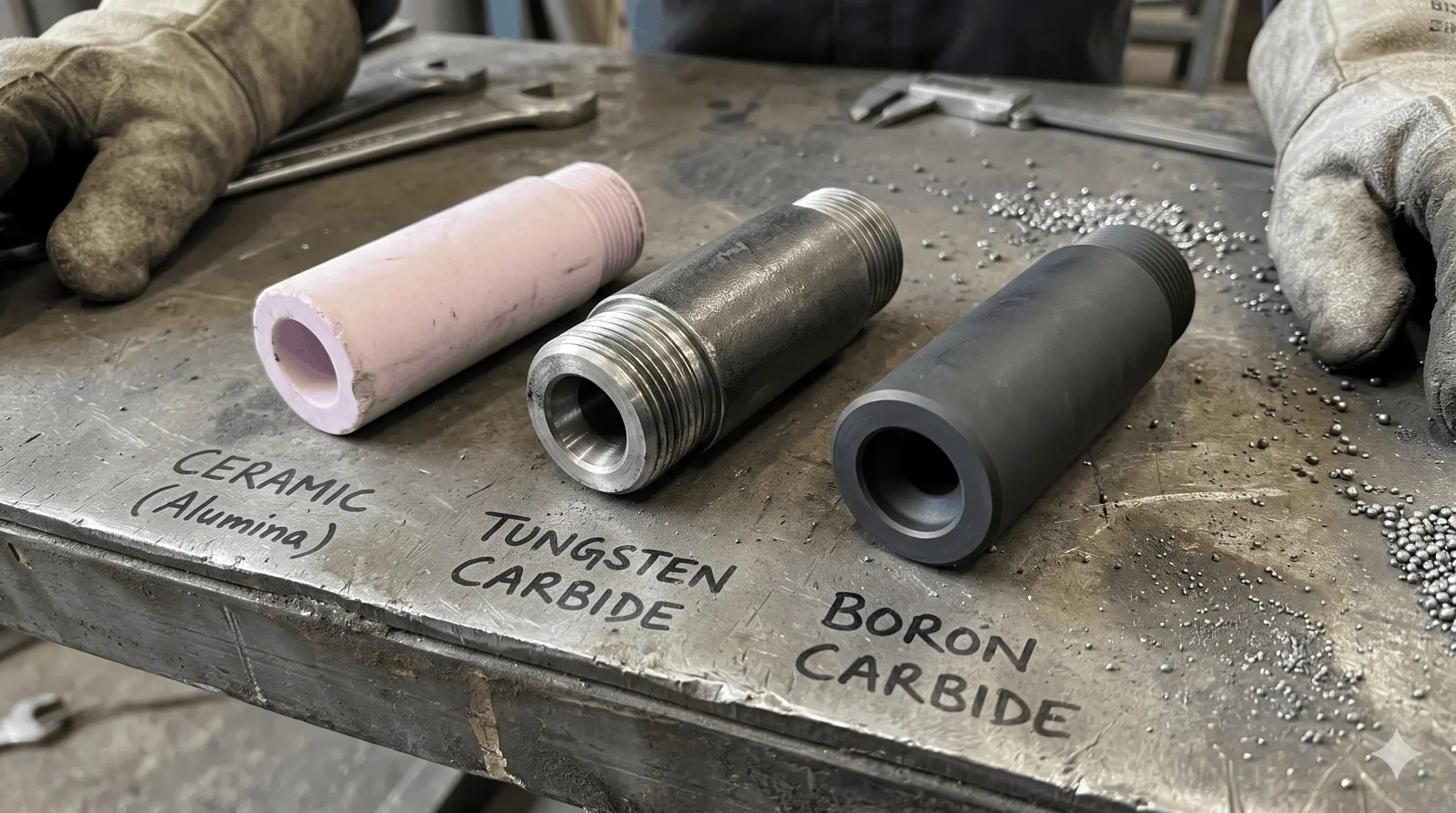
The sandblasting nozzle is the single most critical orifice in your entire surface preparation system. While a blast pot holds abrasive media and an air compressor generates pressure, it is the internal Venturi liner of the nozzle that converts static pressure into supersonic particle velocity (v > 200 m/s). Choosing between Ceramic, Tungsten Carbide (WC–Co), and Sintered Boron Carbide (B4C) determines not only how often operators stop to swap worn nozzles, but also whether your facility wastes thousands of dollars in excess compressor electricity every year.
Master Engineering Comparison: Ceramic vs. Tungsten Carbide vs. Boron Carbide
| Technical Parameter | Ceramic Nozzle (Sintered Alumina / Si3N4) |
Tungsten Carbide (WC–Co Cobalt Matrix) |
Boron Carbide (Hot-Pressed Sintered B4C) |
|---|---|---|---|
| Vickers Microhardness (HV) | 1,400 – 1,650 HV | 1,450 – 1,750 HV | 2,800 – 3,200 HV (2× Harder) |
| Mohs Scale Ranking | ~8.5 – 9.0 Mohs | ~9.0 Mohs | 9.3 – 9.5 Mohs (3rd Hardest) |
| Material Density & Weight | ~3.8 g/cm³ (Lightweight) | ~14.5 g/cm³ (Very Heavy) | ~2.52 g/cm³ (70% Lighter than WC) |
| Life with Aluminium Oxide / Garnet | 2 – 6 Hours (Immediate Washout) | 20 – 40 Hours | 300 – 500+ Hours (10× Longer) |
| Life with Steel Shot / Grit | 5 – 15 Hours | 300 – 400 Hours | 600 – 800+ Hours |
| Life with Micro Glass Beads | 10 – 25 Hours | 350 – 450 Hours | 750 – 1,000+ Hours |
| Impact / Drop Toughness | Brittle (Shatters easily if dropped) | Highest Toughness (Survives rough drops) | Moderate-High (Protected by PU/Al jacket) |
| Upfront Purchase Price | $5 – $15 (Lowest CapEx) | $45 – $75 (Mid-Tier CapEx) | $130 – $220 (Lowest TCO) |
Deep-Dive Material Profiles: Strengths, Weaknesses & Ideal Use Cases
Ceramic Nozzles
Manufactured from sintered aluminium oxide (Al2O3) or silicon nitride, ceramic nozzles are inexpensive and lightweight. However, because their hardness (~1,500 HV) is equal to or softer than industrial mineral abrasives, high-velocity grains rapidly gouge the internal bore.
- Best For: Hobbyist suction cabinets, occasional glass etching, and intermittent small-part touch-ups under 60 PSI.
- Avoid For: Continuous production shifts, pressure blast pots, and hard abrasives (Garnet, Alumina, Steel Grit).
Tungsten Carbide (WC–Co)
Constructed from tungsten carbide grains cemented in a metallic cobalt binder, WC–Co nozzles possess unmatched fracture toughness. While softer than Boron Carbide, the ductile cobalt matrix absorbs mechanical shock without cracking.
- Best For: Rough outdoor shipyards, bridge maintenance, and sites where blasters frequently drop hoses onto steel decks; also ideal for Cast Steel Shots and Micro Glass Beads.
- Limitations: Heavy weight (~1 kg+) causes operator wrist fatigue; cobalt binder washes out rapidly (20–40 hrs) when blasting Aluminium Oxide.
Sintered Boron Carbide (B4C)
Hot-pressed at over 2,100°C, Boron Carbide is the third hardest material on Earth (behind diamond and cubic boron nitride). At 2,800–3,200 HV, it resists micro-abrasion up to 10 times longer than Tungsten Carbide while weighing 70% less.
- Best For: Continuous 24/7 production blast rooms, automated robotic blasters, and aggressive abrasives (Aluminium Oxide, Silicon Carbide, Garnet, Steel Grit).
- Ergonomic Edge: Ultra-low density (2.52 g/cm³) slashes lance tip weight, boosting operator productivity and reducing fatigue.
The Hidden Cost of Cheap Nozzles: The Quadratic Orifice Wear Law (Q ∝ d²)
Many purchasing managers evaluate nozzles strictly by upfront purchase price ($10 vs. $160). In industrial fluid dynamics—as documented across tribological and abrasive impingement research studies and industrial surface engineering presentations—this is a costly error. Volumetric compressed air consumption (Q) scales with the square of the nozzle throat diameter (d):
When a standard No. 5 nozzle (7.9 mm bore) erodes by just 1.6 mm (1/16 inch) into a No. 6 bore (9.5 mm), compressed air demand surges by +43% (from 137 CFM to 196 CFM). If your rotary screw compressor cannot supply that extra air volume, blasting pressure drops from 100 PSI to 70 PSI—cutting cleaning speed by 45% and doubling labor costs per square meter!
500-Hour Total Cost of Ownership (TCO) Benchmark (Blasting Aluminium Oxide @ 100 PSI)
| Cost Component (500 Operating Hours) | Ceramic Nozzle | Tungsten Carbide | Sintered Boron Carbide (B4C) |
|---|---|---|---|
| Average Nozzle Lifespan | 4 Hours | 35 Hours | 500 Hours |
| Nozzles Consumed in 500 Hours | 125 Nozzles | 14.3 Nozzles | 1.0 Nozzle |
| Direct Nozzle Purchase Cost | $1,250.00 (@ $10) | $715.00 (@ $50) | $160.00 (@ $160) |
| Wasted Compressor Electricity (Throat Wear Drag) | ~$1,400.00 | ~$450.00 | $0.00 (Calibrated Bore) |
| Operator Downtime Swapping Nozzles | ~$950.00 (19 hrs lost) | ~$180.00 (3.5 hrs lost) | $15.00 (15 mins) |
| Total 500-Hour Operating Cost | $3,600.00 | $1,345.00 | $175.00 (Saves 87%–95%) |
Which Nozzle Should You Choose? Media-to-Nozzle Pairing Guide
Mandatory Choice: Sintered Boron Carbide (B4C). Aggressive minerals will destroy Tungsten Carbide in days and Ceramic in hours.
Recommended Choice: Boron Carbide (B4C) for blast rooms; Tungsten Carbide if blasting outdoors on rough scaffolding where drops are frequent.
Recommended Choice: Tungsten Carbide or Boron Carbide. Because spherical media rolls smoothly without sharp cutting edges, both carbides deliver 350 to 800+ hours of service.
Budget Choice: Ceramic Nozzles are acceptable only when blasting intermittently for less than 30 minutes per day, including light municipal infrastructure maintenance touch-ups.
Frequently Asked Questions: Sandblasting Nozzles
Q1: How do I know when my sandblasting nozzle needs to be replaced?
Check the nozzle throat weekly using a calibrated drill bit or pin gauge. Once the internal bore diameter widens by 1.5 mm (1/16 inch) beyond its stamped factory size (for example, an 8.0 mm nozzle wearing to 9.5 mm), replace it immediately to prevent compressor overload and pressure loss.
Q2: Why are Long Venturi nozzles better than Straight Bore nozzles?
A Long Venturi nozzle features a convergent inlet followed by a long divergent expansion bell. This aerodynamic profile accelerates abrasive particles to supersonic speeds (> 200 m/s) while widening the blast pattern—increasing square-meter cleaning productivity by 35% to 40% and reducing abrasive consumption by 15% compared to straight-bore nozzles.
Q3: Can Boron Carbide nozzles shatter if dropped on concrete?
Raw Boron Carbide is harder than Tungsten Carbide, making an unjacketed liner more sensitive to sharp mechanical shock. However, industrial-grade Boron Carbide nozzles manufactured with heavy-duty Polyurethane (PU) or Anodized Aluminum outer jackets absorb drop impacts safely for shop-floor use.