Global Economic Shifts and Their Strategic Impact on the Industrial Sandblasting & Abrasive Sector
Introduction: The Macroeconomic Shift (2024–2026)
The global economic landscape over the past two years has been defined by three powerful structural transitions: geoeconomic fragmentation (near-shoring and friend-shoring), prototypical supply chain resilience post-pandemic, and escalating geopolitical energy shocks. As central banks navigate post-inflationary interest rate cycles, heavy manufacturing, maritime logistics, and petrochemical infrastructure are undergoing a capital expenditure (CapEx) super-cycle.
This analysis examines these macroeconomic currents in depth and maps their direct transmission mechanisms to the industrial surface preparation, abrasive blasting, and asset integrity sectors.
Part 1: Deep Analysis of Recent Changes in World Economics
1. Geopolitical Fragmentation and Industrial Near-Shoring
Globalization as it was structured in the early 2000s—characterized by hyper-optimized, single-source just-in-time manufacturing—has fractured. Major economies in North America, the European Union, and India are prioritizing domestic industrial sovereignty.
- The Capital Impact: Massive government-backed manufacturing incentives (such as industrial corridor expansions in the Global South and regional manufacturing acts in the West) have triggered a multi-year boom in structural steel fabrication, modular plant construction, and heavy machinery production.
- Surface Prep Link: Every ton of structural steel fabricated for new industrial parks, defense manufacturing units, and transit corridors requires rigorous mechanical surface preparation (Sa 2.5/Sa 3) and anti-corrosion coating, directly driving baseline demand for abrasive blasting consumables.
2. Energy Shocks, Commodity Inflation, and Supply Chain Restructuring
Sustained geopolitical conflict across Eastern Europe and the Middle East has placed severe stress on global energy corridors, crude refining hubs, and raw material extraction.
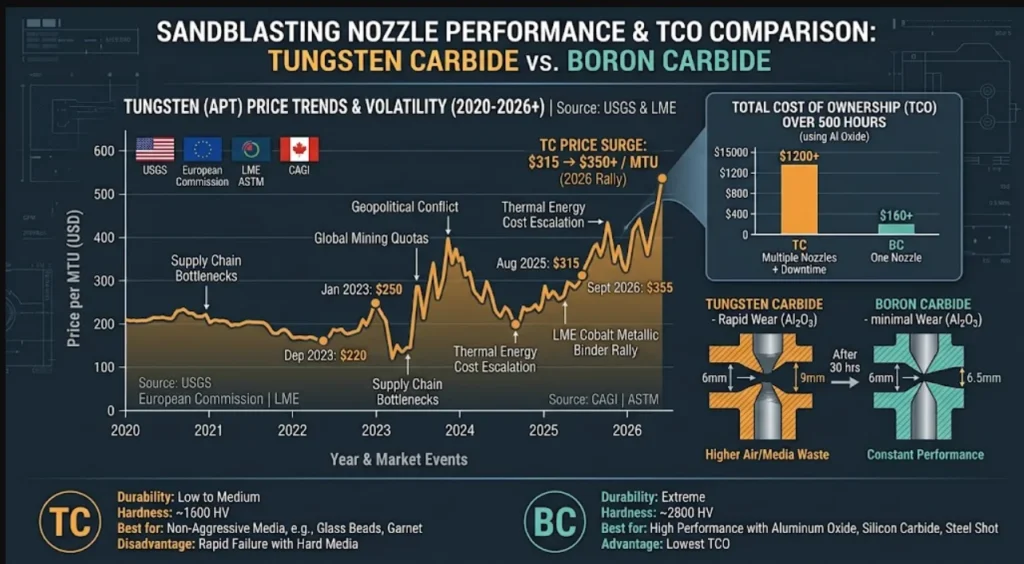
- The Raw Material Squeeze: Upstream mineral and metal markets have experienced severe volatility. For instance, tightening export quotas and high sintering energy tariffs have driven steep price inflation on tungsten and specialized ceramic minerals, accelerating the pivot toward high-durability alternatives such as sintered boron carbide ($B_4C$) for tooling and re-usable high-carbon cast steel media.
- Downstream Reconstruction: Paradoxically, energy infrastructure damage in key producing regions has created an immense secondary wave of downstream refinery and tank farm rehabilitation. Rebuilding damaged crude distillation columns and floating-roof storage tanks requires continuous, 24/7 abrasive blasting cycles to strip fire-damaged wüstite scales and apply protective epoxy novolac linings.
3. Environmental Regulations and the “Green CapEx” Mandate
Stringent ecological and occupational health frameworks (such as US OSHA’s aggressive respirable crystalline silica limits, EU carbon border adjustments, and national particulate emission caps) are reshaping industrial purchasing behavior.
- The Shift from Expendable to Recyclable: Facilities can no longer afford the high disposal liabilities and environmental fines associated with single-pass, toxic silicate slags.
- Capital Efficiency: Plant directors are shifting capital toward closed-loop abrasive recovery systems, automated blast rooms, and high-purity media (such as micro soda-lime glass beads and multi-pass cast steel grit) that reduce solid waste volumes by up to 99%.
Part 2: Strategic Article Titles for the Sandblasting Industry
Grounded in these economic shifts, here are high-impact, SEO-optimized article titles designed for industrial publications, trade journals, and corporate thought leadership:
- 1. Refining the Rebuild: How Global Energy Shocks Are Driving a Multi-Billion-Dollar Surface Preparation Super-Cycle
- 2. From Supply Chain Fragmentation to Asset Integrity: Why Downstream Infrastructure Demands Rigorous Abrasive Standards
- 3. The 2027 Refinery Reconstruction Boom: Navigating Abrasive Supply Chains Amid Global Downstream Turnarounds
- 4. Securing the Industrial Baseline: The Macroeconomics of Steel Fabrication, Surface Prep, and Long-Term Corrosion Defense
- 5. Beating Inflation in the Blast Room: How High-Durability Abrasives and B4C Nozzles Slash Plant OpEx
- 6. The Quadratic Orifice Trap: Why Worn Nozzles Are a Silent Tax on Your Facility’s Compressed Air Budget
- 7. From Expendable Slag to Closed-Loop Steel Grit: The Net Financial Savings of Recyclable Blasting Media
- 8. Zero-Loss Metrology: Preserving Precision CNC Tolerances Without Sacrificing Surface Cleanliness
- 9. Beyond the Silica Ban: Navigating OSHA, CPCB, and International EHS Standards with Amorphous Abrasives
- 10. The 3°C Dew Point Law: Mitigating Flash Rust Liability in Humidity-Controlled Blast Enclosures
- 11. TCLP Compliance and Heavy Metal Containment: Preventing Hazardous Waste Penalties in Tank Overhauls
- 12. Ergonomics and Kinetic Dissipation: Protecting Operators from Shockwaves, Dust, and Noise Trauma